




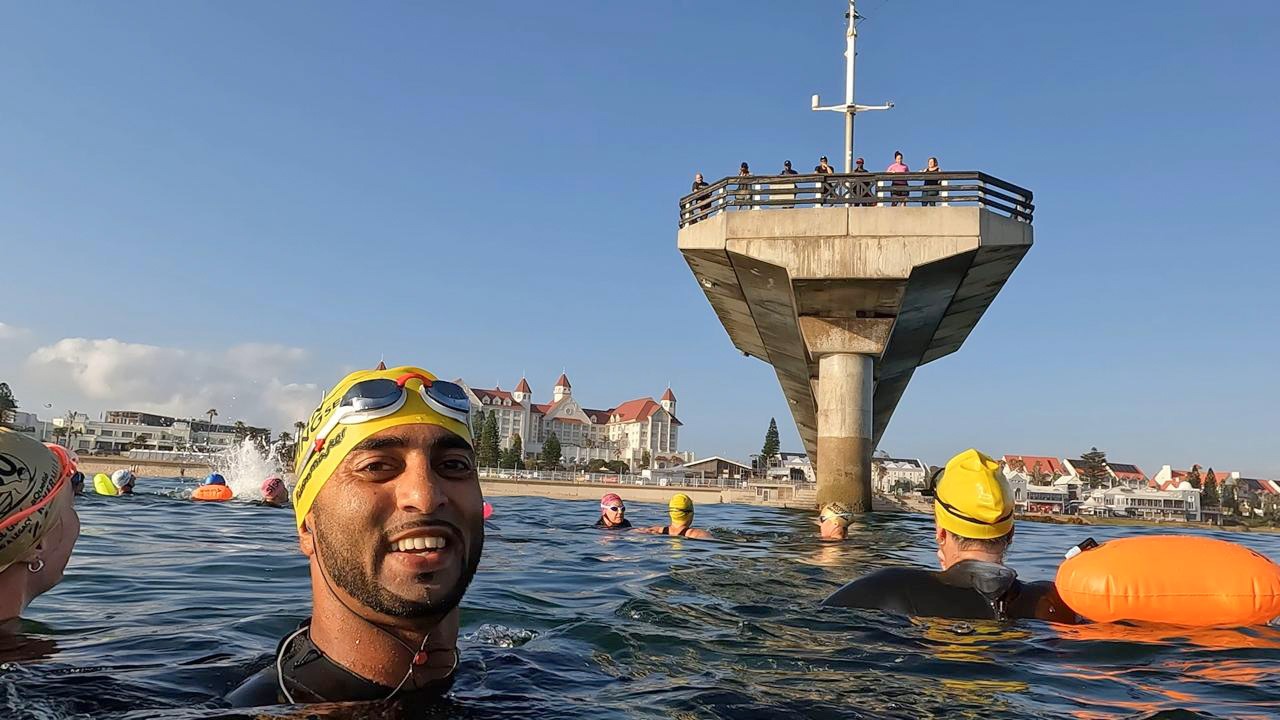
 Sea shepherd and educator Ra’ees Khan at Hobie Beach in Gqeberha. (Photo: Supplied / SwimGQ)
 Not long ago, Nomawethu Nogaga stood on Shark Rock Pier at Hobie Beach in Gqeberha watching other people swim into the waters of Algoa Bay.
She admired them from a distance, never imagining she could be one of them.
Today, the 48-year-old South African Revenue Service legal department employee regularly swims beyond the pier to about as far as local pub Barney’s. Her next goal is to reach the Six Pillars slipway off Humewood Beach, close to a kilometre there and back.
/file/attachments/orphans/NomawethuNogaga_925720_456403.jpeg "Before she joined SwimGQ, Nomawethu Nogaga would visit the beach, but not swim. (Photo: Supplied / SwimGQ)")
“I used to be on the pier watching those people, and I never even thought in my wildest dreams that I could one day be one of them,” she said.
After completing her first proper ocean swim in Gqeberha earlier this year, Nogaga cried.
“I said to him, after we came out, can I just have a moment to take this all in, because I was in so much awe and in disbelief at the same time that I was actually there.”
The “him” was Ra’ees Khan, an educationist at Nelson Mandela University and the driving force behind SwimGQ, a community movement that is boldly changing who feels welcome in the ocean.
For Khan, helping people swim is only part of the mission. “We have a drowning crisis in South Africa, where probably less than 5% of the population can swim,” he said.
“And when I say swim, I mean tread water and save yourself if you’re ever in water. So part of our mandate is to solve the drowning crisis through education and access to water spaces.”
/file/attachments/orphans/2GQ_694649.jpeg "SwimGQ members Nomlindo Makubalo (left) and Humilie Headbush head into the ocean at Hobie Beach. (Photo: Supplied / SwimGQ)")
Ahead of World Ocean Day on 8 June, Khan said SwimGQ deliberately focused on people who would not ordinarily see themselves as open-water swimmers.
“If we want to solve the drowning crisis, we don’t want people that are on the beach already,” he said. “If we want to educate people, you need to do outreach.”
That outreach has helped SwimGQ grow into one of South Africa’s largest open-water swimming communities, with more than 1,500 members connected through its WhatsApp groups and regular sea swims.
The group grew out of Ocean Tribe, an informal swimming circle founded years earlier by longtime open-water swimmer Ralph West, who asked Khan to take over the running of it.
“He didn’t want to be admin at all,” said West, who pushed him to accept. “His passion for this thing was immense.
“He’s been such a blessing for this entire swim community,” West said.
It is not only open to beginners, but caters for swimmers of all levels, even the most advanced. In April, several visitors to Nelson Mandela Bay joined SwimGQ to build confidence in the ocean before competing in the Isuzu Ironman African Championship in Nelson Mandela Bay.
Many triathletes have swum only in pools or dams and are unfamiliar with the sea and how to swim in it safely and efficiently.
But Khan believes the real measure of success lies elsewhere.
“Our mission extends far beyond the WhatsApp groups, “It’s what happens outside of that,” he said.
“Are we making an impact in the community? Are people’s lives changing? Are we seeing the stats that we want to see? Are we making progress?”
For many newcomers, the barriers are psychological long before they are physical.
“People are scared of the deep ocean, of the possibilities of what could happen there. They’re scared of being alone. They’re scared of trying something new. They’re scared of looking silly.”
/file/attachments/orphans/Raees2_296261.jpg "Ra’ees Khan is changing the way people in Gqeberha interact with the ocean. (Photo: Supplied / SwimGQ)")
Others fear currents, waves, sharks, dolphins or simply being unable to touch the seabed, so Khan approaches those fears much as he approaches teaching.
“Education is the art and science of human development,” he said. “If you develop the individual, you develop communities and you develop society.”
That philosophy shapes everything from ocean literacy and water safety education to the culture of the group itself. Before every swim, participants introduce themselves.
“That’s my job: to facilitate respectful engagement,” said Khan. “We allow everybody to introduce themselves, tell us who you are and where you’re from before we swim.”
The result is a community built around what Khan describes as an ethos of respect, consent and ubuntu.
‘Supported environment’
“SwimGQ is a massive operation, run and supported by an entire team of amazing staff and volunteers who ensure fun, safe and enriching experiences in a supported environment.”
Nogaga experienced that support from her first day in the water. Raised in a rural Eastern Cape community, she had learnt basic swimming in a pool with encouragement from her son, but the ocean felt completely out of reach.
“It was something very far-fetched for me,” she said.
Khan stayed by her side as she gradually built confidence in the water.
In a message later shared with the SwimGQ community, Nogaga thanked him for helping her discover a side of herself she did not know existed.
“You didn’t just teach me how to swim. You helped me conquer fear, build confidence and step into a version of myself I never imagined existed.
“Today, I am no longer just a spectator. I am in the water. I am swimming in the ocean.”
Now she hopes her own experience will encourage others.
/file/attachments/orphans/SwimGQ2_214503_251824.jpeg "Ra’ees Khan (right) welcomes ‘tadpoles and newbies’ at a Hobie Beach pre-swim safety briefing. (Photo: Supplied / SwimGQ)")
“For me, it was about breaking that notion that swimming is for certain people. It doesn’t matter about the size, the colour, the gender or the age. It’s never too late. Just go and do it.”
For Khan, those words directly address SwimGQ’s broader purpose: “The society we live in is one of reproduction of social inequalities,” he said.
“All participation is absolutely free of charge, as it’s about breaking barriers through access, equitability, and transformative justice, which enable people to lead healthier, more fulfilling lifestyles.”
Dolphin
That work unfolds in the waters off Hobie Beach, where swimmers are often accompanied by one of the bay’s most famous residents.
“We are the bottlenose dolphin capital of the world,” said Khan. “Dolphins swim with us probably almost every day.”
But ocean access, he insists, must be matched by responsible ocean practice and stewardship. “We need to know how to interact with marine life in a responsible manner. Always maintain a respectful distance and don’t try to touch the dolphins.”
For Nogaga, meanwhile, the ocean has become something she looks forward to rather than fears.
“When I wake up to go there, I get excited,” she said.
She has a message for those standing on the shore wondering if they belong in the water: “Even if I inspire one person, then we’ve won.”
Get in the water: World Ocean Day 2026 with SwimGQ
SwimGQ is hosting a weekend of Ocean Day activities on Saturday and Sunday, 6 and 7 June 2026 In celebration of this year’s theme: “Reimagine: beyond the world we know, a new relationship with our ocean.”
World Ocean Day Swims
Venue: Hobie Beach (Pier), Summerstrand
Time: 07:00 – 10:30.
DM