




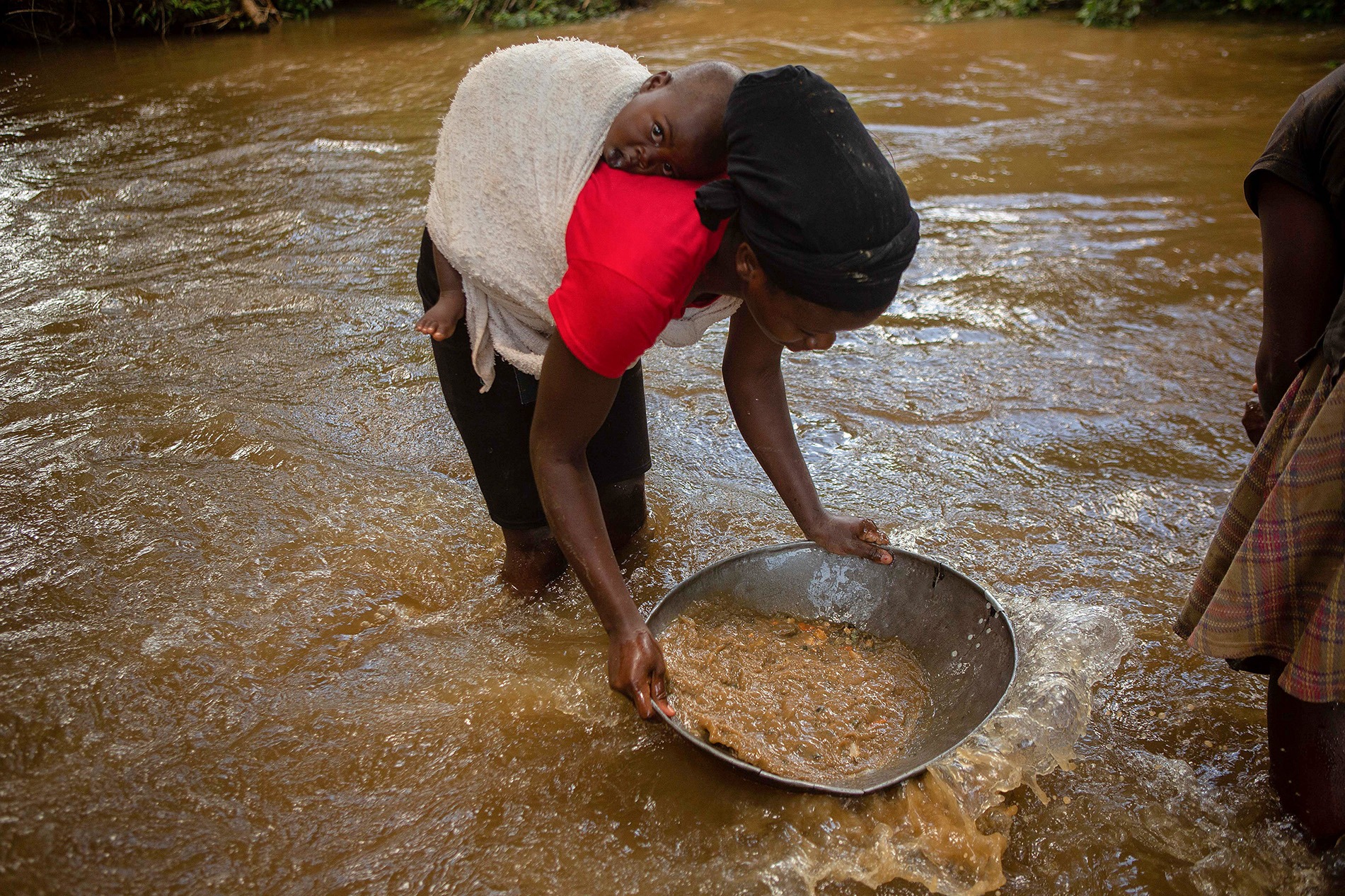
 An artisanal miner carrying a child on her back sifts through ore powder for gold particles in a river in Banket, Zimbabwe. (Photo: Tafadzwa Ufumeli / Getty Images)
Despite the government of Zimbabwe’s on-paper commitment to reduce and regulate the use of mercury in mining, the toxic metal remains pervasive and unfettered in the country’s artisanal gold mining sector.
Zimbabwe is a signatory to the Minamata Convention.
The objective of the convention is to protect human health and the environment from anthropogenic emissions of mercury and mercury compounds. It sets out a range of measures to meet that objective. These measures include controlling the supply and trade of mercury and the regulation of mercury-added products and manufacturing processes. It also commits signatories to reducing, and where feasible eliminating, mercury use in artisanal and small-scale gold mining.
But Zimbabwe’s conformity to the Minamata Convention – while good on paper – seems to be far off the mark, if observations on the ground are anything to go by.
Field notes from an artisanal mining site
In Penhalonga, a mining area 20km from Zimbabwe’s eastern border city of Mutare, small blue tents are haphazardly strewn across hills opposite a strip of shops.
Men and women of all ages make a beeline to and from the shops. Their bodies, clothes and faces are covered in red clay; often it is only their eyes and mouths that break through the mud.
These are artisanal, small scale miners. At the row of shops they meet vendors who sell all they need: foodstuffs, clothing, shoes, beer and deodorants. Know who to ask, and mercury can also easily be bought by at these shops. It is sold discreetly by vendors who want to cash in downstream from the gold boom that is happening in their midst.
The hills adorned with the blue tents house Redwing Mine, which has opened up to artisanal miners for a fee and for a commission from each miner’s takings.
/file/attachments/orphans/115281691_270449.jpg "Penhalonga has hundreds of illegal hammer mills, suspected of being stolen from formal mining operations in the area but mainly from Redwing Mine. (Photo: Bernard Chiketo / GroundUp)")
A muddied and polluted Mutare river runs adjacent to the hills, and scores of illegal alluvial miners are also scouring for gold.
But there is more than meets the eye at the riverbanks. Soaked knee-deep in the river and without protective clothing, the men and women with plastic dishes filled with mercury sieve for gold. The river feeds into the sole water source for Mutare City, home to 225,000 residents, according to the latest census.
“This is the easiest and cheapest way we can get the gold,” said one artisanal miner in the river. He asked for anonymity, because he was using mercury illegally.
“I do not know about the dangers (of mercury) to my health that you are talking about,” he said.
Mercury is a highly toxic heavy metal that can damage the lungs, skin and eyes, and can cause severe neurological, cardiovascular and kidney harm.
It is also particularly dangerous to developing foetuses. Exposure through inhalation of mercury vapour or consumption of contaminated fish can lead to symptoms including tremors, memory loss and sensory impairment.
Another female artisanal miner in the Mutare riverbed, Evelyn Makoni, said that she knew about the dangers of mercury use to both humans and the environment. But she added that using it was still her only means of survival.
/file/attachments/orphans/redwing_medium_shots_70-744x496_880529.jpg "Dozens of mine shafts are concentrated in areas with rich gold deposits. (Photo: Bernard Chiketo / GroundUp")
“For now, I am concerned about getting the gold, everything else is secondary,” said Makoni. She is a divorced mother of two who travelled all the way from Bocha District of Manicaland province in search of a livelihood as an artisanal miner.
“I have to fend for my two kids and pay fees for them. Their father is not supporting them, so I have no option but to turn to mercury use and do riverbed panning,” she said.
The lure for gold has been prompted by the high prices that gold is fetching locally and internationally. In Zimbabwe, a gram of gold is currently going for US$140, according to figures released by Fidelity Gold Refinery, the country’s sole gold buyer, refiner and exporter.
On the banks of the river, a second group of miners – ones who have agreements with Redwing Mine to mine legally – also admit to using mercury as an indispensable component of their operations.
“Despite damage to the lungs, eyes and skin, we have no option but to turn to mercury which is efficient and faster (than other less environmentally harmful processes, such as leaching) for gold extraction and detection,” said one artisanal miner who had bought a claim in Redwing Mine.
The widespread use of mercury in alluvial and reef mining is not isolated to the Penhalonga area. Twenty kilometres away, along Odzi River, alluvial mining and the use of mercury is also rife, our investigation revealed, as artisanal miners snaked along the river, sieving for gold.
Government unlikely to police mercury use
Mercury has been used for centuries by miners around the world as an inexpensive and easy way to extract and collect gold from ore and riverbeds.
In 2025, Zimbabwe set a record high for gold production of 46,7 tonnes, a 28% increase over the 36,48 tonnes that the country produced the previous year. Zimbabwe’s gold export earnings were projected at about US$4.5-billion for 2025, according to the Reserve Bank of Zimbabwe.
Artisanal and small-scale miners account for a significant share of Zimbabwe’s gold output, a dependence that experts say complicates enforcement of environmental regulations – including those that seek to police the widespread use of mercury.
/file/attachments/orphans/11528167_965659.jpg "A gram of unpolished gold in a miner’s palm in Shamva, Zimbabwe. (Photo: EPA / Aaron Ufumeli)")
In July last year, the United Nations Environmental Programme concluded that 96% of artisanal, small scale gold mining processing sites in Zimbabwe still use mercury. Miners, nearby communities, and ecosystems face chronic exposure to toxic pollution. Women and children engaged in or living near mining activities are greatly affected, the programme added.
The objective of the Minamata Convention, which Zimbabwe ratified in 2017, is to protect human health and the environment from anthropogenic emissions and releases of mercury. To achieve this, the convention sets out a range of measures, including controls on the supply and trade of mercury, the phase-out of mercury in existing mining, and the regulation of mercury-added products and manufacturing processes.
/file/attachments/orphans/13464350_146385.jpg "Executive Secretary of the Minamata Convention on Mercury, Monika Stankiewicz. (Photo: EPA / Salvatore Di Nolfi)")
It also requires countries to reduce, and where feasible eliminate, mercury use in artisanal and small-scale gold mining.
However, implementation in Zimbabwe remains a challenge.
The thriving black market remains untouched because the dealers are “well connected individuals with links to powerful politicians” or “simply pay hush money to the police” whose camp is less than a kilometre from the shops where the mercury is being sold, according to several miners interviewed for this story.
Open, illegal mercury trade
At Penhalonga’s strip of shops, mercury is traded openly. The police turn a blind eye.
This journalist posed as a gold dealer who wanted to buy mercury to use to sample gold. He was referred to a mercury dealer only identified as “Rasta”.
Rasta was found at the back of a Penhalonga shop. He said that a teaspoon went for US$10, while a tablespoon cost $20.
“Just come when you are ready, the mercury is here in abundance,” said Rasta.
Sources – one from the Environment Ministry and also a customs agent at the country’s border with Mozambique at Forbes Machipanda – said smugglers used the porous borderlands to bring mercury into the country.
“The mercury finds its way through informal supply chains and import hubs that include South Africa, Dubai and China as the main sources (of supply). As part of the process of buying gold, gold lords and their middlemen provide the mercury directly to miners,” the border agent said.
Government response
Contacted for comment, the Environmental Management Agency admitted having challenges in regulating mercury use, especially in the artisanal small scale mining sector.
/file/attachments/orphans/pic16_115913.jpg "Environmental Management Agency spokesperson Amkela Sidange. (Photo: NewsDay Zimbabwe / Wikipedia)")
“While the controls (in mercury use) have been implemented and the importation is regulated, the agency is aware of the continued clandestine illegal importation of mercury for downstream use in artisanal and small-scale gold mining,” said Amkela Sidange, the Environmental Management Agency’s spokesperson.
“The agency acknowledges that, like any other illegal activity, the sale of mercury on the black market is a complex challenge requiring a multi stakeholder approach. However, Zimbabwe has moved to strengthen existing interventions by increasing capacity at ports of entry focusing on the detection of illegal consignments of mercury and their movement… Offenders found in possession or using mercury unlawfully are subject to penalties in accordance with environmental regulations.”
She added that the Environmental Management Agency informed miners about the harmful effects of mercury and other hazardous substances on human health and the environment, through awareness campaigns. The agency also promoted safer, mercury-free alternative technologies for gold extraction, she said.
Zimbabwe’s artisanal small-scale gold mining activities use more than 50 tonnes of mercury annually in gold processing, the agency reported. And it is such artisanal miners in Penhalonga, Odzi and many other places countrywide that add to the statistics. DM
+ This report has been produced by the Southern Africa Accountability Journalism Project (SA | AJP), an initiative of the Henry Nxumalo Foundation with the financial assistance of the European Union. It can under no circumstances be regarded as reflecting the position of the EU.
Comments
Scroll down to load comments...