



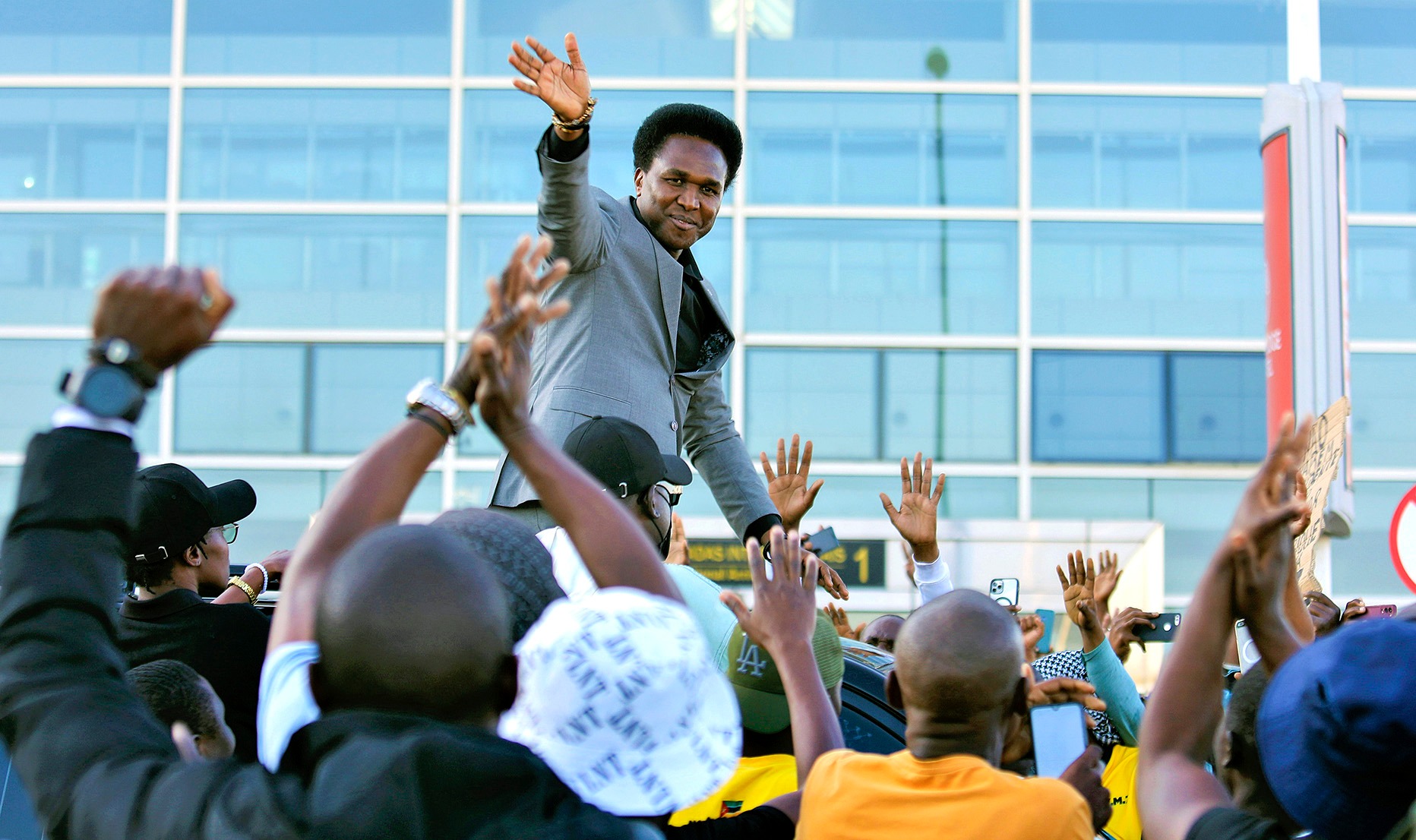
 Venâncio Mondlane arrives at Maputo International Airport on 21 July 2025. (Photo: Luisa Nhantumbo / EPA)
“I’m ready to carry this cross,” says Venâncio Mondlane.
That cross is his onerous and perilous mission to topple Mozambique’s ruthless ruling party, Frelimo, while living on the run and watching as his comrades die at the hands of political assassins.
Mondlane is not just a charismatic politician and an engineer but also a part-time pastor, so his almost religious devotion to his cause should come as no surprise.
In 2024, he shot from behind to come officially second — and in his own eyes and those of many commentators, first — in Mozambique’s presidential elections. Frelimo candidate Daniel Chapo was declared the winner by the state electoral authority, with 65% of the vote versus 24% for Mondlane, who claimed he had actually won with 53%. The result was also questioned by the Episcopal Conference of Mozambique and the European Union.
/file/dailymaverick/wp-content/uploads/2025/01/12745683.jpg "Mozambique's new president, Daniel Chapo (left), greets his predecessor, Filipe Nyusi, during his inauguration ceremony at Independence Square in Maputo on 15 January 2024. (Photo: Luis Nhantumbo / EPA-EFE)")
Using the same social media mobilising skills he had mustered so well in his campaign — appealing especially to young people — Mondlane brought hundreds of thousands of Mozambicans out on the street to protest against what he and they insisted was a stolen election.
The security forces responded with violence, and more than 300 people died in months of protests, riots and government retaliation.
/file/dailymaverick/wp-content/uploads/2024/11/12616969.jpg "A burnt car in Maputo on 8 November 2024 after violent demonstrations contesting the results of the 9 October general elections. (Photo: Luisa Nhantumbo / EPA-EFE)")
Mondlane was forced to flee the country, and since then has been on the move, living mainly between Mozambique and South Africa. He never stays long in one place, but also maintains a vigorous social media blitz on Frelimo.
He says he has survived four assassination attempts and is just as wary in South Africa as in Mozambique.
On 23 March and again on 20 May 2025, he met Chapo and tried to end the protests and the repression.
According to Mondlane’s minutes of the initial meeting, he agreed to halt the protests in exchange for Chapo ending retaliatory actions and releasing dozens of detained demonstrators. Additionally, Chapo agreed to permit hospital treatment for the injured and provide financial compensation to the families of those killed during the unrest.
But, Mondlane said, Chapo later denied to CNN that there had been any agreement. He said he had then responded in interviews that Chapo was a “liar.”
He was talking at the end of the Spier Dialogue, which was run on the Spier wine farm in Stellenbosch by its owner, Yellowwoods, and the Platform for African Democrats (PAD), supported by the Konrad Adenauer Foundation. PAD brings together people like Mondlane, opposition politicians struggling to beat deeply entrenched leaders and parties exploiting their incumbency to cling to power.
/file/attachments/orphans/20260524_140155_177996.jpg "Mozambican opposition leader Venâncio Mondlane at the recent Spier Dialogue in Stellenbosch. (Photo: Peter Fabricius)")
Mondlane had held other offices for both Renamo and the Democratic Movement of Mozambique but ran for president in 2024 under the banner of the Podemos party. They parted company after the poll, and last year he formed his own party, the National Alliance for a Free and Autonomous Mozambique (Anamola).
Since then, he has been working extremely hard to build Anamola even as the Frelimo state worked, apparently almost as hard, to destroy it.
On 12 March, Anamola submitted a dossier to the African Commission on Human and Peoples’ Rights and to Amnesty International “denouncing serious, repeated and systematic human rights violations perpetrated against its members”.
The report documented that “436 Anamola members were subjected to extreme violence, including 55 fatalities ... [in] a systematic pattern of violence targeting members of Anamola. The overwhelming majority of these cases have not led to any form of judicial accountability.”
Shot dead
Mondlane told Daily Maverick the death toll of Anamola members had since risen to 56 after Anselmo Vicente, Anamola’s local political coordinator, was shot dead by unidentified gunmen in the town of Chimoio in the central Manica province on 9 May.
He said Anamola had just held a big rally in the town.
“And the response was to kill him. They don’t react in holding another rally … to convince people to go to Frelimo. Here, they react with guns.”
He said that after four earlier attempts on his life, his opponents were now targeting his party instead, assassinating or kidnapping senior officials. They were no longer targeting him because “they’re afraid of the reaction of the people of Mozambique. Because they know that my voice is [a] very strong voice in Mozambique. If I take a phone right now and I make a video and I say, ‘Tomorrow, nobody goes to work’, the people obey; every county obeys. That’s why they are afraid.”
This sounds like a boast, but it was messages like this that kept protests bubbling for several months after the October 2024 elections.
So instead of physical attacks, the Frelimo government is going after him in the courts on charges related to those protests, he said. He has been charged with five crimes: terrorism, incitement to terrorism, inciting violence, inciting national disobedience and crimes against national security.
He expects to be called at any moment to the Supreme Court to testify and be judged. He says his case is very strong and that Frelimo will be in trouble, no matter what the verdict is.
An acquittal would significantly boost his political leverage. However, he warned of severe unrest if he is convicted. “If they find me guilty, they’re in trouble because the country will burn,” he stated, clarifying that while he wouldn’t personally call for violence, it would happen inevitably — a reality he claims the government’s intelligence services can confirm.
Poison fears
Besides being shot, there are other fears. “I must take care ... [not] to be poisoned. Because they can use it — to poison me or to kidnap my kids or my wife.”
So his wife and three children live outside the country.
He goes to Mozambique for a few days at a time only, no longer than a week, and then leaves. He sleeps in different places and uses different vehicles, “to avoid to be predictable, because they can’t know exactly where I am”.
/file/attachments/orphans/12731759_127864.jpg "Venâncio Mondlane (centre) looks on after returning from exile to Maputo, Mozambique, on 9 January 2025. (Photo: Luisa Nhantumbo / EPA)")
Even in South Africa, where he has been for nearly a month, he is constantly on the move, “because I know that they are friends of [the] ANC”.
This seems like a very hard life with no end to the hardship in sight.
“Yeah. But with time, when you realise that is the purpose of your life, that is your mission. It’s not hard. You don’t have pain when you do something with love.”
Anamola has grown rapidly since Mondlane founded it in August 2025 and now has 25,000 signed-up members. One of Anamola’s strategic goals is to be Mozambique’s biggest party in terms of membership.
He says Frelimo claims four to five million members, “but we don’t believe them because they don’t have a database with those numbers”. On the other hand, Anamola can back up its claims, as it is the first party in Mozambique to have introduced digital membership cards with QR codes.
Legislative initiatives
Another goal of Anamola is to be the biggest party in Mozambique in terms of legislative initiatives, and Mondlane says it has already produced 19 of them, even before being elected to Parliament.
He recalls that when he was an MP, all the parties in Parliament had produced only five Bills in five years.
Another strategic goal of Anamola is to be Mozambique’s biggest party when it comes to submitting proposals for public policies. It has already published and submitted to the government a five-year development plan for public comment.
He recently went to the prime minister’s office to present a plan for recovery after the devastating January 2026 floods. He was met by armed police. “I said, ‘No, I’ve got only a proposal. It’s not a demonstration.’ Because they are really afraid of me there.”
He says the prime minister, Benvinda Levy, later apologised.
Anamola’s third strategic goal is to achieve power in the 2028 local government elections and then the national general elections in 2029.
“And we believe that we will achieve the power. We will win the elections. Because with free and fair elections, we win. Even tomorrow.”
He bases much of his confidence on the party’s growth in the countryside. In the beginning, Anamola was seen as an urban party, but Mondlane says it now dominates the countryside because Renamo, which used to be the biggest opposition party with a strong rural base, was disintegrating and most of its supporters were switching to Anamola.
That was largely because the Renamo leader, Ossufo Momade, who succeeded the founding leader, Afonso Dhlakama, after he died in 2018, had failed as a leader and had been “captured” by Frelimo with bribes, he said.
/file/dailymaverick/wp-content/uploads/2024/10/12552867.jpg "Renamo leader Ossufo Momade casts his vote at a polling station in Maputo on 9 October 2024. (Photo: Jose Coelho / EPA-EFE)")
Mondlane said if he were elected president in 2029, his first act would be to reform the state, starting with establishing an independent judiciary and then more widely depoliticising the bureaucracy. “We must remove the influence of the party, the ruling party in the state.”
Impeachment law
His government would also introduce an impeachment law that would allow all government officials, from the president and judges down, to be impeached.
An Anamola government would end corruption “which is very, very, very high in Mozambique”.
“We are a narco state now. The coast of Mozambique … in the international literature is called the Heroin Coast.” And the government was not just tolerating that; it was promoting it.
Mondlane said his government would decentralise tax-collecting power from the national government to the provinces to allow them to raise revenues for their own development.
He said he campaigned on this platform in 2024, and now all the other political parties, including Frelimo, were imitating him.
An Anamola government would also reduce state intervention in the economy by reducing both the number and the rate of corporate taxes — of which he said there were now 15 — and privatising more state entities. This would attract more foreign investors to the country.
It would also increase physical and digital connectivity across the country, constructing a south-north electric railway and linking the south to the north and the west to the east with fibre-optic cables.
Schoolchildren would use tablets instead of textbooks.
Mondlane said if he were elected president, he would take a new approach to ending the ISS-linked insurgency in Mozambique’s northernmost province of Cabo Delgado.
He would bolster the war against the insurgents by modernising the outdated military, upgrading the development of the province and initiating dialogue with the insurgents.
/file/dailymaverick/wp-content/uploads/2024/09/ISS-Rwanda-in-Moz-main.jpg "Rwandan counterterrorism special units and Mozambique police patrol streets in the town of Palma, Cabo Delgado, on 18 December 2023. (Photo: Cyrile Ndegeya / Anadolu via Getty Images)")
Daily Maverick suggested to Mondlane that he had a tough job, all things considered.
“But I want to carry this cross,” he replied. “I’m ready to carry this cross. The style of my life; I don’t go to the parties, I don’t go to the beach, I don’t walk; my life is always 24 hours, working for my people. If you want to fight organised crime, you must forget your life. You must live only for the people.” DM
Comments
Scroll down to load comments...