




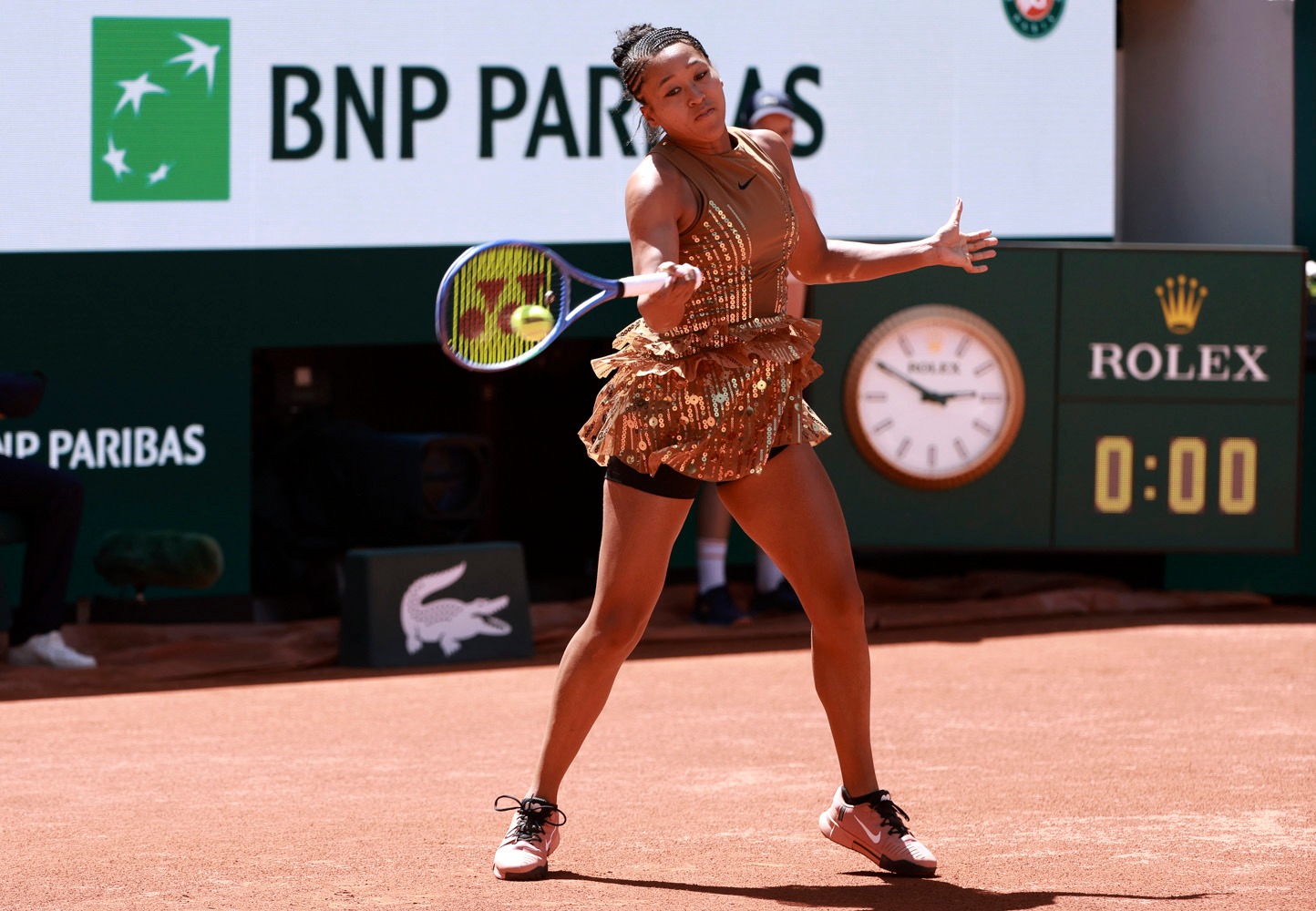
 Naomi Osaka once again turned the tennis court into a catwalk at the 2026 French Open with her golden, sequinned dress that shimmered and sparkled in the Paris sunshine. (Photo: Jean Catuffe / Getty Images)
 When it comes to Grand Slam tennis, there is always an air of anticipation. Who will lift the trophy? Which champion will cement their legacy? And, increasingly, what statement-making outfit will capture as much attention as the tennis itself?
One tennis star who really knows how to turn a tennis court into a catwalk is Naomi Osaka. At the French Open on 26 May, the four-time Grand Slam champion staged an outfit reveal once again, striding out for her first-round match against Germany’s Laura Siegemund wearing a black corset and matching pleated, cascading skirt that skimmed over the clay. They were layered over a gold dress striped with sequins designed by Nike.
Over the course of the tournament, Osaka has displayed several iterations of the Eiffel Tower-inspired outfit, adding an oversized golden jacket, a cream version of the cascading skirt and an ivory train.
In her fourth-round match against Aryna Sabalenka, she paired her sequinned match kit with an overskirt with gold tulle. It was her parting outfit as she lost to Sabalenka 7-5 6-3.
/file/attachments/orphans/GettyImages-2278619936_986667.jpg "Naomi Osaka’s latest Grand Slam fashion statement designed by Nike. (Photo: Robert Prange / Getty Images)")
/file/attachments/orphans/2278423791_431046.jpg "Various couture iterations of the Eiffel Tower-inspired outfit have been worn by four-time Grand Slam winner Naomi Osaka at the 2026 French Open. Her first was a black corset and matching pleated, cascading skirt that skimmed over the clay. (Photo: Jean Catuffe / Getty Images)")
As expected, it sparked conversation and debate, with some critics calling her court-ure problematic.
Fashion in tennis has long been entrenched and spoken about. It has been steeped in tradition – elegant, elite and governed by an explicit yet implicit rulebook of etiquette that extends from the grass courts to the grandstand, with dress codes often leaning towards the conservative.
So for many players, their fashion choices go beyond style. Some dress to make a statement, some to honour their roots and others to simply feel like the most confident version of themselves.
And it is not just tennis. Modern sport already embraces the spectacle. Formula One has paddock fashion, the NBA has tunnel walks, footballers arrive in designer collaborations.
Thus, Osaka is not turning tennis into a runway. Tennis has always been a runway, but people are noticing because Osaka is using fashion as a form of self-expression on her own terms.
Fashion and femininity
She has been turning Grand Slam walk-ons into cultural moments for years.
From the oversized bows and Lolita goth influences at the 2024 US Open to crystal-studded ensembles and matching Labubu dolls in 2025, her entrances have become almost as anticipated as her matches.
Perhaps her most memorable creation arrived at this year’s Australian Open. Designed alongside couturier Robert Wun, the outfit was inspired by jellyfish, a nod to her daughter’s love of the creatures. Osaka entered wearing a pleated white skirt, flowing trousers, a veiled wide-brimmed hat and a parasol with a blue and green Nike dress layered over.
/file/attachments/orphans/GettyImages-2257188596_727979.jpg "At the 2026 Australian Open, Naomi Osaka turned heads when she entered wearing a pleated white skirt, flowing trousers, a veiled wide-brimmed hat and a parasol with a blue-and-green Nike dress layered over. It was inspired by jellyfish, a nod to her daughter's favourite creatures. (Photo: Quinn Rooney / Getty Images)")
Yet, long before Osaka transformed her court entrances into runway moments, tennis stars were defining eras through fashion.
“I grew up with the Goats (Greatest of All Time) of style, Serena, Venus, Sharapova,” said Osaka.
Maria Sharapova’s crystal-embellished dress at the 2006 US Open helped popularise distinct day and night session outfits. Venus Williams, who holds a degree in fashion design, repeatedly challenged conventions through her own creations – remember the “scandalous” cabaret-inspired 2010 look?
Serena Williams pushed even further, turning tennis attire into a statement of power and individuality.
/file/attachments/orphans/GettyImages-119040745_845717.jpg "Maria Sharapova’s 2006 US Open dress inspired by Audrey Hepburn in Breakfast at Tiffany’s and sewn with Swarovski crystals. This outfit helped popularise distinct day and night session outfits. (Photo: Mike Ehrmann / Getty Images)")
As fashion writer Bart Celestino observed, Sharapova’s style was characterised by “skirts that float, dresses that flatter, cuts that speak the language of refinement”.
By contrast he said, the Williams sisters transformed tennis attire with “each outfit a challenge, a rebellion against the polite, pristine world that tennis used to be”.
For much of the sport’s early history, strict ideas about decorum governed what players could wear. Wimbledon introduced its famous all-white dress code in the1890s, while women were expected to compete in full-length dresses with long sleeves.
/file/attachments/orphans/GettyImages-100968861_709791.jpg "During the French Open in 2010, Venus Williams wore a lacy black-and-red dress with a flared skirt. Williams designed the outfit herself under her own clothing brand EleVen by Venus. (Photo: Clive Brunskill / Getty Images)")
Then, in 1922, the French tennis player Suzanne Lenglen shocked Wimbledon by wearing a bright bandeau and later adopted sleeveless and shorter-length dresses designed by Jean Patou. This sparked outrage at the time.
Yet Lenglen’s choices reflected a growing belief that women should be allowed to move freely and compete seriously. Women wanted to define themselves on their own terms.
As Danielle Barnes noted in her thesis, female players were historically permitted to participate so long as they conformed to prevailing ideas of ladylike behaviour. Fashion therefore became more than clothing. It became a site of negotiation over femininity, respectability and power.
As skirts shortened, corsets disappeared and athletes demanded greater freedom of movement, debates about what women wore often revealed deeper discourses about what women were allowed to be.
Few players illustrate that better than Serena Williams. Throughout her career she used fashion as a platform of empowerment. Her iconic 2018 French Open catsuit, designed in part to help prevent blood clots following childbirth complications, became one of the most discussed outfits in tennis history.
Despite its medical purpose, former French Tennis Federation president Bernard Giudicelli later described it as “disrespectful”, and banned the catsuit.
/file/attachments/orphans/GettyImages-963589394_458766.jpg "Serena Williams donning her iconic catsuit at the 2018 French Open. (Photo: Aurelien Meunier / Getty Images)")
‘I don’t do this for them’
After her first-round defeat, Siegemund said Osaka’s walk-ons were “yet another example of big names being treated differently” in tennis.
Siegemund told Eurosport Germany she did not mind the outfits but found it “a bit problematic” that it took Osaka so long to get ready, while lesser-known players were under pressure to unpack their gear as fast as possible to avoid time violations.
“I came here to play tennis, not to put on a fashion show,” Siegemund added after losing to Osaka. “If other people want to do a fashion show, they can do that. It’s fine for me.”
/file/attachments/orphans/GettyImages-2233225882_535777.jpg "One of Naomi Osaka’s many custom made Labubu dolls embellished in Swarovski crystals displayed at the 2025 US Open. (Photo: Sarah Stier / Getty Images)")
Osaka received similar criticism in January at the Australian Open.
“I felt like there was an element of disrespect to the sport of tennis, not walking onto the court with your rackets, and creating such a show in front of your opponent on a first round,” said tennis and fashion content creator Eliza Wastcoat on BBC 5 Live Sport.
Wastcoat said she found the outfit “cheap and tacky”.
“It just kind of takes away from the show that is tennis and what we’re all here to enjoy,” she said.
Osaka took to Threads to respond to critics.
“There’s a demographic that’s been talking about ‘traditional’ tennis outfits and calling me classless for what I wear,” Osaka wrote. “I don’t do this for them, though; they will never get it, and I don’t want them to. I do this for the people that are like me.”
For Osaka, merging high fashion into her day job serves as an homage to her Japanese heritage, her daughter and the fashion icons that came before her.
More than that, it is also a crucial form of self-expression and individuality.
“I feel like fashion, for me, I tell people, I don’t talk a lot, so that way I can talk through my clothes. That means I can be as loud with colours or patterns or fabric as I want,” said Osaka in a news conference at the French Open.
“That’s the fun part, you know. I feel like we lost that a little in tennis. I always tell people I grew up with Serena’s and Venus’ grand reveals. I literally can look at a picture and probably tell you what year that outfit came from.
“I know there are some kids or some people that are similar to me that hopefully feel that same way about my outfits. But, yeah, I am a little dramatic when it comes to my fashion sense.”
/file/attachments/orphans/GettyImages-2168349992_799884.jpg "When Naomi Osaka returned to the US Open in 2024 for the first time since 2022, she arrived in a custom ensemble featuring a high-shine black bomber jacket, a tulle petticoat and an oversized white bow. She later explained that the designs drew inspiration from Japan’s Lolita goth subculture, a lacey, anime-inspired style that emerged in 1990s Japan. (Photo: Robert Prange / Getty Images)")
Osaka has spoken openly about her struggles with depression and anxiety and the challenges of public communication.
For Osaka, fashion then becomes another language. Her outfits bear something deeper; they hold more significance than a superficial opportunity to show off some clothes.
It is about agency; about Osaka finding ways to express her identity and individuality in a sport that often expects conformity.
Whether you love or hate Osaka’s sequins, bedazzled Labubus or jellyfish-inspired gowns, fashion is subjective. But dismissing them as distractions misses what they represent.
The walk-on is not a sideshow before the tennis begins. It is part of the performance and the narrative. Perhaps most importantly, for Osaka the fashion is part of how she chooses to be seen. DM