



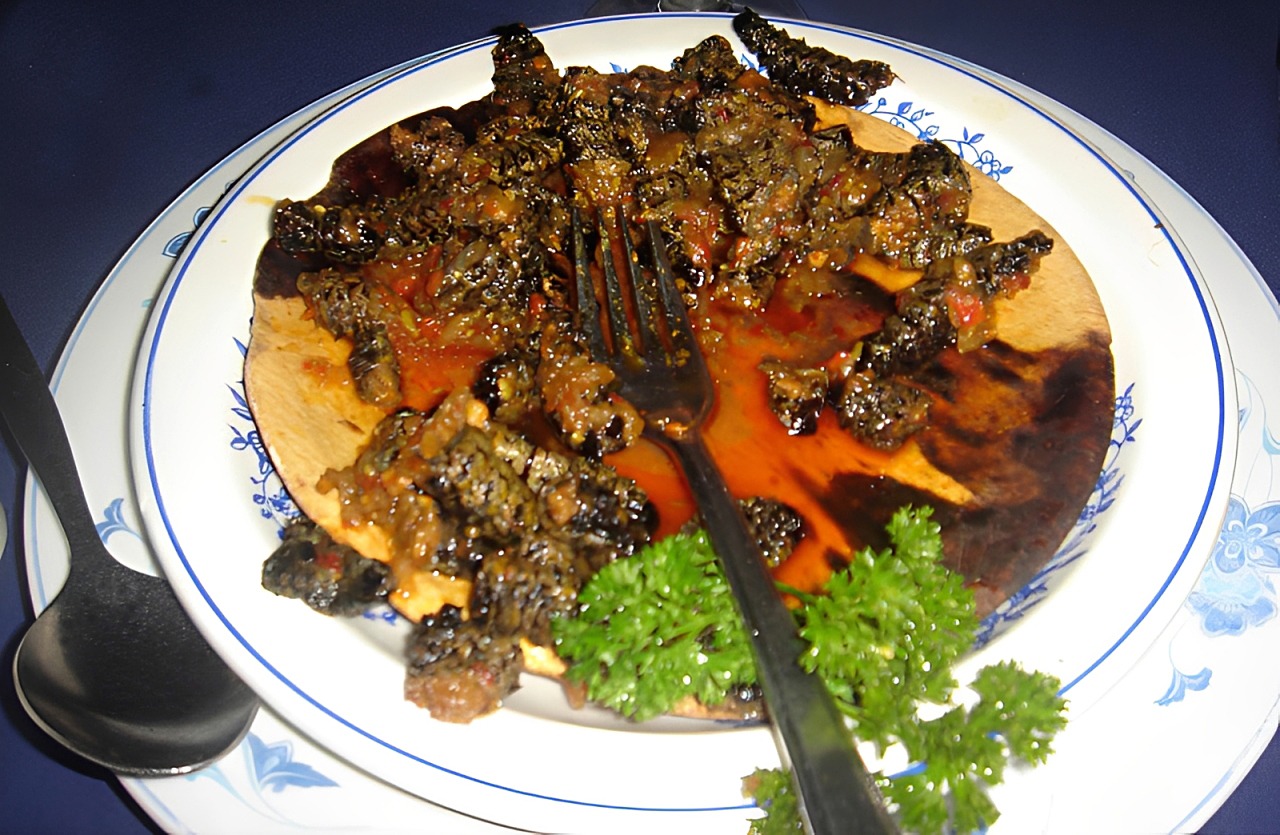
 A plate of cooked mopane worms, a traditional southern African delicacy, prepared with spices and
oil – an enduring source of protein that connects rural livelihoods, cultural heritage and local food
economies. (Photo: Wikimedia Commons)
A plate of cooked mopane worms, a traditional southern African delicacy, prepared with spices and
oil – an enduring source of protein that connects rural livelihoods, cultural heritage and local food
economies. (Photo: Wikimedia Commons)At the Carnivore Restaurant, one of the most famous dining spots in Nairobi, the menu offers a telling contradiction.
You can order crocodile. You can order ostrich. Both are farmed.
But if you wanted kudu – an antelope that moves freely across Kenya’s landscapes – the meat would likely have travelled hundreds of kilometres from South Africa.
For Francis Vorhies, who leads the African Wildlife Economy Institute (Awei), this irony serves as a warning: once a resource is farmed, the economic incentive to protect the wild system it came from begins to disappear – and the landscape itself becomes expendable.
As the commercial value of wild animals grows, explains Vorhies, so does the temptation to simply domesticate and farm them – a move that would remove the financial incentive for rural communities to protect the natural, wild spaces where wild animals, plants and insects thrive.
Awei argues that people living alongside wildlife – or on the edges of protected areas – must be able to legally, sustainably and profitably use the landscapes around them.
Exclusion
This is a reality Wiseman Ndlovu, the deputy director at Awei, understands intimately. Growing up in rural Zimbabwe near Hwange National Park, his connection to the wild was not academic, but rooted in survival and culture. He spent winters hunting impala, kudu and hares with dogs.
“When they say black communities don’t have hunters, I say, no – it’s not because we don’t have hunters, but we don’t have guns, maybe, and spaces to shoot,” says Ndlovu. “And even if people wanted to legally hunt, the system is structured in a way that prices them out, excludes them, and fails to include them meaningfully.”
To directly tackle this exclusion, Awei has established a new partnership with the South African Black Hunters and Sports Shooting Association to explore opportunities for scaling up emerging black hunters. Furthermore, Awei PhD student Klarine Engelbrecht is evaluating the SANParks Game Loan Programme, specifically looking at how game loans affect the social, economic and biological sustainability of emerging farmers.
/file/attachments/orphans/Wiseman1_899873.jpg "Wiseman Ndlovu grew up intimately connected with the wild.
<br>(Photo: Supplied)")
(Photo: Supplied)
Bugs, resin and the business of the wild
Today, Ndlovu has traded his hunting dogs for an economist’s lens. Among his current focus areas is a much smaller, yet culturally significant, wild resource: the mopane worm and other edible insects.
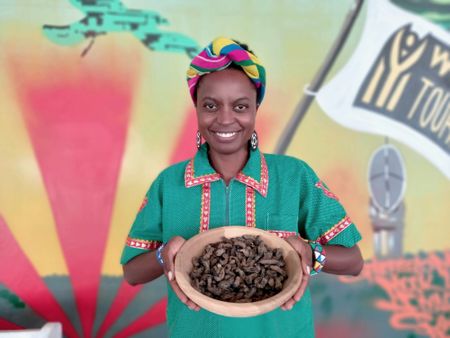
In Botswana and Zimbabwe, entrepreneurs have begun developing flavoured, processed mopane snacks aimed at urban consumers. Ndlovu notes that the appetite for such innovation is already reaching international stages, pointing to the recent COP15 wetlands conference in Zimbabwe where international delegates were served locally harvested mopane worms as part of the official menu. They were also on the dinner buffet at the African Wildlife Consultative Forum last year in Livingstone.
Beyond insects, Awei is working to broaden the traditional understanding of the term “wildlife” to embrace plants, fungi and amphibians. In Kenya and Somalia, for instance, the institute partnered with the FairWild Foundation to conduct exploratory studies on the frankincense trade. They investigated the dynamics of the value chain from harvest to export and explored opportunities for sustainably harvesting other wild species in the landscapes where the native Boswellia trees grow.
/file/attachments/orphans/Frankincense_branches_819791.jpg "(Boswellia spp.) growing in the rugged landscapes of Socotra, Yemen.
<br>Similar species underpin wild-harvested resin economies across the Horn of Africa.
<br>(Photo: Wikimedia Commons)")
Similar species underpin wild-harvested resin economies across the Horn of Africa.
(Photo: Wikimedia Commons)
Connecting dots
Awei was officially launched at Stellenbosch University in August 2018 following two multi-stakeholder workshops in Pretoria in 2016 and 2017, which focused on wildlife ranching, the economics of wildlife and the interface between conservation and development.
“These discussions highlighted the demand for an institute with a strong academic footing that could approach wildlife issues analytically and in an evidence-based way, rather than relying solely on advocacy,” Vorhies says.
After its formal founding, Awei ran on what Vorhies calls “hot air and steam” – a volunteer effort without dedicated funding. It wasn’t until a major grant from Oppenheimer Generations arrived in 2021 that the institute had the core capacity to scale up and formally take off.
Today, Awei functions as a “think-do tank” rather than a traditional academic unit, actively weaving evidence into action across a number of stakeholder groups. Their goal is to connect the dots between economics, ecology, trade policies and practices, ensuring that emerging markets for wild resources actively support the protection of wild landscapes – and the people living within them.
Supply chain hurdles
A major gap in the wildlife economy is figuring out how to safely and legally get wild products from the bush to the marketplace. Awei researchers are tackling these exact supply chain hurdles. Lydia Bhebe is using a “One Health” framework to examine how wildlife health risks, food safety practices and environmental management intersect within South Africa’s commercial game meat sector. Meanwhile, Thapelo Brilliant Lebopa is researching product labelling practices to improve traceability in the game meat industry, while Kumbirai Takawira is developing a framework to evaluate the sustainability of wild meat value chains.
But to make these economies viable, there is a billion-dollar question to answer: Can conservation pay for itself? To address this, Awei researcher Susan de Witt is looking for solutions to fill the private financing gap for conserving biodiversity in private and community conservation areas in South Africa and neighbouring emerging markets.
/file/attachments/orphans/FVorhies_418411.jpg "Francis Vorhies, the director of the African Wildlife Economy Institute , holds an honorary position as a professor extraordinary at Stellenbosch University.<br>(Photo: Supplied)")
(Photo: Supplied)
Originally from the US, Vorhies moved to South Africa in the late 1980s to work as a classical liberal economist in the Faculty of Commerce at Wits University in Johannesburg. His interest in the wildlife economy was first sparked when he visited a private game reserve in the Sabi Sand near the Kruger National Park. He said he was “blown away” to discover that people in South Africa were generating income by conserving nature through private enterprise, which contrasted sharply with the government-run national park system in the US.
Vorhies went on to become the first economist at the International Union for Conservation of Nature in Switzerland. During the 1990s, he also worked with the African Wildlife Foundation in Nairobi, where his projects included exploring the possibility of reopening trophy hunting for the Kenya Wildlife Service.
But even as Awei works to build markets for wild resources, Vorhies says the institute faces an uphill battle against public misunderstanding.
“The institute is often pigeonholed as a hunting group,” he says. “People are quick to dismiss us as just trophy hunting people.”
In reality, Vorhies emphasises, the institute looks at the entire landscape and the value chains of wild resources. That includes everything from medicinal plants and fuelwood, to ecotourism and carbon credits, not just consumptive uses like game meat.
The pushback can be fierce. Vorhies recounts an incident from 2024: Awei hosted its first African Wildlife Economy colloquium in Stellenbosch, immediately after a meeting of the African Wildlife Consultative Forum, a hunting network run by Safari Club International.
“We got yelled at for engaging with groups that others label as ‘bad people’,” Vorhies says. Several South African agencies even wrote complaint letters to the vice-chancellor of Stellenbosch University, accusing Awei of being “in bed with trophy hunters”.
Vorhies says such controversies are a reflection of the highly polarised space in which Awei operates, where conservation, commerce, culture and public perceptions collide.
The institute’s work, he says, involves engaging with diverse stakeholders, and proving that wild landscapes can be an exceptionally valuable and sustainable resource.
For Ndlovu, that means thinking creatively about how even small, culturally important species like the mopane worm can generate income, support nutrition and strengthen local stewardship.
For Vorhies, it means proving that the wildlife economy is bigger than hunting: it’s the full spectrum of human interaction with wild landscapes, from ecotourism to medicinal plants to local food systems.
“In Africa’s amazing wild landscapes,” he says, “there are hidden opportunities for wildlife-based enterprises just waiting to be discovered.” DM
This Roving Reporters story was produced with the support of the independent research engagement agency, Jive Media Africa.


Comments
Scroll down to load comments...