




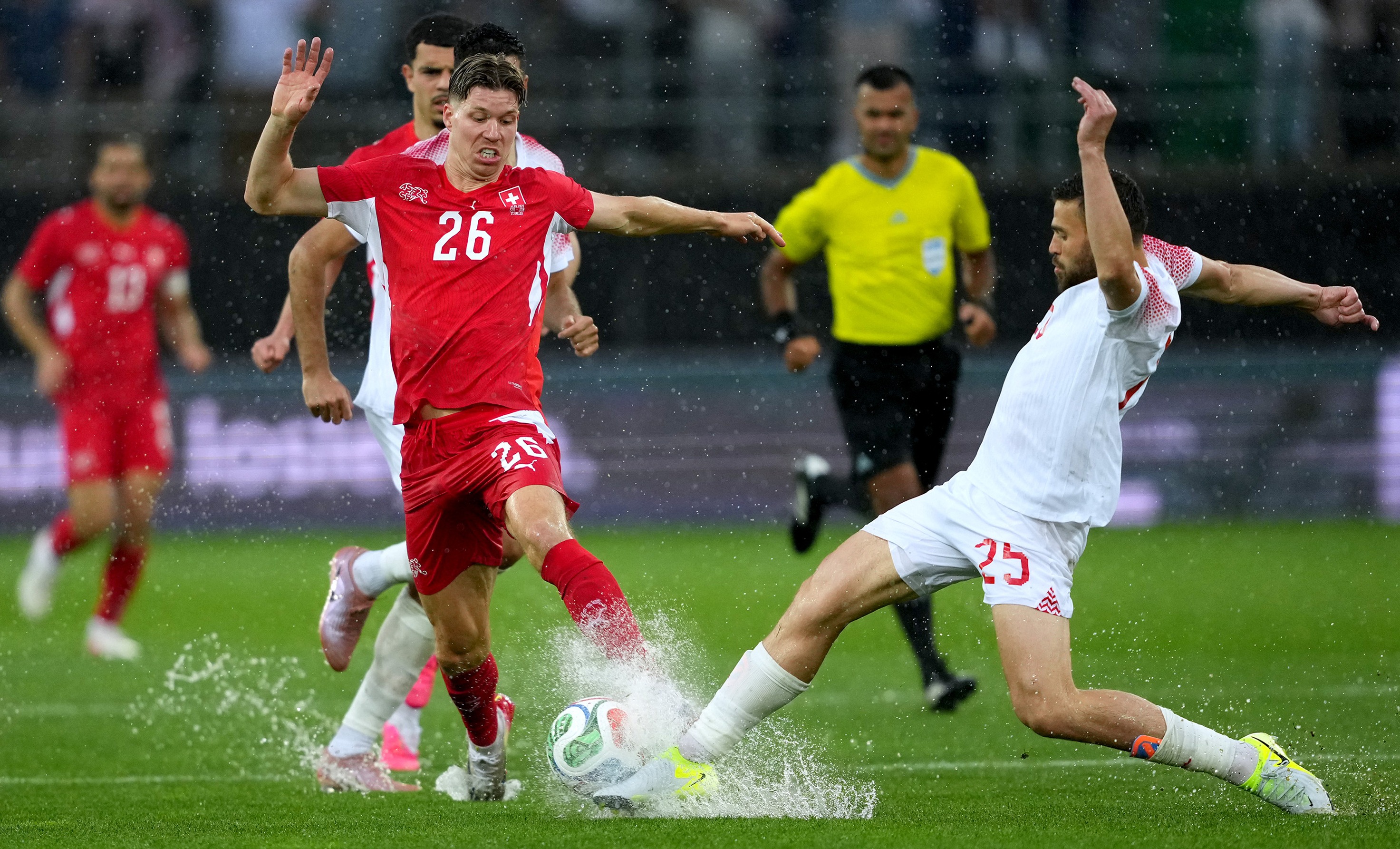
 Cedric Itten of Switzerland (left) battles for possession against Jordan during a pre-World Cup friendly in St Gallen, Switzerland, on 31 May 2026. (Photo: Sona Maleterova / Getty Images)
Canada
The plan
As co-hosts, placed inside a competitive group, Canada enter the World Cup with high expectations, despite having never won a match at the tournament. Since a Concacaf Nations League semifinal defeat to Mexico in March 2025, the team has lost just one of 15 matches at the time of writing, a run that has included some excellent opponents such as Colombia, Ecuador, Ukraine and the USA, whom they have defeated twice in the past two years, including their first win on American soil in 57 years.
Coach Jesse Marsch has maintained a consistent 4-4-2 shape throughout, with the emphasis on pressing from the front and pace in wide positions. “Some teams press to win the ball back, we press to punish and think about scoring immediately when we recover the ball,” said Marsch, who may be American but has captured the hearts of many Canadians since he took the job in May 2024 and guided the team to the semifinals of Copa América.
Success at that tournament, and subsequently since in friendlies, is based on a defensive structure that Marsch worked on immediately when taking the job and playing against Netherlands and France in his first two matches in charge. Nine clean sheets in 13 matches before the pre-tournament friendlies is even more impressive when you factor in that Moïse Bombito, their star centre-back from Nice, and Bayern Munich’s Alphonso Davies did not play a single minute in any of those matches because of injury.
“In my first year in charge we developed the playing style, and it’s clear we are more of a complete team with Moïse and Alphonso,” Marsch says. “The last year has been about developing the overall mentality to make sure when the lights are the brightest we will be ready to host World Cup games, and I think this team is special and can handle that.”
/file/attachments/orphans/GettyImages-2206272942_896662.jpg "Alphonso Davies of Canada. (Photo: Michael Owens/Getty Images)")
The coach
Jesse Marsch’s first venture into the world of international management has been successful, but not one he found easy to adjust to. “From the moment I worked with this group of players in the first camp, I knew I was going to fall in love with these guys,” he says. “They are a unique group of really good people, who are very talented, and when I said goodbye to them, it was different from what I was used to as a head coach in the club game.” Marsch has enjoyed those gaps in his schedule, using time to visit Canadian players across the world and spend a lot of time across the country at the provincial level to help bring a more united approach to the way the game is developed and governed.
Star player
Captain Alphonso Davies has not played for Canada since tearing his ACL against USA in the Nations League third-place match in March 2025. Whether to play him at left-back or on the wing has been one of the biggest questions debated among Canadian sport fans for years, but under Marsch the Bayern Munich man has predominantly been used at the back and has been excellent. However, another injury setback against Paris Saint-Germain in the Champions League semifinal second leg – his third in the past three months – has put his participation for the opening game against Bosnia and Herzegovina in doubt. He has started just 12 of 29 internationals in the Marsch era at the time of writing.
One to watch
Few players have received more work and attention from his national team coach than midfielder Ismaël Koné, a player who was once dropped during Copa América as he struggled to make an impact in matches for Canada. Since then he has been excellent for Sassuolo in Serie A and has turned into a dynamic box-to-box midfielder for Marsch, learning valuable lessons defensively in Italy, where his discipline and tactical concentration have improved significantly. Expected to start next to the excellent Stephen Eustáquio in a key double-pivot tandem for Canada.
Unsung hero
Norwich City’s Ali Ahmed has become a favourite of Marsch’s because of his selfless work on the pitch. In his 4-4-2 system, Ahmed is asked to lead the press on the left wing, often cut inside to increase the midfield numbers and bring intensity and energy off the ball. One of the reasons Marsch has not deployed Davies further forward is because he views his team without the ball more than with it, and in that vision the former Vancouver Whitecaps man is crucial.
/file/attachments/orphans/GettyImages-2269143012_120646.jpg "Canada's Ali Ahmed. (Photo: Vaughn Ridley/Getty Images)")
What to expect from fans at games?
Canada is ready to host the world, but the attention in this country is more on this team than other games happening in the country. Being the only side to start on the east coast and move directly to the west coast allows fans in Toronto and Vancouver to watch their team in the group stages. The supporters group “The Voyageurs” will lead the noise with their flags and chants of “Ooh Ahh Canada”. Canada is known for its cosmopolitan population and cultural diversity, with residents from all over the world, and should benefit from playing three group opponents (Switzerland, Qatar and Bosnia and Herzegovina) with relatively small populations.
Relationship with the US/Trump?
Marsch is not one to keep his opinions to himself and in February 2025, ahead of the Concacaf Nations League Finals, he said: “If I have one message to our president, it’s lay off the ridiculous rhetoric about Canada being the 51st state. As an American, I’m ashamed of the arrogance and disregard that we’ve shown one of our historically oldest, strongest and most loyal allies.”
Canada would go on to defeat the Americans soon after and although it was a match for third place, Marsch was extremely emotional on the sidelines and that led to him being sent off for abusing an official. Marsch, who passionately sings Oh Canada before matches, has never shied away from being American, although he has made an intentional effort to not speak publicly about politics since it is clear that he knows how much Canada enjoys beating the USA at any sport. By Kristian Jack
Qatar
The plan
The 2022 hosts’ preparations for the tournament were disrupted as the US-Iran war caused the cancellation of valuable friendlies against Serbia and champions Argentina in March. The coach, Julen Lopetegui, had wanted as many minutes as possible with his players, having only been appointed in May 2025. Worryingly, they had won only one out of 11 games under the former Spain and Real Madrid manager before the World Cup warm-up games.
Lopetegui did what he had to do though, making sure Qatar reached the World Cup finals, but it was a close call. The Maroons finished fourth out of six teams in the main qualifying group before – aided by home advantage and a favourable schedule – drawing 0-0 with Oman and beating UAE 2-1 to ensure qualification.
The Spanish coach, the latest of several Iberian appointments (Félix Sánchez, Bruno Pinheiro, Carlos Queiroz, Tintín Márquez and Luis García) has tried out several different formations but is likely to go with a 4-2-3-1 when the tournament starts.
The lessons from the last World Cup have been debated at length. Then, it was over pretty much before it had started as the hosts, perhaps burdened by a build-up that lasted 12 years, went 2-0 down within 31 minutes of their opening game against Ecuador, and it could have been even more.
Expect a more solid set-up this time around; a focus on keeping things tight and looking to hit group opponents Canada, Switzerland and Bosnia and Herzegovina on the counter. There is work to be done as the team were all over the place defensively in qualifying, finishing the main round with a goal difference of minus seven after conceding 24 times in 10 games. Lopetegui has been trying to get to grips with that particular problem and we will soon see how successful he has been in that respect.
There will be special attention to set-piece, where Qatar feel they can hurt their opponents. “We are aware of the magnitude of the responsibility placed upon us,” Lopetegui says. “We will spare no effort and will give everything we have to make the fans who stand behind us and support us happy and proud.”
The coach
Julen Lopetegui had plenty of experience with Spain and Real Madrid before moving to England to lead Wolves and West Ham. His reputation is perhaps not quite what it was, but Qatar offered something different. “Life owed me a World Cup,” he said upon qualifying. “We’ve been working for this moment for months and everything has turned out well. It’s a historic moment for the country, something that’s never been achieved before. The atmosphere has been extraordinary.” He will hope that this tournament goes better than when he travelled to Russia for the 2018 World Cup as Spain manager: as news of his deal to take over at Real Madrid after the tournament came out, he was promptly dismissed and replaced by Fernando Hierro.
/file/attachments/orphans/GettyImages-2218810115_780009.jpg "Julen Lopetegui, head coach of Qatar. (Photo: Mohamed Farag / Getty Images)")
Star player
Akram Afif has been one of the stars of Asian football since the 2019 Asian Cup, when he recorded 10 assists as Qatar triumphed. Four years later, in the same tournament, he scored eight and made headlines around the world by scoring a hat-trick in the final, picking out a playing card from his socks every time he did so. He tried his luck in Europe in Belgium (KAS Eupen) and Spain (Villarreal and Sporting Gijón) but it did not quite work out. He has been back in Qatar since 2020. He has always had the talent but did not manage to show it at the 2022 World Cup, so this is his chance.
One to watch
Mohamed Al-Mannai. The Tunisian-born star adds a physical presence in midfield, where he can play pretty much anywhere, from a holding role to further up the pitch, and, at 22, there seems to be much more to come. He made his debut for the famed Al-Sadd as a teenager before being loaned out to Al-Shamal. It was the right move and he contributed to the club having a successful season with five goals, earning the Under-23 Player of the Season award in the process. Lopetegui seems to be a fan too.
Unsung hero
Boualem Khoukhi will be 36 during the tournament so this is the last chance for the Algerian-born defender to make international headlines. Has played more than 100 times for his adopted national team and in a variety of positions, netting 21 goals at the time of writing. Most of his goals for the national team came as he was playing further forward – and he can still fill in wherever Lopetegui needs him. His confidence, reliability and experience have been valued by a succession of coaches at international level, with many seeing him as the ultimate professional.
What to expect from fans
With one of the smallest populations of any World Cup nation, Qatari fans are not going to travel in any significant numbers. Also, unlike some other Asian teams, there isn’t really any community to speak of in North America to get behind the Maroons. The Qatari folk song Shoomilah has become associated with the national team and became something of an unofficial anthem during the 2022 World Cup, and is the most likely to be heard in San Francisco, Vancouver and Seattle.
Relationship with US/Trump?
Qatar is a key US ally with strong diplomatic, economic and military ties, and there is an American air base in the country. The country has tried to stay close to Trump and gave the president a $400-million plane – dubbed Palace in the Sky – last year. But the war in Iran has been an issue, with the US attacks leading to retaliation from Tehran on Qatar, which has damaged infrastructure and the country’s image. By John Duerden
Bosnia and Herzegovina
The plan
To say Bosnia and Herzegovina’s qualification for the World Cup comes as a surprise would be an understatement. A team that had managed only four wins in their previous 19 matches across two qualification cycles arrived at a crossroads when Sergej Barbarez took over in 2024. The campaign that followed was chaotic, emotional and occasionally irrational, which still feels like the most authentic description of Bosnian football itself. But Barbarez’s side somehow found a way through it all, eliminating both Wales and Italy in a dramatic playoff and reaching only the second World Cup in the country’s history.
The former captain had waited years for the job, so long that he had not coached anywhere in the meantime. He played professional poker and enjoyed retirement before the Bosnian FA finally got in touch. He gathered close friends and former teammates around him: Emir Spahic became sporting director, while Sasa Papac and Zlatan Bajramovic joined the coaching staff.
In Barbarez’s first year, 16 players made their debuts, most of them raised and developed abroad, from Sweden and Germany to Austria and the US. That became the foundation of this new Bosnia side. Barbarez may have gone winless in his first eight matches and came under heavy criticism, but insisted that he first needed to rebuild the mentality of the squad.
Bosnia do not play especially beautiful football under the coach and systems change regularly – usually between 4-2-3-1 and 4-4-2 – but formations quickly become secondary once matches turn emotional, and with Bosnia they usually do.
The team’s identity is built around aggressive defending, direct football and quick transitions. Young players such as Kerim Alajbegovic, Esmir Bajraktarevic, Tarik Muharemovic and Amar Dedic have brought new energy to a squad still led by the veteran Edin Dzeko. Bosnia are unlikely to dominate many matches in Group B – against Canada, Switzerland and Qatar – but they have enough quality, emotional energy and unpredictability to become one of the tournament’s more uncomfortable teams.
/file/attachments/orphans/GettyImages-2269275172_491034.jpg "Edin Dzeko of Bosnia and Herzegovina. (Photo: Visionhaus/Getty Images)")
The coach
Sergej Barbarez spent years criticising the way Bosnian football was run and had almost stopped expecting the call from Sarajevo altogether, having first expressed an interest in the role in 2009. About 15 years later he took charge of the national team – with no coaching experience – for the first team against England at the age of 52.
A former captain and cult figure, Barbarez arrived promising honesty, emotional connection and a complete reset after years of dysfunction around the national team. He continued to repeat the same message about passion, pride and the responsibility of representing the country – and in the end this young squad absorbed it. After playoff victories over Wales and Italy, his status only grew further; the win against Italy transformed him from poker-playing outsider into one of Bosnia and Herzegovina’s most important sporting figures yet.
Star player
There are normal footballers and then there is Edin Dzeko. Even at 40, everything still somehow revolves around Edin. Bosnia and Herzegovina’s captain remains the country’s greatest footballer, its all-time leading goalscorer and the reference point of an entire generation. Younger players in the squad speak about him with a reverence bordering on disbelief.
Dzeko no longer dominates matches physically the way he once did at Wolfsburg or Manchester City, but his understanding of space, timing and pressure moments remains elite. During the playoffs he again delivered when Bosnia needed him most. “As long as I feel I can help, I’ll be here,” he said recently. Bosnia would not be at this World Cup without him.
One to watch
Kerim Alajbegovic, at 18, may already be the most naturally gifted attacking talent Bosnia and Herzegovina have produced since Miralem Pjanic. The midfielder, who spent a season with Red Bull Salzburg before Bayer Leverkusen triggered a buyout clause, is arriving at the tournament with that fearless attitude some players have at that age. It is not only his technique that stands out, but his personality too. Barbarez trusted the 18-year-old to take penalties in both playoff shootouts – and Alajbegovic responded with complete calmness. Elegant between the lines and fearless in possession, he feels like the face of Bosnia’s next generation.
/file/attachments/orphans/GettyImages-2268620169_488897.jpg "Edin Dzeko (right) has been Bosnia and Herzegovina’s key player for a decade. (Photo: Huw Fairclough / Getty Images)")
Unsung hero
Bosnia and Herzegovina spent years producing centre-backs who defended first and worried about the football later. However, Tarik Muharemovic feels like the first one shaped by an entirely different mindset. Born in Slovenia and developed in Austria before moving through Italian football with Juventus and Sassuolo, the left-footed defender has quietly become one of the players Barbarez trusts most.
He is not especially loud, aggressive or dramatic, which, for a defender, normally makes people in Balkan football suspicious. Instead Muharemovic solves problems calmly, carries the ball forward and gives Bosnia something they lacked for years – composure.
What to expect from fans
Bosnia and Herzegovina’s support is emotional even by Balkan standards. Some fans will travel from Bosnia itself, others from huge diaspora communities across Germany, Austria, Sweden, Switzerland and the US. Once together they usually become one loud, restless crowd once the matches begin. World Cups matter enormously because they happen so rarely; more than 100,000 people celebrated qualification on the streets of Sarajevo alone.
Part of the support is organised through the BHFanaticos ultra group, which follows the national team in different sports and drives the atmosphere throughout matches. Expect huge blue-and-yellow flags, fleur-de-lis symbols from medieval Bosnia, constant singing, drums, smoke and choreographies. And long nights around games too, because Bosnians tend to celebrate every small football moment as if it might never happen again.
Relationship with the US/Trump?
Bosnia and Herzegovina’s relationship with the US is generally positive, although Bosnians tend to argue about politics with the same energy they reserve for football referees. Many still associate America with eventually helping to end the war in the 1990s, while the US today hosts a huge Bosnian diaspora, particularly around St Louis, which often jokingly describes itself as “the fourth-largest city in Bosnia”.
As for Donald Trump, opinions are divided, which in Bosnia usually means everybody is unhappy for completely different reasons. Still, travelling supporters seem far more irritated by Fifa than the White House. The main complaint has been logistical: internal flights, absurd distances and ticket prices that make this tournament feel less like one World Cup and more like three separate ones accidentally stitched together. By Sasa Ibrulj
Switzerland
The plan
This is the sixth time in a row Switzerland have qualified for the World Cup and, on 2 June they will fly out to the US west coast with high expectations, setting up base in San Diego. “We want to play the best World Cup ever seen from a Swiss team,” the national team coach, Murat Yakin, told Blick. “The feeling that we could have reached the final of the last Euros [they lost on penalties to England in the quarterfinals] gives us something to dream about.”
Switzerland’s best performance at the World Cup came on home soil in 1954 when they reached the quarterfinals. Since then their adventures have ended at the last 16, as was the case in 2022 in Doha when they lost 6-1 to Portugal.
However, there are many reasons Swiss fans can approach the tournament with hope and anticipation. The team were very comfortable in qualifying, finishing top of Uefa Group B ahead of Kosovo, Slovenia and Sweden, winning four games and drawing two.
There is a good mix in the squad between the elder statesmen – such as Granit Xhaka, Manuel Akanji and Ricardo Rodriguez – and a younger generation represented by Dan Ndoye, Fabian Rieder and Johan Manzambi, among others. Moreover the Nati have so far avoided any injuries ahead of this World Cup, with Burnley striker Zeki Amdouni seemingly winning his battle to get back following an ACL injury.
Noah Okafor is back too, having been sidelined after a poor Euro 2024, where he did not react well to not playing, as well as a public dig at Yakin after being left out of subsequent squads. The Leeds United forward has apologised to the coach and the rest of the squad and is in the form of his life. “We’ve both done the right thing. His development has been very positive; he could be a key player at the World Cup,” Yakin says.
Yakin’s preferred system is a 4-2-3-1, though he has recently been flirting with the 3-4-3, with Denis Zakaria in the right-wing-back position. It was with that formation that the Swiss got the last eight at the Euros.
/file/attachments/orphans/GettyImages-2268733119_272290.jpg "Granit Xhaka of Switzerland. (Photo: Alex Grimm/Getty Images)")
The coach
Murat Yakin. The national team coach’s standing has never been higher – and the defender Ricardo Rodriguez is one of those who are impressed. “Murat is doing a really good job,” says Rodriguez. “Over the years, he’s become even more open and communicative with us players. He talks to us a lot, asks for our opinions from time to time and listens to us. He’s really brilliant at that.”
Yakin’s appointment as Vladimir Petkovic’s successor in August 2021 came as a surprise given that he was in charge of second-tier FC Schaffhausen at the time and there have been sticky periods, such as the 6-1 defeat to Portugal and weak performances in the build-up to Euro 2024, when he was publicly criticised by captain Granit Xhaka. After the positive tournament, however, he extended his contract to 2028.
Star player
The captain, Granit Xhaka, remains the team’s most important player at the age of 33. He is the linchpin of Switzerland’s build-up play, dictating the tempo and ensuring a balance between defence and attack. This will likely be the last World Cup for the man who is Switzerland’s record appearance-maker, but he could well continue his international career after the tournament. He has followed up two outstanding years with Bayer Leverkusen, with an equally impressive one in Sunderland, the Premier League newcomers who secured Europa League football on the last day of the season. Xhaka, as he himself says, is like a good red wine: the older, the better.
One to watch
Johan Manzambi. The Geneva-born midfielder’s impressive season at Freiburg has not gone unnoticed, with Europe’s top clubs now monitoring the all-rounder. Hardly a week goes by without a new rumour surfacing about where Switzerland’s greatest talent will play next. He could become the most expensive Swiss transfer yet following the World Cup, beating the €45-million fee Arsenal paid Borussia Mönchengladbach for Granit Xhaka in 2016. His versatility helps as he is able to play as a No 6, No 8, No 10 or even up front. For the national team he is not yet a regular starter but is often brought on in a wide position. Yakin has already said Manzambi can be a “secret weapon” for the Swiss in North America, adding: “His development is really impressive. When he was first called up to the national team last summer we realised straight away the incredible potential he has.”
/file/attachments/2993/fifa_2026_groups_465215.png)
Unsung hero
Remo Freuler. The Zurich native had to work hard to get to the top, having once been told he wasn’t good enough for Grasshoppers, which led to a move to second-tier Winterthur. Four years later his move from Lucerne to Serie A and Atalanta took many by surprise, but he settled in Italy and became increasingly important for the national team as well. Having fought his way into the starting line-up after the 2018 World Cup he is now indispensable and the perfect complement to playmaker Xhaka in midfield. The 34-year-old excels through his running capacity, his strength in one-on-one situations and his footballing intelligence – and has even scored the odd important goal from time to time.
What to expect from fans at games?
Swiss supporters usually turn out in droves for major tournaments and the fan marches at Euro 2024 in Germany are still fresh in memory. Then, more than 10,000 of them turned the cities red and white. That, sadly, won’t happen in North America. Only about 500 people have tickets for the group games through the Swiss FA and about 2,000 for the knockout stages. As was the case four years ago in Qatar, the political situation is stopping some from making the trip, and it is compounded by the high costs of flights, accommodation and travel within North America. Their favourite song is Schwiizer Nati, olé olé and the fans have come up with their own chant for striker Breel Embolo to the tune of The Lion Sleeps Tonight.
Relationship with the US/Trump?
Don’t expect any player to comment on the US president or the political situation. The Swiss FA president, Peter Knäbel, said at the end of 2025: “We will ensure again this year that the team can and will focus 100% on the sport. If an issue directly affects our values as an association, we will – as we have done in the past – take a clear stand. The US and Switzerland have been involved in tense trade discussions in recent months, with Trump hitting out at the Swiss in April. “Switzerland presents itself as a ‘small and brilliant’ country,” he told CNBC. “They’re brilliant because they pay us almost nothing. Now they pay a little bit. They should pay much more.” By Christian Finkbeiner
Comments
Scroll down to load comments...