




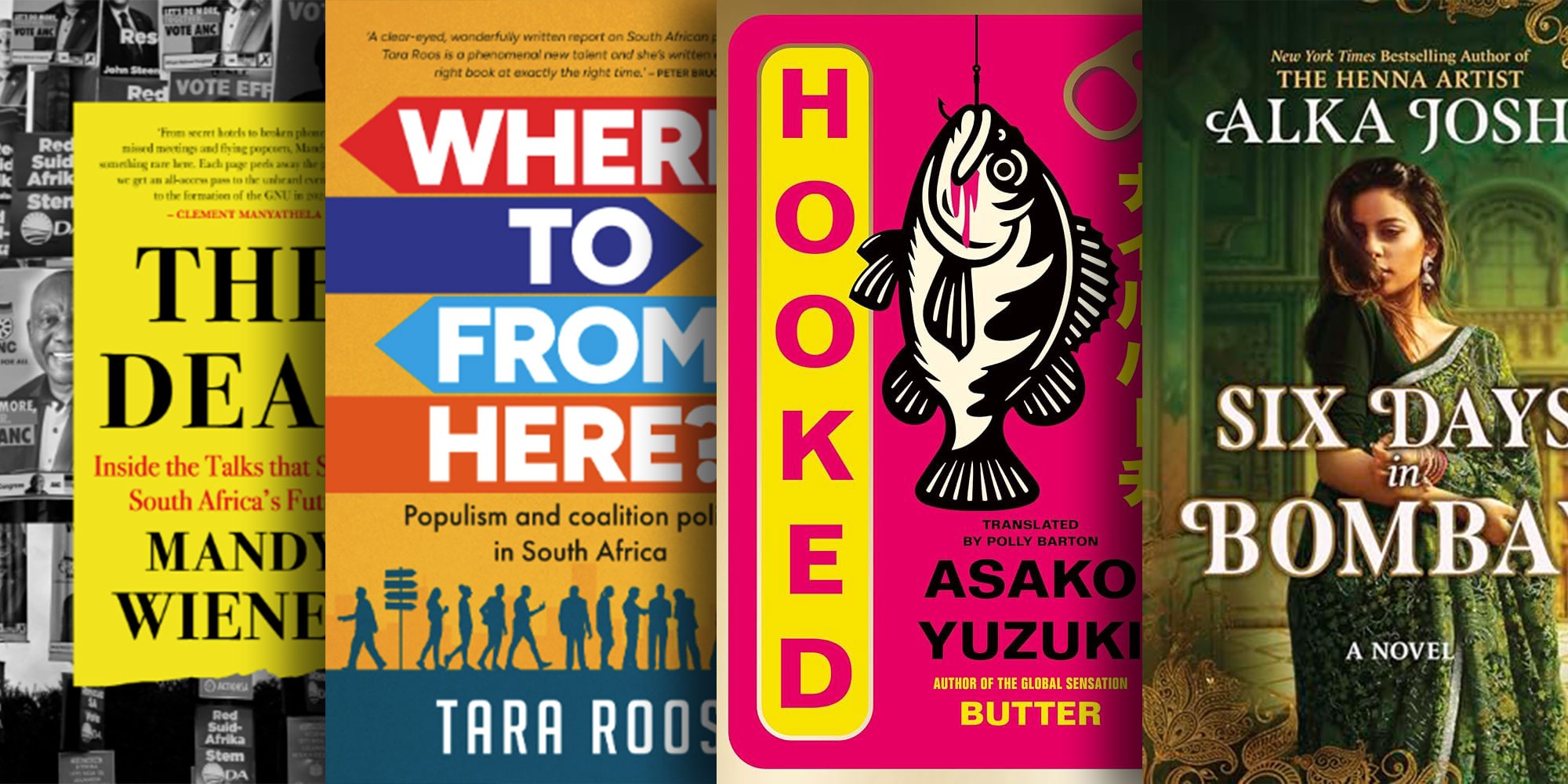
 Illustrative Image: The Deal by Mandy Wiener, Where to From Here by Tara Roos, Hooked by Asako Yuzuki and Six Days in Bombay by Alka Joshi. (Image: HarperCollins Publishers / Jonathan Ball Publishers) | (By Daniella Lee Ming Yesca)
 It is becoming increasingly difficult to choose my four book picks of the month. This is not a bad problem to have. In fact, it’s rather a wonderful one.
I’m getting so many good books at the moment that narrowing them down begins to feel a little like an episode of Survivor, except the contestants are novels and I become irrationally attached to all of them. Every month there are books I desperately want to keep on the island, but there are only so many reading hours in one life, and only so much space to write about the books we love. Here are the ones that made it onto the list.
Hooked by Asako Yuzuki
There is a particular kind of female friendship that feels less like companionship and more like a hostage situation, and Hooked captures it with unnerving precision. This is a novel about two women who cannot quite figure out how to be close to other people, and what happens when one of them decides to solve that problem through surveillance.
Shoko is a housewife who has built a modest online following by refusing to do any housework and blogging about it. Her meals exist primarily to be photographed; in one unforgettable moment she plates a dish, snaps the picture and bins the lot.
Eriko, by contrast, is a senior executive in the seafood division of one of Japan’s largest trading companies. She has a coveted job, a good salary and very little in the way of a life outside the office. Then she finds the blog. And Shoko.
What begins as digital obsession quickly calcifies into the real thing. Eriko mines Shoko’s posts for clues: the neighbourhood, the restaurants, the small rhythms of her life, before engineering herself into Shoko’s orbit. For a short while it is lovely. This is the trick Yuzuki pulls off so effectively: the friendship is warm before it is wrong, and by the time Shoko senses something is off, the reader is already 10 steps ahead of her.
Then, when Shoko tries to extricate herself from the friendship, Eriko begins to unravel. The tension is taut and nasty in the best way.
Beneath the stalker thriller, Yuzuki is writing something sharper: a dissection of the people and structures that shaped these women. Shoko’s serially divorced father. Eriko’s mother, who ironed herself flat into the shape of the perfect wife. The power structures that still insist women perform domesticity as love.
The sharper insight, though, lies in how female friendship itself becomes caught inside the same design. What looks like connection begins to mirror the very dynamics these women are trying to escape: need misread as closeness, attention mistaken for care, proximity enforced rather than chosen. What makes the novel riveting is not simply the collapse of the friendship, but the constant renegotiation of power beneath it.
The novel is not without its flaws. The final act falters slightly, and the prose occasionally could have been tighter. The momentum also wavers in places. Still, Hooked remains a tense, unsettling novel that lingers.
Hooked by Asako Yuzuki was published in March 2026. Retail price: About R390.
Six Days in Bombay by Alka Joshi
I recently got to sit down for coffee with Alka Joshi, and within minutes it became clear why her novels resonate so deeply with readers across the world. She speaks with enormous warmth and generosity, but also with the kind of observational intelligence that makes you feel as though she is constantly collecting fragments of human behaviour for future stories.
Spending time with her felt strangely intimate, less like interviewing an internationally bestselling author and more like falling into conversation with somebody who understands the complicated emotional terrain of women’s lives with unusual precision.
Six Days in Bombay continues the rich, immersive storytelling that readers loved in The Perfumist of Paris and The Henna Artist. This time, Joshi turns her attention to Sona, a young nurse working at a hospital in Bombay, whose life becomes entangled with that of Mira Novak, a glamorous painter recovering from a miscarriage.
Sona is captivated by Mira’s stories of Europe, art and lovers scattered across the continent, and the two women quickly form an unlikely intimacy. But after Mira dies suddenly under mysterious circumstances, Sona finds herself under suspicion and drawn into an unexpected journey across Prague, Paris and Italy through paintings and messages Mira leaves behind.
As Sona pieces together the truth about Mira’s life, she also begins confronting her own complicated history and questions of identity, abandonment and belonging. It is a premise that allows Joshi to move elegantly between mystery, emotional reckoning and historical sweep, while continuing her fascination with women negotiating freedom, expectation and reinvention across borders and relationships.
Joshi’s novels possess an extraordinary sensory quality. She writes cities, food, fabrics, scent and atmosphere so vividly that reading her work often feels less like turning pages and more like stepping bodily into another world. But what makes her books linger is not simply the beauty of the settings. Beneath the elegance and historical richness is a deep curiosity about longing, self-definition and the versions of ourselves we construct in order to survive.
During our conversation, Joshi spoke about memory, displacement and the emotional lives of women, themes that pulse beneath all her work. It is precisely this combination of intimacy and scale that makes her novels so compelling. They are transporting without ever becoming hollow escapism, emotionally intelligent without becoming sentimental.
Six Days in Bombay is a reminder of the pleasures of deeply immersive storytelling and of the rare magic that happens when a writer can make readers feel swept away.
Six Days in Bombay by Alka Joshi was published in April 2025. Retail price: Around R385.
Where to From Here? by Tara Roos
One of the books that lingered with me this month is Tara Roos’s thoughtful and sharply observed exploration of South Africa’s political landscape.
At a moment when political debate often feels dominated by slogans, outrage and shallow commentary, Roos does something increasingly rare: she slows down the conversation and asks readers to think carefully about power, policy, ideology and the electorate itself.
Where to From Here? offers readers an accessible but nuanced guide to South Africa’s major political parties, unpacking not only their policy positions, but also the histories, constituencies and social conditions that have shaped their growth, stagnation or decline over time.
Roos explores where parties are gaining traction, where they are losing relevance and what possibilities may exist for future political realignment in an increasingly volatile and fragmented democracy.
What makes the book particularly compelling, however, is that it never loses sight of the people beneath the politics. Running through the analysis is a larger reflection on what South Africans are asking for from democracy itself.
What do voters want from a government that genuinely works for all? What frustrations, fears and aspirations are shaping electoral behaviour? And what happens when citizens no longer feel represented by the political institutions meant to serve them?
The result is a politically astute, deeply readable book that manages to be analytical without becoming dry, and humane without slipping into sentimentality. At a time when South African politics can often feel exhausting or performative, Where to From Here? offers something valuable.
Where to From Here? by Tara Roos was published in May 2026. Retail price: About R280.
The Deal by Mandy Wiener
Mandy Wiener’s The Deal takes readers directly into the extraordinary two weeks that reshaped South African politics following the 2024 elections. Built on roughly 100 hours of interviews with key political players, the book reconstructs the tension, uncertainty, backroom negotiations and competing calculations that ultimately gave birth to the Government of National Unity.
What makes the book particularly compelling is the way Wiener captures not only the mechanics of the negotiations, but also the vastly different organisational cultures and governing philosophies that collided in the process.
The negotiations were never simply about positions and portfolios. They were also about mistrust, ego, institutional history and fundamentally different understandings of how power should operate.
Running through the book is the recognition that the GNU often resembles a difficult marriage entered into under conditions of necessity rather than romance. The parties may need to stay together for the sake of the country, but Wiener continually probes the tensions this creates beneath the surface.
What does communication look like inside such a marriage? How does collective governance function when parties remain deeply invested in protecting their own political brands and constituencies?
One of the book’s sharpest insights is the way party-political interests continue shaping governance inside the GNU itself.
Ministries begin to function almost like political showcases, with parties eager to demonstrate competence within their own portfolios rather than necessarily advancing a coherent, shared vision of government. In the process, Wiener raises a larger question about whether South Africa risks losing the idea of governance as a genuinely collective national project.
Importantly, the book never collapses into cynicism. Wiener approaches her subjects with enough nuance and humanity to avoid caricature, even while exposing the fragility, ambition and improvisation underpinning the coalition experiment. The result is an engrossing political account that doubles as an unusually intimate portrait of power under pressure.
The Deal by Mandy Wiener was published in September 2025. Retail price: About R370. DM
Joy Watson is book editor-at-large at Daily Maverick.