




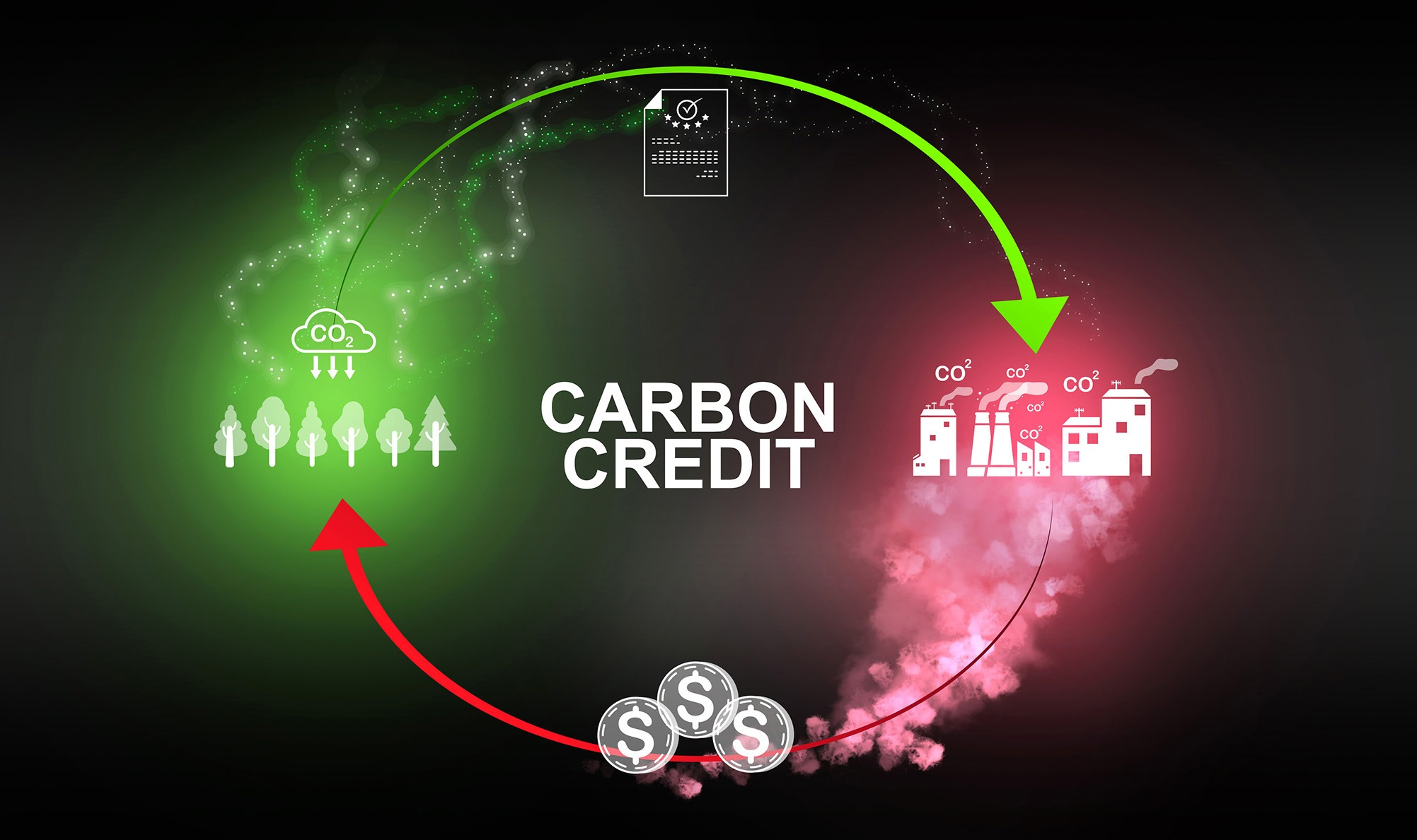
 The European Union's Carbon Border Adjustment Mechanism (CBAM), which imposes a financial liability on carbon-intensive imports, is reshaping global trade by linking industrial competitiveness with decarbonisation for South African exporters. (Image: iStock)
 /file/dailymaverick/wp-content/uploads/2025/10/label-Op-Ed.jpg)
The European Union’s Carbon Border Adjustment Mechanism (CBAM) entered a new phase on 1 January 2026, moving from a reporting and data-gathering exercise to a system that now imposes a financial liability on imports of certain carbon-intensive products entering the EU.
It should be noted that the financial liability of CBAM applies to the importers of defined affected products into the EU, and not directly to producers in South Africa.
While much attention has focused on compliance requirements and administrative obligations, the bigger story for South African business lies elsewhere. The real significance of CBAM is that it is reshaping the relationship between trade, industrial competitiveness and decarbonisation.
For SA’s export-oriented industries, the mechanism signals a future in which carbon intensity may increasingly influence market access alongside price, quality and reliability.
The immediate impact of CBAM on South African exports is relatively limited. However, the scope of CBAM is expected to expand over time, and the European Commission is already considering changes that could significantly increase SA’s exposure.
Most important among these is the possible inclusion of indirect emissions associated with electricity consumption – a development that could bring Eskom’s coal-dominated generation fleet directly into the competitiveness equation for South African exporters.
What CBAM is designed to do
CBAM was introduced to address “carbon leakage” – the risk that industrial production could move from Europe to countries with less stringent climate policies, or that European producers could be displaced by imports from jurisdictions where carbon taxes are lower.
The mechanism is intended to place a carbon price on imports equivalent to that faced by producers operating under the EU Emissions Trading System. In principle, it seeks to ensure that the carbon cost externalities associated with producing a product is reflected in its price in the EU, regardless of where that product is manufactured.
European officials stress that CBAM applies to companies rather than countries. The mechanism is based on the carbon emissions embedded in products and allows deductions for carbon prices already paid in the country of origin.
For exporters, the practical implication is straightforward: the lower the carbon intensity of production, the lower the potential CBAM liability.
SA’s limited current exposure
CBAM currently covers six sectors: iron and steel, aluminium, cement, fertiliser, electricity and hydrogen – and of these, only iron and steel and aluminium products are exported in significant volumes from SA to the EU.
According to figures presented by the European Commission, products currently covered by CBAM represented approximately 6% of SA’s exports to the EU in 2024. Iron and steel accounted for roughly 3.3% of exports to the bloc, aluminium represented about 2.8%, while cement and fertiliser together were less than 0.1%.
Furthermore, currently only direct (Scope 1) emissions in the production of primary iron and steel and aluminium products are considered, while indirect (Scope 2) emissions such as those arising from Eskom electricity consumed during production are not counted. Thus, the current exposure of South African companies to CBAM is quite limited.
However, this may understate the longer-term implications. The issue is not simply the value of current exports affected by CBAM, but how the mechanism may evolve and influence future investment, procurement and industrial location decisions.
Downstream products in the firing line
One of the most significant proposed changes to CBAM is the extension of its scope beyond the six primary materials listed above.
In December 2025, the European Commission proposed adding approximately 180 downstream product categories containing significant iron and steel or aluminium content. These include machinery, fabricated metal products, vehicle components, construction equipment, electrical equipment, engines, motors and various industrial products.
The logic behind the proposal is clear. Without extending CBAM downstream, European producers of manufactured products could find themselves at a competitive disadvantage against imported products made using carbon-intensive materials.
For SA, this matters because the country is already among the largest exporters to the EU of several affected downstream products. If adopted, the extension would move CBAM beyond basic commodities and deeper into manufacturing value chains.
The proposed extension is still under consideration by EU lawmakers, but it provides a clear indication of the direction of travel. Rather than narrowing over time, CBAM is likely to expand its reach into broader segments of industrial production.
The carbon tax dilemma
SA faces another challenge in the form of its comparatively low carbon tax.
CBAM allows importers to deduct carbon costs already paid in the country where products are manufactured. This creates an incentive for countries to implement their own carbon pricing systems so that revenues remain within the domestic economy rather than being collected at the border by importing jurisdictions.
SA’s carbon tax remains extremely low once allowances and exemptions are taken into account. Research by the Presidential Climate Commission indicates effective carbon prices in SA of between $0.30 and $2.60/tCO₂e (tonnes of carbon dioxide equivalent), compared with the global average of about $6/tCO₂e, and EU carbon prices that have frequently exceeded $60/tCO₂e.
The result is that South African exporters are likely to receive only limited relief from CBAM through the deduction mechanism. This has reignited debate about the future trajectory of SA’s carbon tax.
Some argue for more aggressive increases in domestic carbon pricing, with carbon tax revenues ringfenced for targeted support of industrial decarbonisation initiatives in SA – a measure that would retain carbon revenues within the country while strengthening export competitiveness.
Others caution that raising carbon costs too quickly could undermine industrial activity and employment in already stressed sectors. The debate is likely to intensify as CBAM implementation progresses.
The indirect emissions threat
However, the most important issue for SA may not be carbon taxation or even the downstream extension. It may be the future treatment of indirect emissions.
During the transitional phase of CBAM, importers were required to report both direct and indirect emissions. However, under the definitive regime that commenced in January 2026, indirect emissions currently attract a financial liability only for cement and fertiliser products, which are in any case not exported from SA to the EU.
For iron and steel, aluminium and hydrogen products, only direct emissions are presently included in the CBAM calculation, and the exemption of indirect emissions for these commodities is significant and material for SA.
The country’s electricity system remains heavily dependent on coal-fired generation and has a carbon intensity substantially higher than many competing export jurisdictions. In sectors such as aluminium smelting, ferro-alloys, steelmaking and metal fabrication, indirect electricity-related emissions can account for a significant proportion of the total emissions associated with production.
As a result, the current exclusion of indirect emissions effectively shields South African exporters from a potentially much larger carbon cost burden, and this protection may prove temporary.
The European Commission has indicated that a further review of CBAM will take place in 2027. Among the issues to be considered is whether indirect emissions should be extended to the remaining CBAM sectors, including iron and steel, aluminium and hydrogen.
If such a change were adopted, the implications for SA could be profound. The carbon intensity of Eskom’s electricity supply would become directly relevant to the competitiveness of exported products.
Companies dependent on grid electricity could face materially higher carbon costs than competitors supplied by lower-carbon electricity systems. For many South African exporters, this could become the defining CBAM issue.
Strategic implications for business
The prospect of future indirect-emissions liability is already influencing corporate strategy.
Across the mining, metals and manufacturing sectors, companies are increasingly pursuing renewable-energy procurement, wheeling arrangements, private generation projects and battery storage investments. While these initiatives are often justified on the basis of energy security and cost management, they are also becoming important tools for managing future carbon exposure.
The same applies to investments in emissions monitoring, reporting and verification systems. Under CBAM, companies able to demonstrate lower actual emissions may be better positioned than those relying on default emissions values.
More broadly, the mechanism reinforces a trend that is becoming increasingly evident across global markets: decarbonisation is evolving from an environmental issue into a core business and competitiveness issue.
For South African industry, this creates both risks and opportunities. Carbon-intensive production may face increasing pressure in export markets, while producers able to demonstrate lower-carbon products could enjoy growing competitive advantages.
The implications extend beyond individual companies. The future competitiveness of South African exports will increasingly be influenced by progress in electricity sector reform, renewable-energy deployment, industrial decarbonisation and carbon accounting systems.
Beyond compliance
Much of the discussion around CBAM has focused on compliance obligations, reporting requirements and administrative complexity. These issues are important, but they are not the central strategic question.
The more important question is how global trade is changing. CBAM represents one of the clearest signals yet that climate policy and industrial policy are becoming increasingly intertwined. The mechanism is likely to evolve, expand and be emulated by other jurisdictions over time.
For SA, the immediate exposure may be concentrated in iron and steel, and aluminium exports. However, the combination of downstream expansion and the potential future inclusion of indirect emissions could substantially broaden its impact.
The greatest long-term risk may therefore lie not in today’s CBAM rules, but in the possibility that the carbon intensity of Eskom’s electricity supply becomes directly embedded in the cost of exporting South African products to international markets.
For business leaders, the challenge is no longer whether carbon constraints will influence competitiveness, but how quickly companies can adapt to a trading environment in which carbon intensity increasingly matters. DM
Chris Yelland is the Managing Director, EE Business Intelligence.
© Copyright 2026 – EE Business Intelligence (Pty) Ltd. All rights reserved. This article may not be published without the written permission of EE Business Intelligence.