




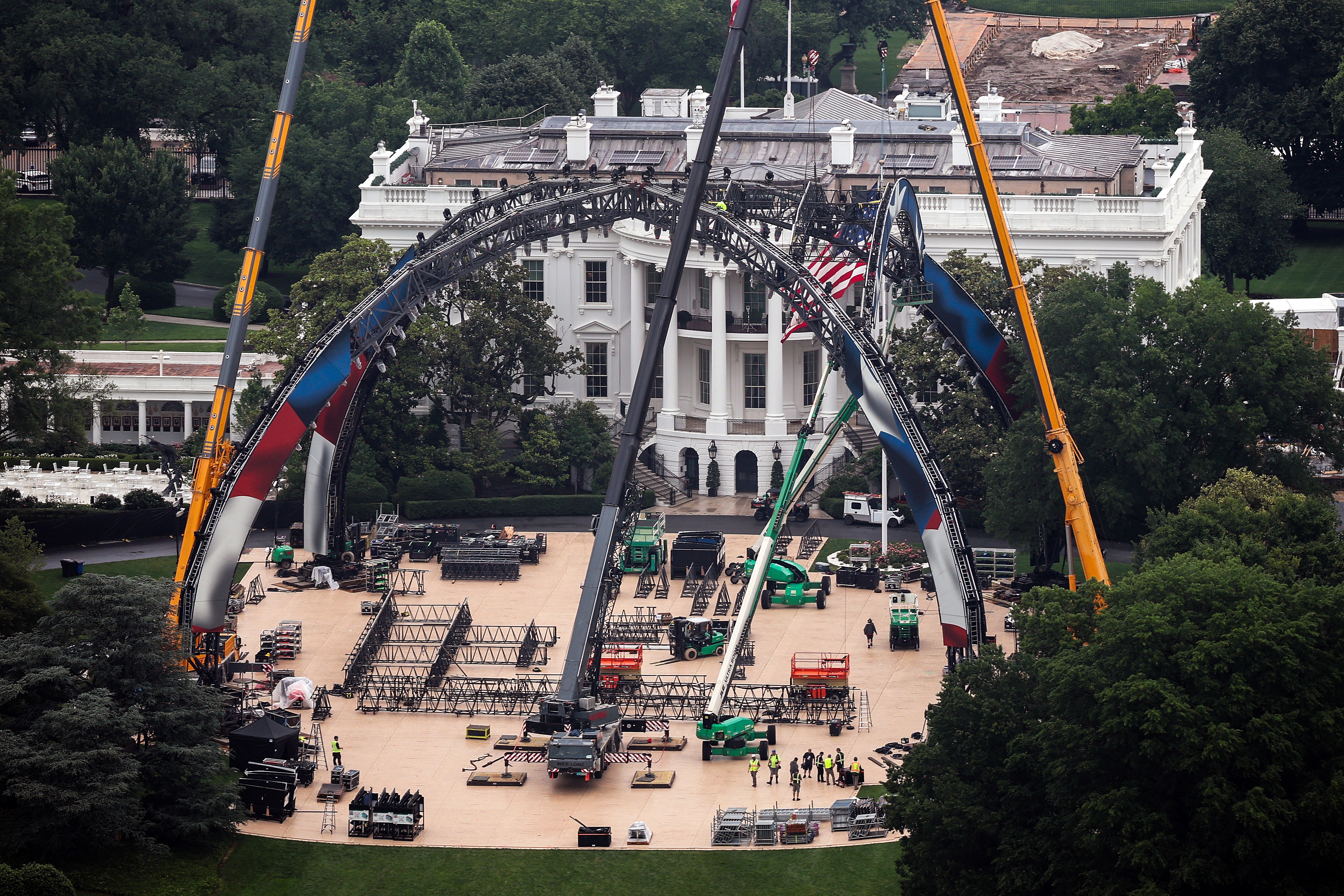
 Construction on 26 May for the upcoming UFC match on the South Lawn of the White House. (Photo: Kevin Dietsch/Getty Images)
The year 1976 delivered a palpable sense of national relief to many Americans. The country had survived its disastrous engagement in the Vietnam conflict (although calamity would continue to overwhelm Cambodia for years more). The World’s Fair in Philadelphia in 1876, celebrating the hundredth anniversary of US independence, had something of the same cathartic effect, coming a decade after a civil war that nearly broke the nation.
As for the 1976 celebration, the resignation in 1974 of Richard Nixon, a president who had been enmeshed in the Watergate scandal, meant the 1976 presidential election would pit two decent men — the incumbent, President Gerald Ford, and the former Georgia governor Jimmy Carter — against each other, in a sharp contrast to the former chief executive.
Those bicentennial celebrations of the country’s birth featured a raft of uplifting events, including the emotionally uplifting arrival of a vast international flotilla of sailing ships — “Operation Tall Ships” — in New York City’s harbour.
The near-universal acclaim for British broadcaster Alistair Cooke’s television series America: A Personal History of the United States, released in 1972, led to Cooke being invited to address a joint session of Congress in 1976 to speak about what it had all meant.
Cooke said that of all the things he had done over his career, he was most proud of that TV series. In 1976, serving in Africa as a US diplomat, we had access to the full series, and showed it to multiple audiences of friends, acquaintances and official contacts. Given what the US had recently been through, the series gave us hope for the future.
Sadly, this year, the semiquincentennial — or 250th — celebration of the creation of the country is now a battle — and a growing fiasco — over how it will be recognised, and what this commemoration is even celebrating.
As David Frum recently wrote in The Atlantic, “ ‘You talk too damn much, and it’s too damn much about you.’ That quote from Raymond Chandler’s The Long Goodbye is a good summary of the fiasco that Donald Trump has made of the 250th anniversary of the Declaration of Independence. You might have thought that presiding over such a celebration would be an easy success for Trump. He is a showman, after all. He loves parades and extravaganzas. It was all an easy layup, a gimme, a chance for a now-unpopular second-term president to reinvent himself as the leader of all of the American people. The only thing he had to do was — for once in his life — not act like an insane egomaniac. He couldn’t do it.”
Back to the beginning
But to really think about this impending anniversary, we must go back to the beginning. We start with the letter John Adams (later the country’s first vice-president and its second president) had written to Abigail, his wife, after independence had been voted for by representatives from those 13 British colonies. Adams had helped draft the document — although Thomas Jefferson wrote most of its memorable phrases.
Adams said:
“[Independence Day] will be the most memorable Epocha, in the History of America. I am apt to believe that it will be celebrated, by succeeding Generations, as the great anniversary Festival.
“It ought to be commemorated, as the Day of Deliverance by solemn Acts of Devotion to God Almighty. It ought to be solemnized with Pomp and Parade, with Shews, Games, Sports, Guns, Bells, Bonfires and Illuminations from one End of this Continent to the other from this Time forward forever more.
“You will think me transported with Enthusiasm but I am not. I am well aware of the Toil and Blood and Treasure, that it will cost Us to maintain this Declaration, and support and defend these States.
“Yet through all the Gloom I can see the Rays of ravishing Light and Glory. I can see that the End is more than worth all the Means. And that Posterity will tryumph in that Days Transaction, even altho We should rue it, which I trust in God We shall not.”
He was correct; it would become one of the country’s two national, secular religious holidays (Thanksgiving is the other) — but he was also right in that achieving it would demand “Toil and Blood and Treasure”.
/file/attachments/orphans/GettyImages-803351_164017.jpg "A portrait of the second US president, John Adams (1735-1826). (Courtesy of the National Archives/Newsmakers)")
Still, Adams was a complex man. He was a lawyer who had defended British troops in a trial following the Boston Massacre of 1773 (when a mob attacked British troops in Boston and the troops fired on that crowd). But when he became president, he pushed for the Alien and Sedition Acts to place restrictions on the right of free speech he had supported years earlier.
The resulting revolutionary war was actually fought among a bitterly divided population of supporters of independence, loyalists to the British crown, and perhaps a third of the population who just wanted to be left alone.
Meanwhile, the world’s great print propagandist, Thomas Paine, would write his pamphlet The American Crisis in the same year as the new Continental Army was suffering successive defeats. It was designed to bolster the spirits of an army and people who were now realising that this independence idea was no walk in the park.
/file/attachments/orphans/GettyImages-3317110_484803.jpg "The English-born American revolutionary philosopher Thomas Paine (1737 - 1809). (Photo: Hulton Archive/Getty Images)")
Paine wrote:
“These are the times that try men’s souls. The summer soldier and the sunshine patriot will, in this crisis, shrink from the service of their country; but he that stands it now deserves the love and thanks of man and woman.”
This pamphlet became a bestseller, read to crowds and army units alike all across the new nation.
In the actual combat, the belligerents had made use of Native American allies — and, on the side of the rebels, promises were made (but not kept) to slaves that they would be granted manumission if they fought against the British.
Once the British had been defeated (with help to the rebels from France), thousands of loyalists were transported to Canada’s Maritime provinces to begin their shattered lives anew. The peace often split families, as was the case with Benjamin Franklin and his loyalist son, who had been the royal governor of Pennsylvania.
At Britain’s surrender after the Siege of Yorktown, Virginia, a drum and bugle corps played The World Turned Upside Down. History can have unexpected consequences. France’s virtual bankruptcy due to its aid to the US contributed to the French Revolution, the Terror, Napoleonic rule, and bourgeois liberalism, rising nationalism, and constitutional governments across much of Europe.
‘A new man’
In America, meanwhile, their revolution was turning colonists into Americans. In 1782, the French writer Hector St Jean de Crèvecœur described this transformation in Letters of an American Farmer, exclaiming: “The American is a new man, who acts upon new principles. He must therefore entertain new ideas and form new opinions.”
In fact, the words of the Declaration of Independence had set out the claim of a country based on an idea rather than geography, history, myth, or ethnicity, when it declaimed:
“We hold these truths to be self-evident, that all men are created equal, that they are endowed by their Creator with certain unalienable Rights, that among these are Life, Liberty and the pursuit of Happiness.
“That to secure these rights, Governments are instituted among Men, deriving their just powers from the consent of the governed,
“That whenever any Form of Government becomes destructive of these ends, it is the Right of the People to alter or to abolish it, and to institute new Government, laying its foundation on such principles and organizing its powers in such form, as to them shall seem most likely to effect their Safety and Happiness. about all men are created equal…”
/file/attachments/orphans/GettyImages-171075149_570457.jpg "'Signing the Declaration of Independence, 28th June 1776' — a painting by John Trumbull, commissioned in 1817. (Photo: Culture Club/Getty Images)")
Nearly 200 years later, some of those words were even found in the Vietnamese Declaration of Independence, written by Ho Chi Minh following the Japanese defeat in 1945, but before the French could reassert control of Indochina.
By 1787, for the new nation, after half a decade of interstate conflict, it was clear that some new arrangements were necessary. Delegates to a constitutional convention scoured literature for examples — ancient and modern — of governments that did not embrace monarchy — but simultaneously would not allow a descent to mob rule — in line with Plato’s warnings. Thus, they were more concerned with Thomas Hobbes’ fears of chaos than they were about embracing the aspirations of an optimist like Jean-Jacques Rousseau.
In response to those fears and hopes, they crafted compromises about shared/separated powers — thus the checking of each unit of government by another — to preclude the disastrous impulses of leaders. James Madison, a drafter of the new Constitution, had written, “If all men were angels, there would be no need for governments.” Sadly, now, it seems we are learning for real about the realities of such fears yet again, just as it is not clear those systems of checks and balances are enough to prevent a political monster.
A fatal compromise
One thing they also did was to build in an ambiguity — and a fatal compromise — over the institution of slavery. The slave trade was set to end in 1807, but there was no abolition of the institution itself or any mechanism to do so. In this, as Jefferson said, the very idea of a continuation of slavery (although he was a slave owner) was like “a fire bell into the night.”
Post-independence, the national debate over slavery created a conflict that plagued the nation for decades, eventually leading to the Civil War. The conflict initially was over the expansion or restriction of the legal institution of slavery, but ultimately led to its abolition. Or, as Abraham Lincoln said during the campaign for Illinois’ seat in the US Senate in 1858, forecasting events:
“A house divided against itself can not stand. I believe this government cannot endure permanently, half slave, and half free. I expressed this belief a year ago; and subsequent developments have but confirmed me. I do not expect the Union to be dissolved…”
In the midst of that inevitable war, Lincoln’s speech at the site of the Battle of Gettysburg recast the very nature of the country, announcing that governments must be of the people, “by the people, and for the people”. The historian-journalist Gary Wills has argued that Lincoln’s argument changed the way the country described itself from “the United States ARE” to “the United State IS”.
Years later, we can make a similar argument for Franklin Delano Roosevelt’s governmental revolution in the midst of the Great Depression. It established the nation’s social welfare network of Social Security pensions and mobilised millions of jobless people into New Deal work programmes.
Roosevelt’s revolution in what the government should and could do also gave an impetus for modern conservatism as a political force in the US — labelling the New Deal and all it stood for as the imposition of foreign ideas of socialism and even communism.
In our own time, with the rise of Donald Trump and the rage of Maga, a new division of the country has come about over socioeconomic ideas and beliefs. Even if the likelihood of a second civil war is vanishingly small, and as the divisions do not correspond to specific geographic delineations, it largely represents divides between the small town and rural worlds versus big cities and prosperous suburbs of the nation. And, of course, Trump has attracted men (largely white, without university degrees) who believe they have been left behind by women and minorities.
But those divisions are sufficiently real. Trump has taken advantage of that split, setting up a second 250th anniversary committee to compete with the one authorised by Congress years earlier. Now it is Trump’s Freedom 250 vs the America 250 committee, a conflict that would have been unthinkable in 1976.
The congressionally mandated committee has been organising debates, discussions, exhibitions and celebrations. By contrast, the Trump version plans to stage Ultimate Fighting Championship cage fights on the White House lawns, build a massive triumphal arch, and have buses traverse the country showing videos of inspirational bits from Trump’s speeches and tweets.
/file/attachments/orphans/GettyImages-2278336525_456499.jpg "Demonstrators in Washington on 26 May protest against Trump's proposed 250-foot 'Triumphal Arch' . (Photo: Anna Moneymaker / Getty Images)")
Most recently, there has been the embarrassing spectacle of the public collapse of a planned open-air concert as many of the performers backed out after they realised the concert was White House-organised agitprop. In a petulant huff, the president then cancelled the concert and said he would deliver a major speech at a rally instead, rather than knuckle under to the demands of “overpaid” performers.
Now, after 250 years of painful efforts to achieve a common national ethos, there is the growing collapse of a consensus about what it means to be an authentic American. This is a sad erosion of the evolution from earlier years.
Only a few weeks before the national birthday anniversary, the question is: Can the country embrace the entirety of its history even as the Trump administration seems intent on wiping out that diversity, and substituting a whitewashed national history of Trump-blessed apogees, rather than embracing the larger meaning of all those hard-fought debates about what it means to be America — and an American?
On this fundamental question, the imminent semiquincentennial, together with the upcoming mid-term elections in November, need to encourage a robust debate about whether the US can and will embrace its “better angels,” as Abraham Lincoln had called them, or if it will continue a slide towards domestic and foreign policies that speak only to who holds power and what they wish to do with it. DM
This is a revised version of the author’s speech at the University of the Third Age.
Comments
Scroll down to load comments...