




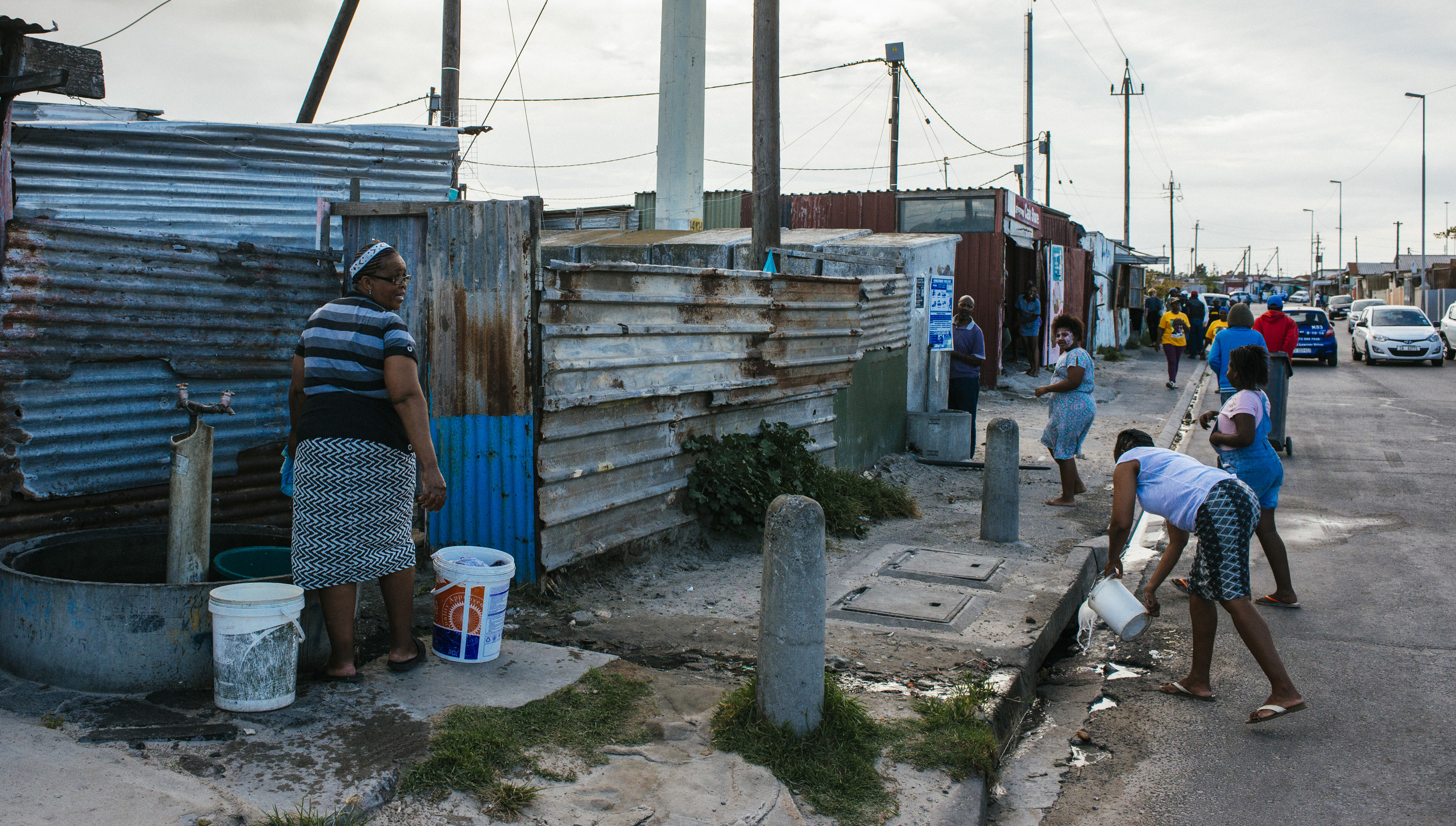
 Residents at a communal tap in Khayelitsha, Cape Town. (Photo: Waldo Swiegers / Bloomberg via Getty Images)
 /file/dailymaverick/wp-content/uploads/2025/10/label-Op-Ed.jpg)
For a long time, the African Water Commons Collective (AWCC), together with community-based groups from townships all over Cape Town, has engaged the City of Cape Town in numerous campaigns and communications about their struggles with access to water. Time and again, the City has responded by defending policy choices and practices that exclude and punish Black and poor households.
To bring public attention to the struggles of communities facing water injustice, the AWCC and The Movements Collective (TMC) collaborated on a research project that examined the anti-poor bias in the City of Cape Town’s free basic water policy. The project worked with Water Action Committees in Elsies River, Makhaza (Khayelitsha) and Nyanga, which consist of community organisers who are building resistance against water discrimination, exclusion and injustice. Common water-related challenges across these areas include water cut-offs, broken meters left unrepaired by the City, leaking and blocked toilets and inadequate drainage systems that result in frequent street flooding. To show the systemic racism and sexism in the way Cape Town City “provides” free basic water, the AWCC highlights three very serious problems for poor communities.
The first is that free basic water is neither free nor affordable. Supposedly, 15,000 litres per month are provided at no cost (this source on the Cape Town City website actually states 6,000 litres). Afterwards, people who can’t afford any bills start accumulating arrears and their water flow is restricted or blocked completely (the City calls the drip system “controlled flow”). Especially for large households, common in poor communities, the free basic water is insufficient. This problem is compounded by the fact that poor households are situated in areas that have the worst infrastructural problems, such as leaking pipes and inadequate water infrastructure. The consequences are dire. Women and young girls often responsible for domestic chores that require water are exposed to violence during their search for water, and communities as a whole face serious health risks due to problems with both the quantity and quality of water provided.
Free basic water is only supplied to households registered as indigent. According to Cape Town’s Open Data Portal, 229,654 “formal indigent households” were reported in 2025. Meanwhile, National Treasury allocated funds for the estimated 641,505 poor households in Cape Town that should be getting the package of free basic services. What happened to the equitable share funds allocated to more than 400,000 households not registered as indigent?
The second problem is that the City automatically deducts water arrears from prepaid electricity purchases. This way poor households are punished for not being able to pay for water by reducing access to (paid for!) electricity as well. People with water arrears are not asked to consent to this practice. The City chooses to prioritise debt collection over people’s access to the basic services they need to survive. Poor households don’t buy more electricity than needed and are not set up to waste any resources. Due to poverty and worsening unemployment, people are simply unable to pay for any services. In response, the City systematically denies poor people access.
The third problem demonstrating the anti-poor bias of Cape Town’s free basic water policy practices is that the City links people’s indigent status to their arrears and debt. The word “indigent” is derived from Latin and literally means “in need”. People in need of free basic services have to register and prove that they are poor in order to qualify for indigent benefits. The registration process is costly and stigmatising and excludes many poor households from receiving the free basic services they are entitled to. The income criteria and link to debt and arrears by design disadvantages exactly those households that are supposed to benefit from the indigent policies and free basic services. The City offers a one-off debt cancellation to applicants, but people have to reapply after one year (pensioners after three years) and poverty and unemployment will ensure they no longer qualify since, inevitably, new arrears will have accumulated.
AWCC members understand that the City of Cape Town does not have to treat poor people this badly and with such contempt. It is a political choice. For instance, the free basic water policy allows for an increase in the allocation of the minimum amount of free basic water. The City does not have to deduct money from prepaid electricity purchases to collect water arrears. It can target more poor households automatically for the indigent register instead of forcing people through costly and humiliating registration processes. Instead of choosing a pro-poor mechanism and practices, the City insists on making access to basic services dependent on how much money people have.
Cape Town’s latest decision to approve the outsourcing of the Faure wastewater recycling plant demonstrates the consistent neoliberal and anti-poor approach to service delivery. The Faure New Water Scheme will drive up the cost of water and increase water tariffs that are already unaffordable for many.
The AWCC attempted to use the public participation processes to submit comments on the proposed outsourcing of the Faure water project. Members couldn’t find the project proposal in public libraries, as promised by the City. They couldn’t submit their comments via WhatsApp because they don’t have data, reception or electricity to charge phones. When water action committee members from Makhaza (Khayelitsha) went to the municipal office to submit their comment against the privatisation of water services they faced hostility and non-cooperation. Such an attitude is widely experienced by Black people from poor communities when people engage with City procedures.
The AWCC keeps addressing water injustices directly with the City of Cape Town and knows that these injustices are part of an ongoing struggle against oppression. Another letter has been sent with demands to make different political choices and change the current anti-poor free basic water policy practices. It is unacceptable that after 30 years of constitutional democracy Black people in poor communities are blocked from meeting their basic needs and continue to face denial, defensiveness and disdain when they bring these dire issues to the City. DM
Femke Brandt and Sithandiwe Yeni are from The Movements Collective, a nonprofit organisation specialised in research-based documentation and training to support social justice work in Africa and beyond. This op-ed was written on behalf of the African Water Commons Collective, a collective of water campaigners supporting and collectively learning for mobilising and organising for water justice in and beyond South Africa. The research project has been produced with the financial assistance of the European union’s “State Capture and Beyond” project. The contents of this publication are the sole responsibility of the African Water Commons Collective and The Movements Collective and can under no circumstances be regarded as reflecting the position of the European Union.
For more information contact the AWCC: africanwatercommonscollective@gmail.com