




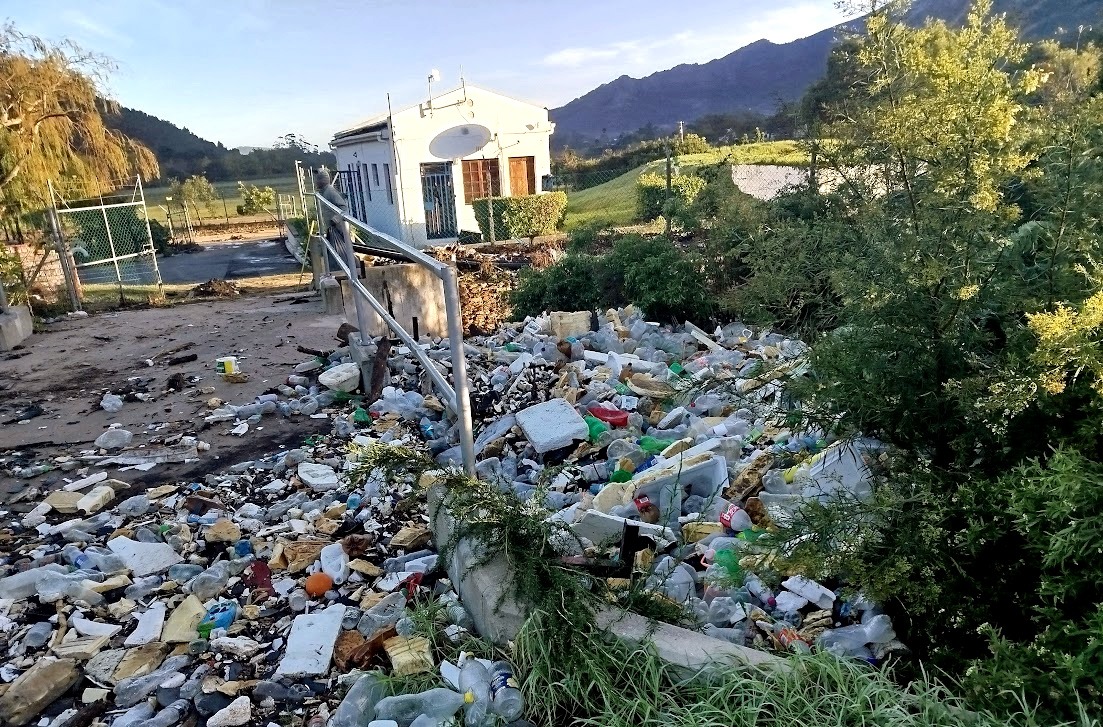
 Accumulation of solid waste at the Water Hub bridge that throttled the flow of the Stiebeuel River, resulting in excessive flooding and erosion. (Photo: Supplied)
 /file/dailymaverick/wp-content/uploads/2025/10/label-Op-Ed.jpg)
The recent flooding in Franschhoek has once again exposed the growing vulnerability of communities, farms and critical environmental infrastructure to extreme weather events. The intense rainfall was undoubtedly unusual for early winter, with 160mm reported in the valley from 10 to 12 May 2026. Most attention was focused on the flood damage to the formal town and the clearing operations that followed. Less attention was given to the flood damage along the Stiebeuel River, a relatively small stream during low flow, with its headwaters less than 3km from the town centre before discharging into the Franschhoek River. The river passes through a densely populated informal settlement with an estimated population of 12,000 – four times the size of the formal town of Franschhoek.
The storm event caused temporary flooding on the slopes of the informal settlement, but wind damage was more severe to the housing structures in the settlement. Residents have had their resilience tested again. On 23 and 24 September 2023, more than 300mm of rainfall was recorded in the catchment. The previous flood and most recent have revealed an uncomfortable truth: climate change and unseasonal weather events are colliding with failing waste management systems, underserved informal settlements and human behaviour in ways that are amplifying disaster risk and consequences.
The Stiebeuel River overtopped its shallow banks, causing extensive damage to nearby farms and to the Water Hub research site on the lower stretches of the river. In the aftermath, field observations indicate that large quantities of solid waste trapped within and beneath river crossings obstructed the natural flow of water, causing the river to back up and spill over its banks.
The lesson is becoming clear. Flood disasters in South Africa are not only natural events, but are also social and infrastructural failures from limited, sometimes overwhelmed municipal services in informal settlements.
Climate change and extreme rainfall events
Climate scientists have warned that climate change is increasing the frequency and intensity of extreme rainfall events across many parts of southern Africa and the Western Cape in particular. The extreme rainfall event from 10 to 12 May was caused by the deep wedge in the Atlantic High-Pressure System that brought low-pressure systems laden with moist air that met landfall in Cape Town and surrounding mountainous regions. Warmer atmospheric temperatures allow the air to hold more moisture, resulting in heavier downpours over shorter periods.
It’s a phenomenon that is increasingly common… Rivers effectively become convenient conduits for unmanaged waste.
In the mountainous catchments of Franschhoek, high-intensity rainfall rapidly generates runoff that flows into rivers and streams, and recharges groundwater. Under normal conditions, river channels and floodplains absorb and convey much of this water. However, when waterways are constricted or blocked, floodwaters quickly spill into surrounding areas.
There is no denying that the extreme rainfall initiated the flooding in Franschhoek, but human activities and poor management of rivers and their channels often determine how severe the impacts become.
River channels altered by solid waste
The Stiebeuel River flooding highlighted the significant role that solid waste plays in altering river hydraulics. Plastic packaging, bottles, discarded household waste and clothing materials, and other refuse accumulated in sections of the river channel and around culverts and bridge crossings in the lower sections of the river, driven by floodwaters.
As water levels rose during the storm, the accumulation of this solid waste acted as a temporary barrier. Water flow was restricted, river levels rose rapidly upstream and floodwaters burst the shallow banks and flowed into the adjacent agricultural lands.
The Franschhoek flooding should also be viewed as a warning about the consequences of persistent social inequality.
It’s a phenomenon that is increasingly common, especially in peri-urban areas of South Africa. Rivers effectively become convenient conduits for unmanaged waste. During storms, the waste transforms into a dangerous physical obstruction.
The damage caused to farms and the Water Hub is therefore not simply a matter of bad weather. It is also the outcome of river systems progressively degraded by pollution and poor management of the river corridor.
Underserviced settlements
The Langrug informal settlement reflects a broader national reality. Thousands of South Africans continue to live in densely populated settlements with inadequate municipal services, insufficient waste removal, limited stormwater infrastructure and access to safe sanitation.
/file/attachments/orphans/unnamed1_701489.jpg "Widespread erosion of the lower Stiebeuel River channel, destruction of fencing and accumulation of solid waste. (Photo: Supplied)")
Under such conditions, managing household waste becomes extremely difficult. Where bins are unavailable, collection is irregular, or illegal dumping sites proliferate, waste inevitably finds its way into nearby open spaces and rivers.
It is important to recognise that residents of informal settlements are themselves often the first victims of flooding and environmental degradation. Homes located near waterways face direct exposure to floodwaters, contamination and infrastructure damage.
Every piece of waste discarded into a river eventually returns to society in the form of pollution, ecosystem damage or disaster costs.
Blaming poor communities alone misses the larger systemic issue. Informal settlements emerge because of deep structural inequalities in housing, urban planning and economic opportunity. When municipalities fail to provide adequate services and infrastructure, environmental risks accumulate over time until a disaster occurs.
The Franschhoek flooding should therefore be viewed not only as a hydrological event, but also as a warning about the consequences of persistent social inequality.
Dealing with waste
Municipal support and human behaviour around waste disposal remain a critical component of environmental management. Across South Africa, rivers are routinely treated as dumping grounds. Plastic bottles, nappies, food packaging and household refuse are discarded into waterways despite widespread awareness of the consequences. This behaviour cuts across social and economic groups and reflects a broader erosion of environmental responsibility. Residents in informal settlements are not unaware of these impacts and consequences. The local municipality is unable to service the settlement efficiently because access routes are limited. Instead, large containers are placed near access roads and waste is removed twice weekly. They don’t solve the problem because the containers are too far from the houses, so the river becomes a convenient means of disposal.
Informal settlement upgrading must become a climate adaptation priority.
Changing behaviour requires much more than simple expectations that education and awareness alone can change the situation. Already schools, faith communities, local organisations and environmental initiatives in the settlement are doing what they can with limited resources to build a culture of environmental stewardship. However, the reality is simple: every piece of waste discarded into a river eventually returns to society in the form of pollution, ecosystem damage or disaster costs.
Finding solutions
The flooding in Franschhoek demonstrates the urgent need for integrated solutions that address climate adaptation, waste management and social inequality. That seems obvious, but the added dimension of flooding and damage may be just the catalyst to bring a fresh level of cooperation from a wider range of affected stakeholders. Possible solutions:
The Stellenbosch Municipality will need to prioritise reliable waste collection and recycling services. Preventing waste from entering rivers is far more effective and less costly than managing flood disasters afterwards which in this case is largely thrust on private landowners.
River maintenance and ecological restoration programmes need to be strengthened all along the Stiebeuel River. Clearing invasive vegetation, removing accumulated debris and restoring natural floodplains can significantly improve the capacity of rivers to absorb floodwaters safely and make room for the river.
Investment in nature-based solutions should be accelerated. Wetlands, retention ponds, biofiltration systems and rehabilitated riparian zones all help slow runoff, improve water quality and reduce flood risks. Facilities such as the Water Hub illustrate how ecological infrastructure can contribute to water resilience, but they also highlight the vulnerability of such systems when broader catchment management fails.
Informal settlement upgrading must become a climate adaptation priority. Safer housing, improved drainage, sanitation and waste services are essential not only for dignity and public health, but also for reducing disaster risk.
The floods along the Stiebeuel River were not caused by a single factor. They emerged from the convergence of extreme rainfall, inadequate infrastructure, unmanaged waste and entrenched inequality. As climate change intensifies, such compound disasters will become more common unless decisive action is taken. DM
Kevin Winter is an emeritus associate professor at the University of Cape Town and director of research at the Water Hub, Franschhoek.