



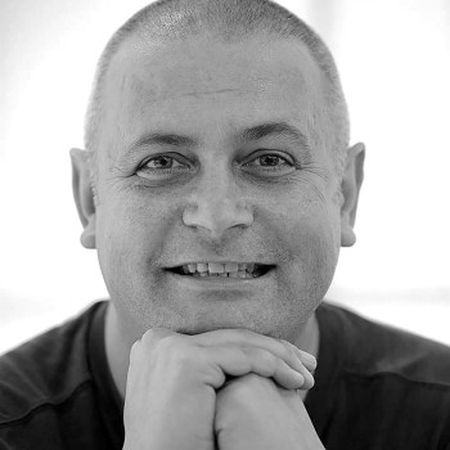
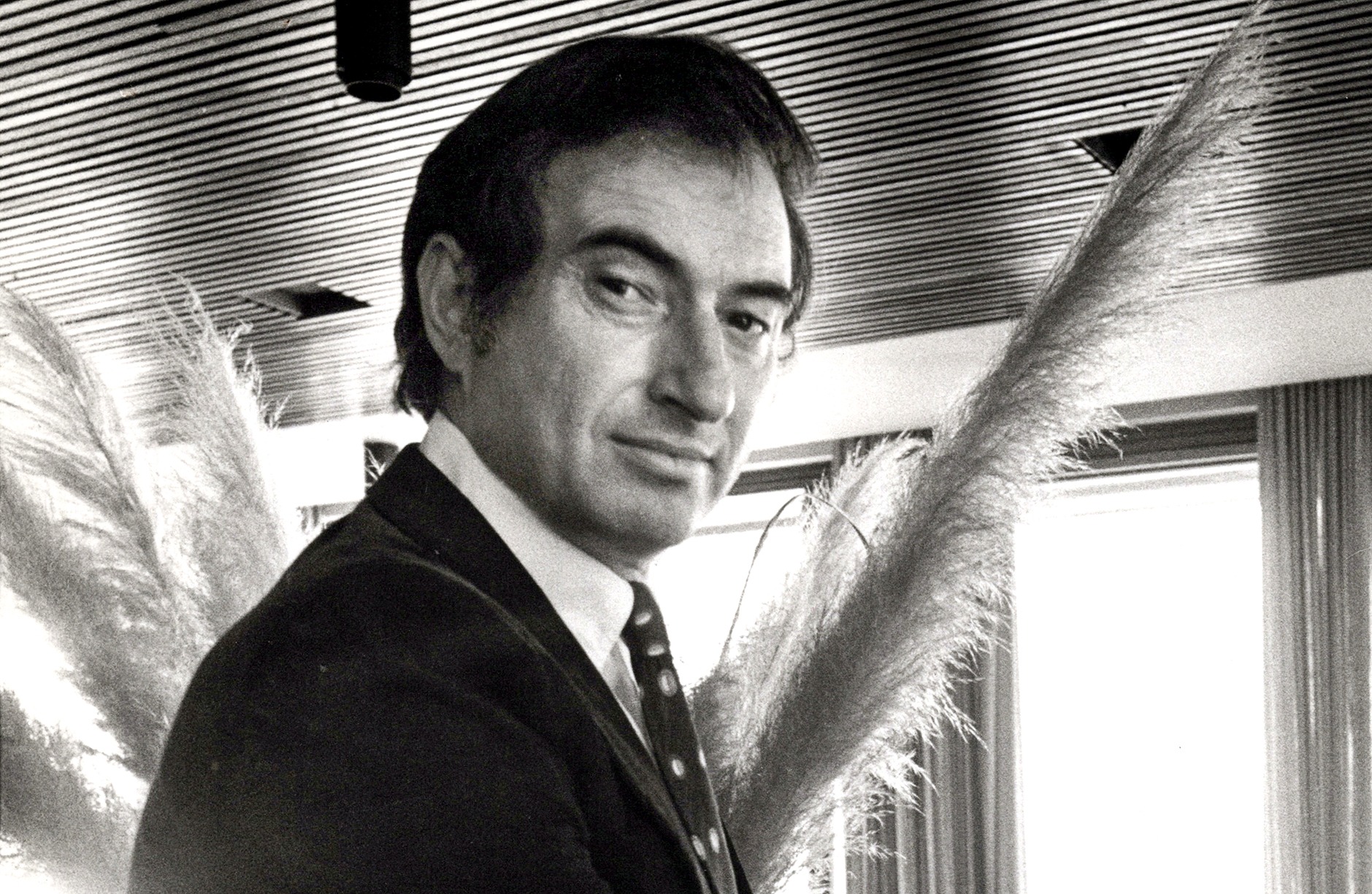
 Emiliano Sandri in the early 1980’s at La Perla in Sea Point. (Photo: La Perla Archive)
Emiliano Sandri, who died on 14 May aged 91, arrived in South Africa in 1956 with little more than a single suitcase, a sexy cosmopolitan attitude and an ambitious hotelier’s training.
Over the next seven decades, he would be a vital part of a team that helped transform a city whose dining culture was a dour affair into one of the world’s most cosmopolitan culinary capitals, largely through the creation of La Perla, the Sea Point institution that became a theatre of Mediterranean elegance on the Atlantic seaboard.
To comprehend the scale of his achievement, one has to recall Cape Town, and South Africa more broadly, in the mid-1950s. The restaurant world, along with much else, was a far cry from the vibrant tapestry it is today. That decade predates this obituarist’s birth, though I have a vivid childhood memory of the grim mood of the 1970s.
/file/attachments/orphans/smac_album_1_0050_645103.jpg "Emiliano Sandri outside original La Perla Waterkant Street early 1960’s. (Photo: La Perla Archive)<br>")
/file/attachments/orphans/image0016_779687.jpg "La Perla Waterkant Street circa 1959. (Photo: La Perla Archive)")
/file/attachments/orphans/smac_album_1_0023_196374.jpg "La Perla Sea Point circa 1970. (Photo: La Perla Archive)")
A brief diversion is necessary to grasp the spirit (or lack thereof) of those times, the one into which Sandri arrived. Sundays were particularly restrictive: no selling of alcohol, watching films, shopping, gardening or dancing – zilch. They were euphemistically called Sunday observance laws.
The Dutch Reformed Church pressured the boorish National Party leaders into creating laws that would make the above criminal offences. Such were the contradictions that you could bulldoze District Six, consign fellow South Africans to matchbox houses on the outskirts of towns, push people off rooftops, but woe betide anyone who dared to have any form of bonhomie, or human rights for that matter.
Entire suburbs suffered under that dreadful heavy hush comparable to the eerie silence after an atomic bomb drops. The streets emptied and the only refuge for those seeking a meal out was the formal hotel lunch, where you were allowed a glass of wine because you were eating. Menus were dominated by British and American staples: steak and eggs, mixed grills, hamburgers, chips and milkshakes.
Carveries lent an air of faux refinement to proceedings, while buffets offered food that had been simmering for hours. The greasy smell of reheated hotel food was a particular torture. Scrambled eggs took on a bluish tinge; pork sausages resembled scorched, fossilised fingers; coffee was bitter, and the milk was so hot it stripped your lips until you were left showing only teeth.
Mediterranean flavours had barely arrived. African cuisine was ignored or frowned upon, and appropriated Malay dishes such as bobotie were only for special occasions, because Afrikaner tables remained steadfastly loyal to rys, vleis en soetpampoen (overcooked rice, meat and sweetened pumpkin).
Sundays were a hostage situation. By late afternoon, it was Dante’s Inferno of boredom. Can you imagine entering this stifling apartheid milieu from hell in 1956 at the adventurous age of 21.
***
Emiliano Sandri was born on 9 January 1935 in Cossano Belbo, Piedmont, where the landscapes were dominated by rolling hills and vineyards. He completed his hospitality training at Bad Gastein in Austria, an impressive and upmarket spa and ski town in Austria’s Hohe Tauern Alps.
“He also worked at establishments in Rome, Turin and Santa Margherita,” says his son Baylon, who owns and manages La Perla. “In 1956, the South African government recruited skilled Italians to bolster the country’s fledgling hospitality sector, offering free passage,” he says.
Sandri accepted. He had always wanted to come to Africa. His first postings were humble but a welcome challenge: a waiter on the (then) Cape Town-Bulawayo railway route, followed by a stint at the restaurant in Parliament.
It was during these years that he forged a crucial friendship with the Italian businessman Cleto Saporetti, founder of the High Rustenberg Hydro in Stellenbosch. With Saporetti’s backing, Sandri opened La Perla in 1957 on Waterkant Street, in the heart of Cape Town’s theatre district, adjacent to the Alhambra.
La Perla was an immediate success. It introduced olive oil, garlic, pasta and a continental sensibility to a palate accustomed to vaalkos: bland, uninspiring fare. The restaurant became a playground for the affluent.
/file/attachments/orphans/smac_album_2_0018_917265.jpg "Emiliano and his wife Monica in the late 1960’s. (Photo: La Perla Archive)")
Its celebrity roll call reads like a mid-century Who’s Who: Marlene Dietrich, Liberace, Françoise Hardy, Cliff Richard and Charles Aznavour all dined within its walls. Sandri’s friendship with heart surgeon Chris Barnard, forged in the 1950s long before the first transplant, proved pivotal. Through Sandri, Barnard connected with Italian publishing magnate Giorgio Mondadori, organising a hero’s welcome in Italy for Barnard after the first transplant and cementing La Perla’s reputation as a hub of networking and savoir-faire. The restaurant’s clientele soon included Marcello Mastroianni, Sophia Loren and Gina Lollobrigida.
***
In 1969, after the original Waterkant Street building was demolished, La Perla relocated to its current premises on Beach Road, Sea Point. The new structure embodied late-1960s Mid-Century Modernism, with strong Le Corbusier International Style influences: a clean horizontal emphasis, expansive floor-to-ceiling glass, and a rectilinear concrete-and-plaster frame that prioritised volume, light and function. It was a first for SA, a modern restaurant with a grand interior overlooking the Atlantic Ocean.
The move coincided with a new chapter in Sandri’s personal life: his marriage to Monica Pepler, dubbed by newspapers the “Rose of the Kalahari”. Hailing from Upington, she possessed an elegance that the press likened to the Italian dolce vita ideal. Over the next four decades, Sandri opened and eventually sold numerous restaurants across the Western Cape: the first Italian establishments in Paarl, Stellenbosch and Rondebosch (where he also ran a subterranean jazz club), alongside Canzone Del Mare, Il Gambero, Trattoria, La Vita, San Marco and La Scala. He anchored developments for Old Mutual, including Cavendish Square and Dean Street, Newlands.
Yet, La Perla remained his chief passion. It became a training ground for generations of Cape Town chefs, waiters and managers, many of whom went on to shape the city’s culinary evolution. Sandri was renowned for his undaunted work ethic, known to stand beside his staff during service, sharing the same metal cups for coffee and earning their fierce loyalty.
It was of course during apartheid, and La Perla, even before 1994, started attracting guests from all colours and creeds. There were sport stars, politicians, actors, businesspeople and visual artists; its walls were adorned with works by Irma Stern, Edoardo Villa and Cecil Skotnes, who treated La Perla as a second home.
/file/attachments/orphans/Smac_album_3_703703.jpg "Sandri and Françoise Hardy in Sandri’s home in Bantry Bay in the early 1960s. (Photo: La Perla Archive)</p>
<p>")
/file/attachments/orphans/smac_album_1_0005_843304.jpg "La Perla Sea Point in the early 1970’s. (Photo: La Perla Archive)")
He ran his kitchens with precision and designed the cooking line to function like a railway carriage’s kitchen. Every station sat within arm’s reach. Chefs moved in straight lines, minimising steps, maximising speed. Staff remembered the lack of hierarchy. He spoke to dishwashers and head chefs in the same tone. His son Baylon recalled the blend of theatre and discipline that defined his father’s approach. His style was his flair, Baylon recalls. He was a bon vivant, a storyteller who understood that a restaurant lives on its food, its fashion, its celebrities – Sandri measured success by repeat bookings, not newspaper columns.
He cultivated regulars who returned for decades. Third and fourth generations of the same families claimed their usual tables. He encouraged staff to remember preferences, to greet patrons by name, to treat every meal as a continuation of a long conversation.
***
La Perla in Sea Point also had a long list of well‑known visitors over the years; commonly mentioned names include Michael Jackson, Sting, Elton John, Whitney Houston, Lady Linda Wong Davies, Graham Norton, Thabo Mbeki and (anecdotally) Elvis Presley.
This obituarist often spotted Vito Palazzolo, the Sicilian figure long described as a man with Cosa Nostra connections, moving through Cape Town in the years when the city’s edges between legitimate business and organised crime were more porous than anyone cared to admit.
In later years, his name would surface in international investigations and court proceedings abroad, where he was linked to mafia financial networks and eventually convicted in Italy. In Cape Town, however, he remained an oddly discreet presence, just like the late German fraudster Jurgen Harksen, also a regular.
As a child I was mesmerised by the beauty of Barbara Barnard, one of the star attractions on a Saturday night. My mother had a friend, a cross-dresser called Lady Petersen (real name the late Rian Smit from Klawer).
/file/attachments/orphans/image0015_409914.jpg "La Perla in the late 1990’s. (Photo: La Perla Archive)")
/file/attachments/orphans/caption_738630.jpg "Red neon glows against the twilight, with string lights twinkling in the trees. The Pearl still shines after nearly 60 years. (Photo: Tripadvisor / Wikipedia)")
Lady Petersen loved dressing up as Sophia Loren and bore a striking resemblance to her. His trick was to make a dramatic entrance and then speak to customers and waiters entirely in character, as Sophia Loren would of course, turning the room into a small stage where illusion and performance briefly passed for reality. Even the loo, with its vintage glamour, felt like a Film Noir set where one half-expected Gloria Swanson to appear at the top of the stairs.
Sandri on one occasion hosted Gianni Agnelli, once the head of Fiat and one of Italy’s most powerful industrial figures, at Table One, while Henry Ford II, then chairperson of the Ford Motor Company and heir to the Ford empire, sat at Table Two. The evening drifted easily between the language of boardrooms and spontaneous toasts, old money and new industry sharing the same air. He moved through it all with a quiet smile, allowing the room to settle into its own rhythm rather than imposing one of his own.
***
Decades on, the restaurant’s reputation has endured, even through periods of nostalgia-driven decline. One recent critic, who had previously dismissed La Perla as “a tired institution running on the fumes of old glamour”, returned with a visiting friend from London and found a transformed experience.
Seated beside an open sliding door overlooking the sea, they were met with crisp service, “molten, indecently good” lasagne, kingklip cooked to juicy perfection, and spaghetti with crispy broccoli and capers that struck the perfect balance.
“It felt like the old La Perla again,” the review noted. “Maybe someone read my last piece. Maybe the chef had an epiphany. Or perhaps the ghosts of the past, Chris and Barbara Barnard, had drifted back to bless the kitchen.” The verdict was unequivocal: five stars. “The pearl in La Perla glitters again.”
Beyond the restaurant, Sandri was a tireless cultural ambassador. He was awarded the title of Cavaliere Ufficiale by the Italian government for his contributions to Italian-South African relations.
/file/attachments/orphans/image0013_639053.jpg "Celebrating Italy winning the 1982 World Cup at La Perla. (Photo: La Perla Archive)")
/file/attachments/orphans/image0014_715084.jpg "Emiliano Sandri at the funeral of Victor Chetty (who worked at La Perla from 1962-2008), standing with Albert Maswali (worked at La Perla from 1959-2010) to his right, Daya Naidoo standing to his left (worked at La Perla from 1969-2025) and Theron Makila (worked at La Perla from 1960-2015) in front of him. (Photo: La Perla Archive)")
/file/attachments/orphans/GettyImages-2180411074_958957.jpg "Elton John was one of many celebrity guests who dined at La Perla. (Photo: Lester Cohen / Getty Images for City of Hope)")
/file/attachments/orphans/GettyImages-540230105_943242.jpg "French singer Charles Aznavour was another. (Photo: Michael Putland / Getty Images)")
/file/attachments/orphans/GettyImages-95587430_827687.jpg "Italian tenor Luciano Pavarotti (1935 - 2007) also dined at La Perla. (Photo: Michael Putland / Getty Images)")
/file/attachments/orphans/GettyImages-51312861_994700.jpg "Singer Whitney Houston was one of many celebrities to have dined at La Perla over the years. (Photo: Kevin Winter / Getty Images)")
He helped launch Cape Town’s first international cycle race, played a key role in establishing the Italian Club in the 1970s, facilitated direct Alitalia flights to Cape Town, co-founded Friends of Italy, and forged sporting links with the Italian rugby club Rovigo. In his later years, he devoted himself to his farms: Welbedacht outside Wellington, and Sandputs in the Kalahari, which held a special place in his heart.
The journalist and novelist Hilary Prendini Toffoli, author of the Pistola Trilogy, said Sandri belonged to a remarkable generation of young Italians who arrived in SA in the 1950s to work on the Blue Train and ended up transforming the country’s food culture. The historical novels follow Italian immigrants who left post-war Italy for SA, tracing their struggles, ambitions and the profound influence they had on their adopted country, particularly through food, hospitality and a new café culture that slowly took root in places like Johannesburg and Cape Town.
“Men like Emiliano Sandri came here in the 1950s and introduced South Africans to the food they had grown up eating. At a time when many people thought spaghetti came from a tin, they brought proper pasta, olive oil, espresso and a different way of dining. Their stories inspired my Pistola novels, but their real legacy is the way they changed how South Africans eat. Sandri is most likely the last of those men, and now he is gone,” she says.
The mid-1990s saw the second generation take over La Perla, later adding the Wijnhuis in Stellenbosch and purchasing the Sea Point building from Old Mutual in 1996, securing its future. He never fully retired. He visited the kitchens, tasted sauces, corrected portion sizes with a tap of his finger on a plate. He remained the anchor, even when others held the helm.
Emiliano Sandri is survived by his wife, Monica; his sons, Baylon, Paolo and Pepler; and seven grandchildren. In Italy, he is survived by a nephew, Stefano.
Sandri arrived in SA with one suitcase and left a forever changed culinary environment. Buon appetito! DM
Emiliano Sandri: 9 January 1935 to 14 May 2026.
Comments
Scroll down to load comments...