




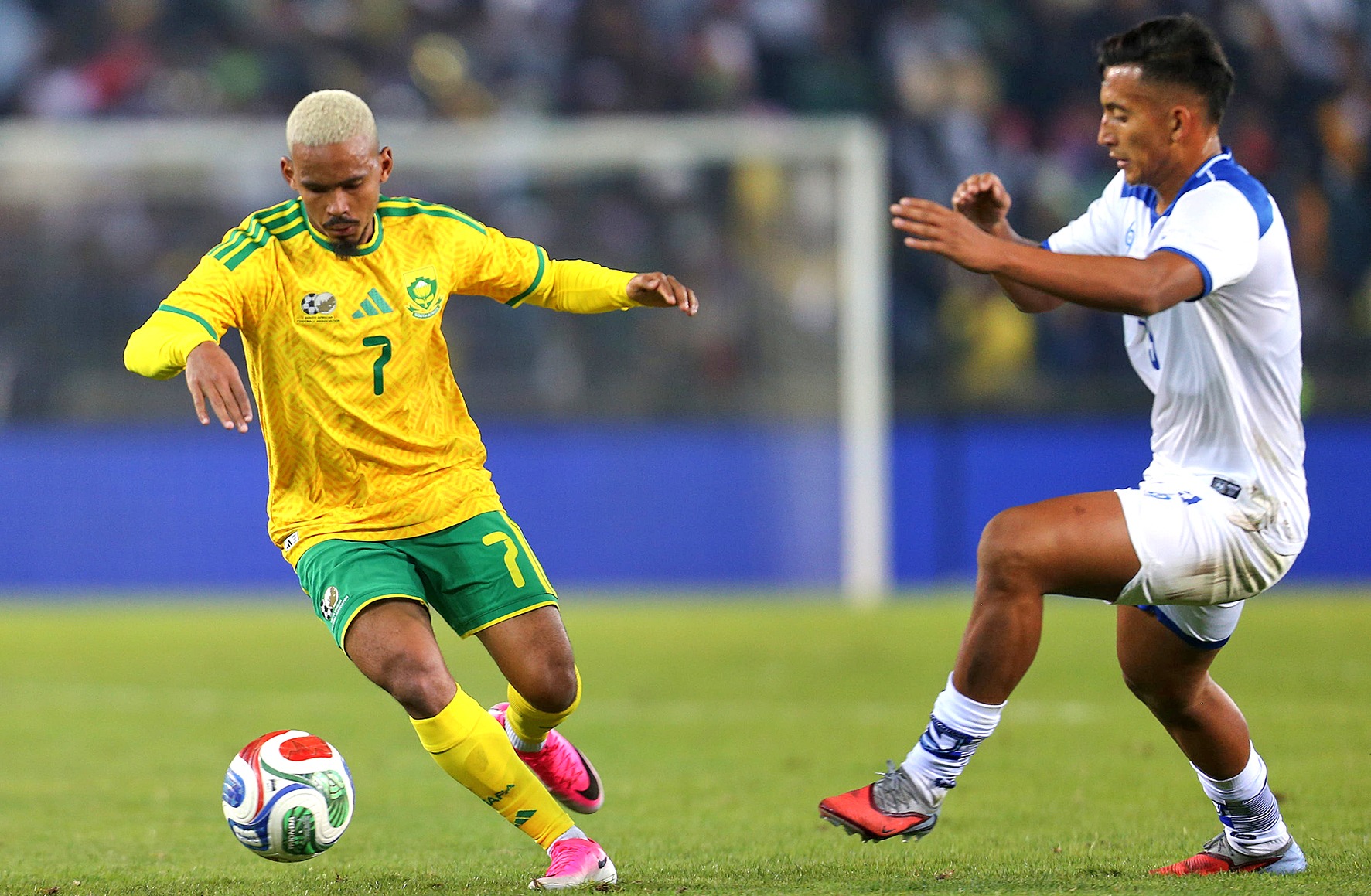
 Bafana’s Bafana’s Oswin Appollis on the ball during the friendly against Nicaragua at Orlando Amstel Arena on 29 May 2026. (Photo: Daniel Hlongwane / Gallo Images)
 Czechia
The plan
The role of the underdog has historically suited Czechia, and perhaps they can surprise people again — but they do not have many tools to do so. For a long time, the team has lacked technical players and rely too heavily on physicality, work rate, aggression and set-pieces. That was evident in the World Cup play-offs against Republic of Ireland and Denmark, winning both ties on penalties after two battling performances.
At the World Cup, long-distance travel, time-zone changes and altitude will play a major role, and there are question marks over how the team will cope with playing two matches in Mexico at around 2,000m above sea level — especially as the team base is in Dallas.
The spine of the team is experienced. Tomas Soucek remains the leader in midfield despite being stripped of the captaincy after the players failed to thank the fans after a 6-0 win against Gibraltar. “The fans have a full right to express their disagreement with the unsatisfactory performances in the recent games,” the FA said. “The reaction of the players should have been quite the contrary. They should have thanked the active fans.”
Ladislav Krejčí, the hard-tackling Wolverhampton centre-back, stepped in as captain and scored in both playoff matches and drove the team forward. In attack, Patrik Schick is expected to be the main offensive weapon, and his fitness improved towards the 2025-26 season.
There was embarrassment – a historic defeat to the Faroe Islands – during qualification, which led to the coach, Ivan Hašek, being sacked. Thankfully, many things improved after Miroslav Koubek took over.
The starting XI is likely to be a combination of players from the Premier League and other top European leagues, as well as those making a name for themselves in the Czech league. There is strong competition for the goalkeeping position with Matej Kovar helping PSV Eindhoven win the Dutch league and saving two penalties in the playoffs, but Braga’s Lukas Hornicek is pushing hard for his place. Lukas Provod and Pavel Sulc are among the players who should make things happen creativity-wise. The aim will be to get out of the group.
The coach
Miroslav Koubek was set to become the oldest coach at a World Cup at 74, but Dick Advocaat, four years his senior, was reappointed to lead Curaçau at the tournament. Even so, Koubek is at the peak of his powers. It took him a long time to be recognised – he was coaching in the lower Czech leagues while working as an insurance broker until his 50s, gradually working his way up to the Czech top flight. He eventually managed both Slavia Prague and Viktoria Plzen, winning the league with the latter in 2015. It came at a price, though, as he had promised his players he would get a small tattoo on his arm as a memento of the triumph.
He can get the absolute maximum from limited resources and continues to move with the times, following the latest trends. He uses data and is respected by players, fans and the media alike, not only because of his achievements, but also his dry sense of humour, which can liven up otherwise dull press conferences.
Star player
Patrik Schick remains Czechia’s biggest star and international reference point. The Bayer Leverkusen striker combines elegant movement with outstanding finishing and can decide matches almost on his own. Injuries have occasionally disrupted his rhythm at times, but his quality is unquestionable. Schick shot to fame during Euro 2020, scoring five goals, one of them among the greatest in the history of the tournament as he found the net from the halfway line against Scotland. For Czechia, he is not only the main source of goals but also the player opponents fear most. Sixteen Bundesliga goals in 2025-26 show that he is in form.
/file/attachments/orphans/2276556511_545802.jpg "Patrik Schick, who plays his club football for Bayer 04 Leverkusen, will be a key player for the Czechs. (Photo: Lars Baron / Getty Images)")
One to watch
Pavel Sulc has rapidly developed into the face of the new Czech football generation. After emerging as a star at Viktoria Plzen, the attacking midfielder joined Lyon last year and has had an outstanding first campaign in Ligue 1. Sulc brings unpredictability and technical flair between the lines – and he can score, create chances and press aggressively. Lyon fans appreciate his intelligence and clinical finishing, and while he may not be a household name outside Czechia and France, that could change after the World Cup.
Unsung hero
Tomas Holes rarely attracts headlines outside Czechia yet coaches and teammates value him enormously. The Slavia Prague player is tactically intelligent, disciplined and capable of playing both in midfield and defence. The 33-year-old does much of the invisible work that allows more creative players to shine. He covers space, wins second balls and helps maintain the team’s structure under pressure. Czech supporters still remember his outstanding performances at Euro 2020, when he successfully kept big names quiet and even scored in the Last 16 game against the Netherlands. He may not be a star but he is exactly the kind of player every team needs.
Probable starting XI
(3-5-1-1)
Kovar; Holes, Hranac, Krejci; Coufal, Provod, Soucek, Darida, Zelený; Sulc; Schick.
What to expect from the fans
Czech supporters are unlikely to travel in large numbers in the same way as, say, England, Argentina or Mexico, but those who do are usually passionate, loud and heavily beer-fuelled (but not in a violent way). They traditionally sing simple chants such as “Cesi do toho!” (“Come on, Czechs!”) and create a friendly atmosphere mixed with self-deprecation and dark humour. Violence is very rare around the national team compared with club football. Just reaching the World Cup was worthy of heavy celebration, and not many fans will have the financial resources to travel to the US and Mexico. The ones who make it, though, will not be quiet.
Relationship with the US/Trump
In general, Czech society remains one of the more pro-American in central Europe because of historical ties after the 1989 Velvet Revolution and Nato membership 10 years later. It is true that the current Czech president Petr Pavel has been rather critical of Trump and even described him as “a truly repulsive human being”, but fans travelling to the United States are expected to focus far more on ticket prices, accommodation and transport costs than on politics. — by David Čermák
Mexico
The plan
Mexico will arrive at their home World Cup carrying a strange mixture of excitement, pressure and the need to reconnect with themselves. Co-hosting the tournament alongside the United States and Canada spared them the grind of a long qualifying campaign, but it also removed the chance to build competitive rhythm. That is why their manager, Javier Aguirre (“El Vasco”), has turned friendlies and regional competitions into character tests.
El Vasco’s footballing idea is far more pragmatic than aesthetic. Mexico do not try to dominate through endless possession; they play with intensity, aggressive pressing and quick transitions. Aguirre wants to make his team uncomfortable to face, something that became evident in the recent friendlies against Portugal and Belgium. As he puts it: “At a World Cup, the team that plays the prettiest football does not always win. The team that knows how to compete does.”
A flexible 4-3-3 that can become a 4-2-3-1 or even a 4-4-2, depending on the opponent, is most often used. Edson Álvarez operates as the midfield anchor, Erik Lira acts as the silent worker who balances everything, while Gilberto Mora, Brian Gutiérrez and Álvaro Fidalgo provide movement between the lines. Out wide, Alexis Vega and Roberto Alvarado bring pace and unpredictability, while Raúl Jiménez and Armando González alternate as attacking references.
Defensively, Mexico have more clarity. Johan Vásquez has established himself as the most reliable centre-back thanks to his Serie A experience with Genoa, while César Montes provides leadership and aerial dominance. At full-back, Jesús Gallardo and Israel Reyes maintain the profile of the modern Mexican defender: attack-minded, intense and constantly involved on both sides of the pitch, especially Reyes, who has adapted from centre-back to right-back.
But the biggest storyline surrounding Mexico is still Raúl Jiménez. Beyond football, he represents resilience. The Fulham striker recently revealed the physical nightmare he endured before the 2022 World Cup in Qatar. “It was very difficult, because it started in 2019… I played from September or October 2019 with pubalgia,” he told Claro Sports.
The situation worsened after an injection caused an infection: “One night I woke up in a lot of pain… I practically couldn’t walk.” But he rejected suggestions he should skip the World Cup and focus on recovering properly. “After everything I had gone through, for someone to tell me: ‘You can’t,’ it was impossible for me to accept it,” Jiménez said.
Such resolve shows why Aguirre continues to value him so highly. Mexico may no longer boast the most talented generation of players, but they do have an experienced squad used to constant criticism and the pressure of playing at home. The biggest challenge will be psychological: turning the pressure of the Azteca into positive energy rather than anxiety.
/file/attachments/orphans/GettyImages-2278995011_505596.jpg "Luis Romo of Mexico (right) during a warm-up game against Australia at Rose Bowl Stadium on 30 May 2026 in Pasadena, California. (Photo: Luiza Moraes / Getty Images)")
The coach
Javier Aguirre will manage his third World Cup with Mexico after Korea/Japan 2002 and South Africa 2010. Few coaches understand the pressure surrounding El Tri better than him. With managerial experience in Spain, Japan and the Middle East, El Vasco has always been known as a pragmatic, direct and emotionally strong coach. He does not promise spectacle, he promises competitiveness. His return in 2024 was intended to restore character and stability after years of inconsistency. Aguirre emphasises a robust mentality: “You have to learn how to suffer,” he says. Rather than building a dazzling national team, he wants one that is resilient, uncomfortable to face and tough.
Star player
Raúl Jiménez remains the emotional face of the Mexican national team. The Fulham striker represents far more than experience and goals: he symbolises survival. After suffering a fractured skull in 2020 and battling the physical problems that shaped his road to Qatar 2022, many believed he would never truly return. Jiménez never accepted that idea, though. His ability to play with his back to goal, combine with teammates and deliver in key moments remains crucial for Mexico. Beyond football, though, Jiménez brings quiet leadership and a story that commands respect inside the dressing room.
/file/attachments/orphans/2277996976_877777.jpg "Mexico star Raul Jimenez, who plays for Fulham, heads the ball against Newcastle United at Craven Cottage. (Photo: Peter Nicholls / Getty Images)")
One to watch
Armando González could become one of the surprises of the tournament. The Chivas striker exploded on to the scene after winning the Golden Boot in the Apertura 2025 and finishing runner-up in the scoring charts during Clausura 2026. His “La Hormiga” nickname came from a childhood story: he used to be afraid of ants, yet now he plays without fear: aggressive, relentless and constantly pressing defenders. His development has already attracted European attention, with clubs such as Borussia Dortmund and Feyenoord monitoring his progress. Young and imperfect, he possesses something difficult to teach: constant hunger and the personality to compete under pressure.
Unsung hero
Erik Lira rarely makes headlines, but has become a fundamental piece of the national team. He organises, recovers possession, balances the midfield and handles the invisible work that allows others to shine. Aguirre particularly values his tactical discipline and competitive mentality. After facing Portugal and Belgium, Lira said something that resonated with Mexico supporters: “Anyone who wants to come to the Azteca and win is going to leave dead.” He also said recently: “I raised my hand so Javier knows I’m another soldier ready for war.” That line captures him perfectly: he does not seek the spotlight, but he is always ready for the fight.
Probable starting XI
(4-3-3)
Raúl Rangel; Israel Reyes, César Montes, Johan Vásquez, Jesús Gallardo; Álvaro Fidalgo, Erik Lira, Gilberto Mora; Roberto Alvarado, Raúl Jiménez, Brian Gutiérrez.
What to expect from the fans
Mexico will have one of the largest and loudest fan bases at the World Cup, especially at the Estadio Azteca. The atmosphere is usually a mix of celebration, pressure and national pride: green shirts, oversized sombreros, flags and non-stop chants. But Mexico supporters can also be demanding and impatient. Against Portugal, sections of the crowd booed their own team and ironically chanted “olé” for the opposition when the performance failed to impress.
The Azteca can become an emotional advantage or a psychological burden if the team start showing doubt. The relationship between the national team and its supporters has grown increasingly tense due to the lack of success at major tournaments.
Relationship with the US/Trump
Co-hosting with the United States inevitably adds a political backdrop to the tournament. The relationship between the countries continues to be shaped by migration debates, economic tensions and the figure of Donald Trump, who for years used Mexico as a recurring theme in his political rhetoric.
Within the national team, however, the public approach has been to avoid direct political confrontation. Players and federation officials prefer to speak about cultural unity and the privilege of staging a World Cup.
Among supporters, there is frustration over ticket prices, migration controls and travel logistics within the US. Even so, the tournament will provide a unique opportunity to showcase the cultural connection between both nations.
There will be rivalry, tension and political noise, but also millions of Mexicans celebrating and turning American cities into extensions of the Azteca if Mexico make an unexpected deep run in the tournament. — by Jesús Valdéz
/file/attachments/2992/fifa_2026_groups_222141.png)
South Africa
The plan
Under Hugo Broos, this South African side has moved from being a timid team that could barely qualify for major tournaments to one that has now reached three in a row, taking in the Africa Cup of Nations (2023 and 2025) and this year’s World Cup.
The Belgian was appointed in 2021, at a time when South Africa had not reached a World Cup in 11 years. Back in 2010, of course, they became the first African country to stage the tournament. In fact, the last time Bafana Bafana qualified for the Fifa showpiece was back in 2002.
This time, they had to dig deep as an administrative error saw them retrospectively forfeit a match against Lesotho, which they had won 2-0 on the pitch. They had, however, inadvertently fielded the suspended Teboho Mokoena in that game and were docked three points, meaning a nervous wait until the end of the group. As it happened, South Africa pipped Nigeria by one point to top the group.
“It’s been an amazing journey, with a lot of good and bad moments where we had to draw strength from each other,” the captain and goalkeeper Ronwen Williams told SABC Sport after qualifying had been clinched.
Grouped with co-hosts Mexico, as well as South Korea and Czechia, South Africa’s prospects of reaching the knockout phase for the first time appear remote, however.
“It will be a very good experience for our team,” Broos said. “It’s something we need, to play against such teams. We will learn a lot and then we will see. In football, anything is possible. We will fight, like we have done in recent years.”
South Africa’s squad is made up mainly of players in the domestic league, with forwards Relebohile Mofokeng and Oswin Appollis two important players. Counter-attacks will be key.
/file/attachments/orphans/TL_2574838_651975.jpg "Bafana head coach Hugo Broos. (Photo: Zamani Makautsi / Gallo Images)")
The coach
A former defender and Belgium international, Hugo Broos represented only two clubs – Anderlecht and Club Brugge – during an 18-year playing career. After retiring in 1988, he moved into coaching, taking charge of clubs in Belgium, Greece and Turkey.
His first foray into international coaching came when he took over a Cameroon team in transition and led it to victory at the 2017 Africa Cup of Nations.
Four years later came the offer from South Africa – and he has transformed the nation’s football team. Bafana Bafana have gone from playing in empty stadiums to selling out arenas. “People love Bafana Bafana again, and they are coming to the stadium to support us,” he says.
Star player
Broos and his technical team have built a side that makes it difficult to pinpoint a true star player. This is a group who focus on teamwork.
But there are a handful of players that form the spine of the team, including Ronwen Williams in goal and the defender Khuliso Mudau. However, the glue of South Africa at the moment is the Mamelodi Sundowns midfielder Teboho Mokoena. The 29-year-old provides a healthy balance between defence and attack, as well as contributing from set-pieces.
/file/attachments/orphans/TL_2564934_994294.jpg "Teboho Mokoena, who plays for Mamelodi Sundowns, will be a key figure for Bafana at the World Cup. (Photo: Lefty Shivambu / Gallo Images)")
One to watch
Relebohile Mofokeng is one of the most popular players in South Africa, revered by supporters of his club, Orlando Pirates. However, he is yet to truly show what he is made of for the national team.
The World Cup will provide him with this platform, and Broos has suggested the 21-year-old will be handed a bit more responsibility in North America. Mofokeng brings goals, assists and flair to the field. Now it is up to him to deliver on the biggest stage of them all.
Unsung hero
Burnley striker Lyle Foster does not receive the praise he deserves when representing his country. Maybe that is because he does not have the flair and flamboyance of some of his more popular teammates.
Yet, as the focal point of South Africa’s attack, Foster’s contribution is vital. Even when he does not directly contribute with a goal or assist, his aerial prowess and hold-up play are crucial to Bafana Bafana’s forward play.
Probable starting XI
(4-3-3)
Ronwen Williams; Khuliso Mudau, Ime Okon, Mbekezeli Mbokazi, Aubrey Modiba; Thalente Mbatha, Sphephelo Sithole, Teboho Mokoena; Oswin Appollis, Lyle Foster, Tshepang Moremi.
What to expect from the fans
Just like South Africa’s multi-coloured flag, the country’s football supporters bring a personality that is vocally and visually vibrant. One of their most popular songs is Shosholoza, which originates from South Africa’s miners during British colonial rule.
However, because of the high cost of travel to North America, there will be little support for the team at the game. That said, the department of sport has sourced private funding to send 20 lucky supporters to the team’s opening match against Mexico.
Relationship with the US/Trump
The US’s relationship with South Africa has been extremely frosty during Donald Trump’s administration.
Under his leadership, the American government has claimed there is a genocide against white people in South Africa and created refugee and asylum programmes for white Afrikaners seeking to leave the country.
Only a handful of South Africans have taken up the offer. A 2025 trip to the White House by President Cyril Ramaphosa, aimed at dispelling the fake news, has not stopped the US administration from expressing its dislike for South Africa. — by Yanga Sibembe
South Korea
The plan
Hong Myung-bo’s side stuck rigidly to a back four throughout the qualifiers, only pivoting to a back-three in the second half of the final match after their spot in the finals had already been secured.
This tactical shift, appearing only after the heavy lifting had been done, leaves the team grappling with a desperate lack of preparation time and cohesion – if they are to start with the tournament in a 3-4-3.
One of the problems with that formation is the lack of wing-backs capable of delivering high-level performances in such a system. This scarcity of options is why so much intrigue surrounds Borussia Mönchengladbach’s Jens Castrop and where he will play; his versatility means he can be deployed both centrally or out wide – that could make him the ultimate wild card in North America.
/file/attachments/orphans/2277544384_721945.jpg "Son Heung-Min, playing for Los Angeles Football Club, is still the heartbeat of the South Korea team. (Photo: Shaun Clark / Getty Images)")
In a recent interview with KBS, Hong tried to dispel the nervousness surrounding his formation, saying: “I think it’s difficult to rely on just one tactical approach, and I have experience of that. There’s about a six-day break after the first match, so we can assess the strength of our next opponent and adapt our formation to approach the game in different ways.”
Adding to the anxiety is the precarious state of the team’s spine; key figures such as Son Heung-min, Kim Min-jae, Lee Kang-in, Lee Jae-sung and Hwang In-beom are all battling a cocktail of injuries, erratic club form and even being relegated to the bench.
The situation is particularly dire in the central midfield, where a string of injuries has already ruled out several candidates. In addition, Hwang In-beom has spent much of the season struggling to find his rhythm amid recurring physical setbacks.
Strong in qualifying, South Korea did not lose any of their 16 matches, finishing six points ahead of Jordan in the second group stage, and there are hopes of getting out of a group that consists of co-hosts Mexico, South Africa and Czechia. “Our first goal is to advance to the round of 32. After that, anything could happen,” says Hong.
The coach
South Korea’s 2022 Qatar campaign was defined by an admirable brand of football, holding their own against Uruguay and orchestrating a dramatic victory over Portugal to reach the knockout rounds.
However, the subsequent era has been one of administrative chaos. The appointment of Jürgen Klinsmann by the KFA president ended in complete failure, the German lasting less than a year.
His successor, Hong Myung-bo, then started amid a whirlwind of selection controversies. Hong may be one of the nation’s greatest footballing icons, but he currently operates without the vital oxygen of neither media nor public support. He has already been in charge for a World Cup, in 2014, which ended without a win. Can he exorcise those ghosts in North America? The outlook, quite frankly, remains bleak.
/file/attachments/orphans/GettyImages-2278349921_756846.jpg "Hwang In-Beom shoots against Trinidad and Tobago during the second half of an international friendly match at BYU South Field on 30 May 2026 in Provo, Utah. (Photo: Chris Gardner / Getty Images)")
Star player
Son Heung-min. Sonny, Sonny, Sonny. There is perhaps no figure in the history of South Korean sport more universally adored. His achievements – a Premier League Golden Boot winner and being the captain of a Europa League-winning side among them – are those of a generational talent who has consistently delivered for the national team. Yet, for all his individual brilliance, a major international trophy remains absent from his and his country’s cabinet.
That won’t change in North America, but the nation still waits with bated breath to see if he can shed his recent troubles at LAFC and once more find redemption on the world stage.
One to watch
Oh Hyeon-gyu. If 2022 was the year of Cho Gue-sung, 2026 surely belongs to Oh. Last year, he was set to join Stuttgart for £24-million, but the Bundesliga club suddenly pulled out because of concerns over an old knee injury.
“I have not had any problems with my knees since high school,” said the former Celtic striker, who joined Besiktas in January instead. Oh has maintained a rich vein of form in Turkey, positioning himself as a formidable challenger to Son Heung-min for the starting striker role as the finals approach.
Unsung hero
Lee Jae-sung. To label a player with more than 100 caps as an unsung hero might seem a contradiction, yet Lee’s immense contribution to the Taeguk Warriors has often been overshadowed by more glamorous names.
Regardless of who holds the clipboard, Lee is a permanent fixture on the team sheet – a tenacious, cerebral presence who balances attacking flair with defensive grit.
Having only recently returned from a lengthy injury layoff, the 33-year-old veteran is preparing to ignite one final flame alongside his lifelong peer, Son.
Probable starting XI
(3-4-3)
Kim Seung; Hanbeom (Yoomin), Minjae, Kihyeok; Youngwoo, Inbeom, Seungho (Jinseop), Taeseok (Castrop); Kangin, Sonny, Jaesung.
What to expect from the fans
Mexico remains a world away – not just geographically, but emotionally too. Despite the staggering popularity of BTS across the region, the likelihood of South Korean fans making the arduous pilgrimage is slim. This reluctance isn’t merely a matter of distance; it is a reflection of a fractured relationship. At this precise moment, neither the KFA nor Hong Myung-bo can inspire the kind of devotion required for such a journey.
Relationship with the US/Trump
In his first term as president, Trump often talked about the Koreas. His pursuit of a Nobel Peace Prize made him surprisingly amicable toward the then leaders of the North and South, earning him a peculiar brand of popularity in Seoul.
His second term, however, has struck a different chord. A public once intrigued is now fatigued by a tenure defined by tariffs and erratic foreign policy. Reports suggesting his administration pushed for Italy to replace Iran in the World Cup have only served to cement his image as a reckless disruptor in the eyes of the Korean public. — by Hyung Seo
DM