



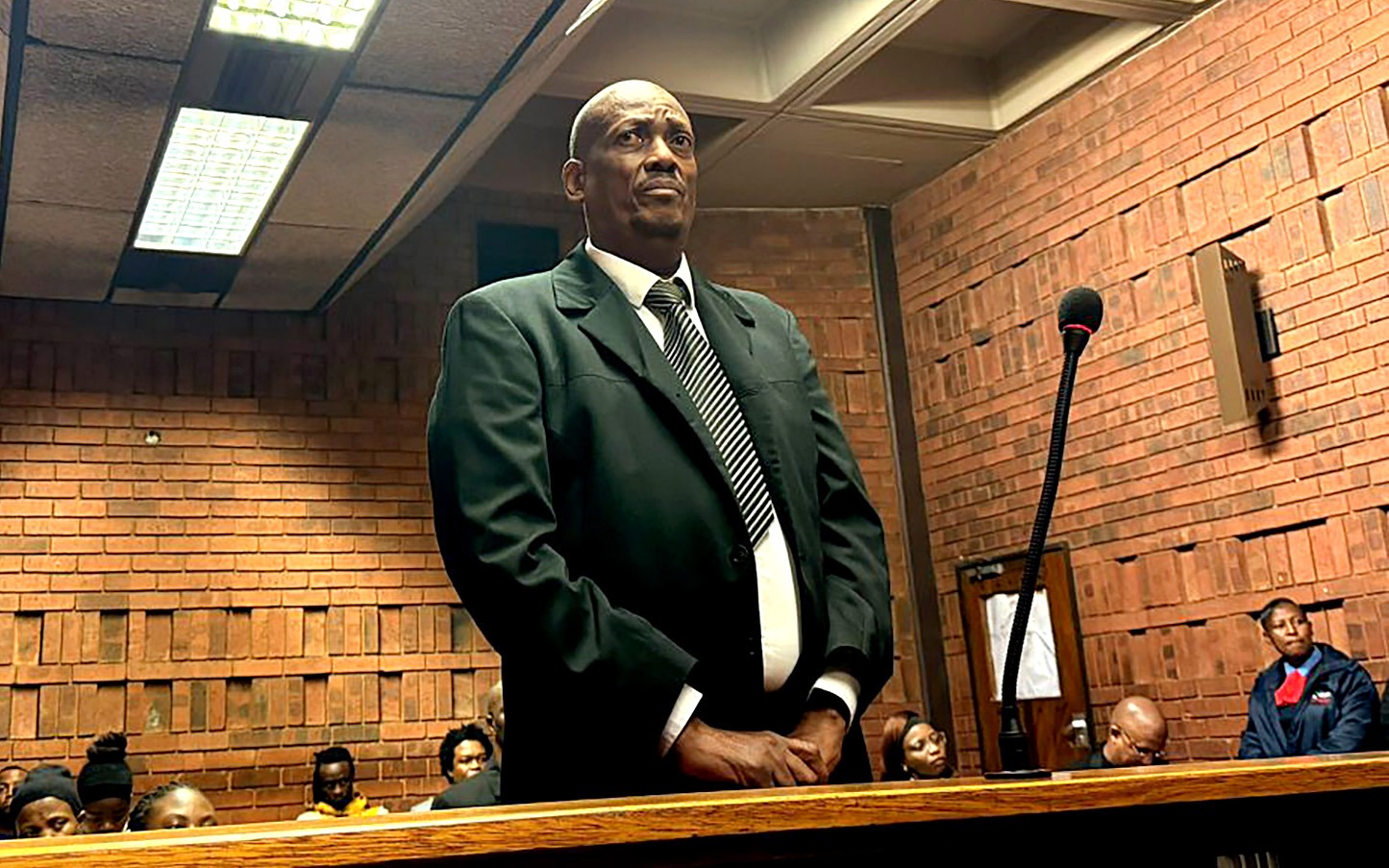
 Captain Laurence Makgotloe at the Pretoria Magistrates' Court on 25 May.
(Photo: Inside Politics / Wikipedia)
Captain Laurence Makgotloe at the Pretoria Magistrates' Court on 25 May.
(Photo: Inside Politics / Wikipedia)Captain Laurance Makgotloe, a police forensic analyst, is facing charges for allegedly tampering with crucial ballistic evidence in the April 2024 murder of engineer Armand Swart. The allegations against Makgotloe came to light during testimony at the Madlanga Commission of Inquiry.
Following an investigation, the commission’s Recommendations Task Team arrested Makgotloe at his Pretoria home on Friday, 22 May. National police spokesperson Brigadier Athlenda Mathe confirmed that during the arrest, team members seized state property, including ballistic reports, rounds of ammunition and other evidence relevant to the case.
Makgotloe made a brief appearance in the Pretoria Magistrates’ Court on Monday, 25 May. The matter was postponed to Tuesday, 2 June, for a formal bail application.
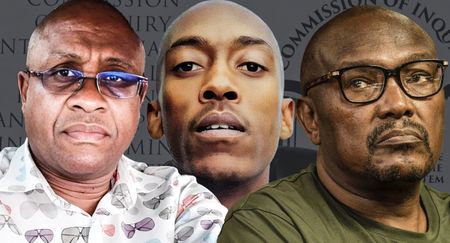
The Madlanga Commission had previously heard testimony about the alleged tampering of forensic evidence linked to the murder of Swart.
Central to this testimony was evidence by witnesses A and B, detectives attached to the SAPS Gauteng Organised Crime Unit, who raised concerns about the ballistic investigation conducted at the SAPS Forensic Science Laboratory in Pretoria.
According to Witness A, police recovered 15 rifle cartridges in a plastic bag, along with a firearm found inside a Mercedes-Benz Viano allegedly belonging to Warrant Officer Michael Pule Tau, one of those arrested for Swart’s murder.
Investigators also seized an AK-47, several pistols, and a Hyundai i20 allegedly used in the murder. While the initial ballistic examination in Pretoria allegedly failed to establish key links, a second analysis conducted at the Amanzimtoti Forensic Science Laboratory later linked the firearms to 30 serious and violent crimes.
/file/attachments/orphans/G3uKbT6WIAA28uL_326504.jpg "Michael Pule Tau. (Photo: X)")
Detectives allege evidence tampering
The testimony of witnesses A and B painted a troubling picture of alleged interference in investigations targeting organised crime networks.
Appearing before the Madlanga Commission in October 2025, the two detectives raised concerns about the handling of critical ballistic evidence, particularly 15 cartridges recovered from the Swart murder scene.
The detectives testified that the cartridges were handed over for forensic analysis but were omitted from a ballistic report, despite being acknowledged as received.
Witness A told the commission he believed the omission was deliberate, describing the cartridges as a crucial piece of evidence that could have linked suspects to multiple crime scenes.
“I believe there was tampering aimed at not linking the suspect to this case,” he testified.
/file/attachments/orphans/04-armand1_165052.jpg "Murdered engineer Armand Swart. (Photo: Supplied)")
The report that raised red flags
Witnesses A and B testified that when they collected the ballistic report from Makgotloe in Pretoria, he told them the original report was incorrect and had to be rewritten, forcing them to wait more than an hour for a revised version.
The detectives further alleged that Makgotloe told them the firearms linked to the Swart investigation had surfaced in numerous violent crimes and that discussing the matter could be dangerous.
Their suspicions deepened when they discovered the report contained no findings on 15 cartridges recovered during Tau’s arrest. Seeking a second opinion, they took the exhibits to a KwaZulu-Natal forensic laboratory, where a ballistic expert reportedly noted that although the cartridges had been submitted for analysis, they were absent from the results section.
A particularly troubling aspect of Witness B’s testimony detailed the hurdles investigators faced while trying to secure the original ballistic report for disclosure.
While prosecutors already held an electronic copy, the physical original had vanished from the South African Police Service ballistics laboratory. Witness B explained that laboratory officials put investigators through a lengthy tracing process to find the missing document. Meanwhile, detectives were growing increasingly concerned, trying to determine why expected ballistic linkages were missing from the findings they did have.
Seeking clarity, investigators questioned a Colonel Lesu. However, his response only raised more red flags. Lesu reportedly told them, “I cannot ... explain to you where the Integrated Ballistics Identification System is concerned.”
He did, however, confirm that the report had been deleted — on 6 December 2024.
According to the testimony, 6 December 2024, was a pivotal day for the investigation for two reasons. First, it marked the arrest of Katiso “KT” Molefe, an alleged member of the Big Five cartel and a key accused in the Swart murder case.
/file/dailymaverick/wp-content/uploads/2025/09/ED_565542.jpg "Katiso ‘KT’ Molefe. (Photo: Rosetta Msimango / Gallo Images / News24)")
Second, it was the same day law enforcement executed a search-and-seizure raid at the Centurion residence of organised crime suspect Vusimuzi “Cat” Matlala. That operation stemmed from intelligence gathered during the investigation into the kidnapping of Pretoria businessman Jerry Boshoga, who had implicated Matlala — his own business partner — in his abduction.
A widening investigation
Witness B testified that gaining access to the suspects’ firearms, cellphones, and related intelligence allowed investigators to link the men accused of Swart’s murder to numerous other crime scenes.
A major breakthrough occurred when subsequent ballistic analysis on the recovered weapons yielded at least 30 links to other cases — a number expected to rise as investigations continue. This evidence suggested that the firearms were tied to a broader series of serious and violent crimes, significantly expanding the scope of the case well beyond a single murder.
The true scale of these ballistic connections became clear on 4 December 2025, when the National Prosecuting Authority announced that Molefe and his co-accused — Tau, Floyd Mabisela and Musa Kekana — were facing 35 charges, including murder, conspiracy to commit murder, and the unlawful possession of firearms and ammunition.
The State further alleges that Molefe orchestrated the murder of Oupa Sefoka, popularly known as DJ Sumbody, who was shot dead in Woodmead, Johannesburg, on 20 November 2022.
According to the State, forensic evidence linked the high-calibre rifles used in Sefoka’s murder to several other high-profile killings, including those of Hector Buthelezi (DJ Vintos), Don Tindleni and Swart.
Communication with a prisoner
Witness B also testified that analysts tracking call data uncovered frequent communication between Tau and an inmate at the Groenpunt Correctional Centre using a prison landline.
“When we interviewed this inmate, he [confirmed] it was him communicating with Tau even after [he] was released,” Witness B stated.
The inmate dropped a bombshell during questioning, revealing that he already knew about the interference with the ballistic report — a detail investigators had kept quiet.
“At this point, nobody knew about our struggles in getting the ballistic reports and linkages,” Witness B testified. “But we were told by an inmate that he was told by Tau that Molefe is the one who made us not find the ballistic reports.
“The inmate reported the following: interference with the ballistics report. Mr Tau informed the inmate that Mr Molefe had arranged that we get the incorrect report.”
Makgotloe’s version
Appearing before the commission on 2 February, Makgotloe denied deliberately manipulating ballistic evidence linked to the murder of Swart.
He told the commission that he, along with a Warrant Officer Masha, had attended the Vereeniging murder scene.
Investigators recovered 22 ballistic exhibits from the Vereeniging crime scene: 14 pieces of 9mm ammunition (10 cartridge cases and four bullets) and eight pieces of AK-47 ammunition (six fired bullets and two bullet cores).
In his evidence, Makgotloe pointed out a strange anomaly at the site: “From our observation and processing of the Vereeniging crime scene, we could tell that an AK-47 assault rifle had been used. However, there were no AK-47 cartridge cases at the scene.”
Despite the total absence of spent rifle casings, the initial investigation safely concluded an AK-47 was involved due to the multiple fired bullets and cores left behind.
He rejected claims that he had informed investigators that the firearms were linked to other high-profile cases.
Forensic backlog
Testifying before the commission in October 2025, Brigadier Mishak Mkhabela revealed that the SAPS ballistics unit was battling a backlog of more than 41,000 cases amid severe staff shortages.
/file/dailymaverick/wp-content/uploads/2025/10/ED_584308-1.jpg "Brigadier Mishak Mkhabela. (Photo: Frennie Shivambu / Gallo Images)")
Mkhabela’s testimony shed light on the growing controversy surrounding the Swart murder investigation and the disputed ballistic report. However, when pressed on why the ballistic exhibits were ultimately transferred from Pretoria to a forensic laboratory in KwaZulu-Natal, he conceded he had no answer.
He maintained that only a formal investigation could determine whether the crucial omissions in the report were the result of an innocent mistake or deliberate tampering. DM
Comments
Scroll down to load comments...