




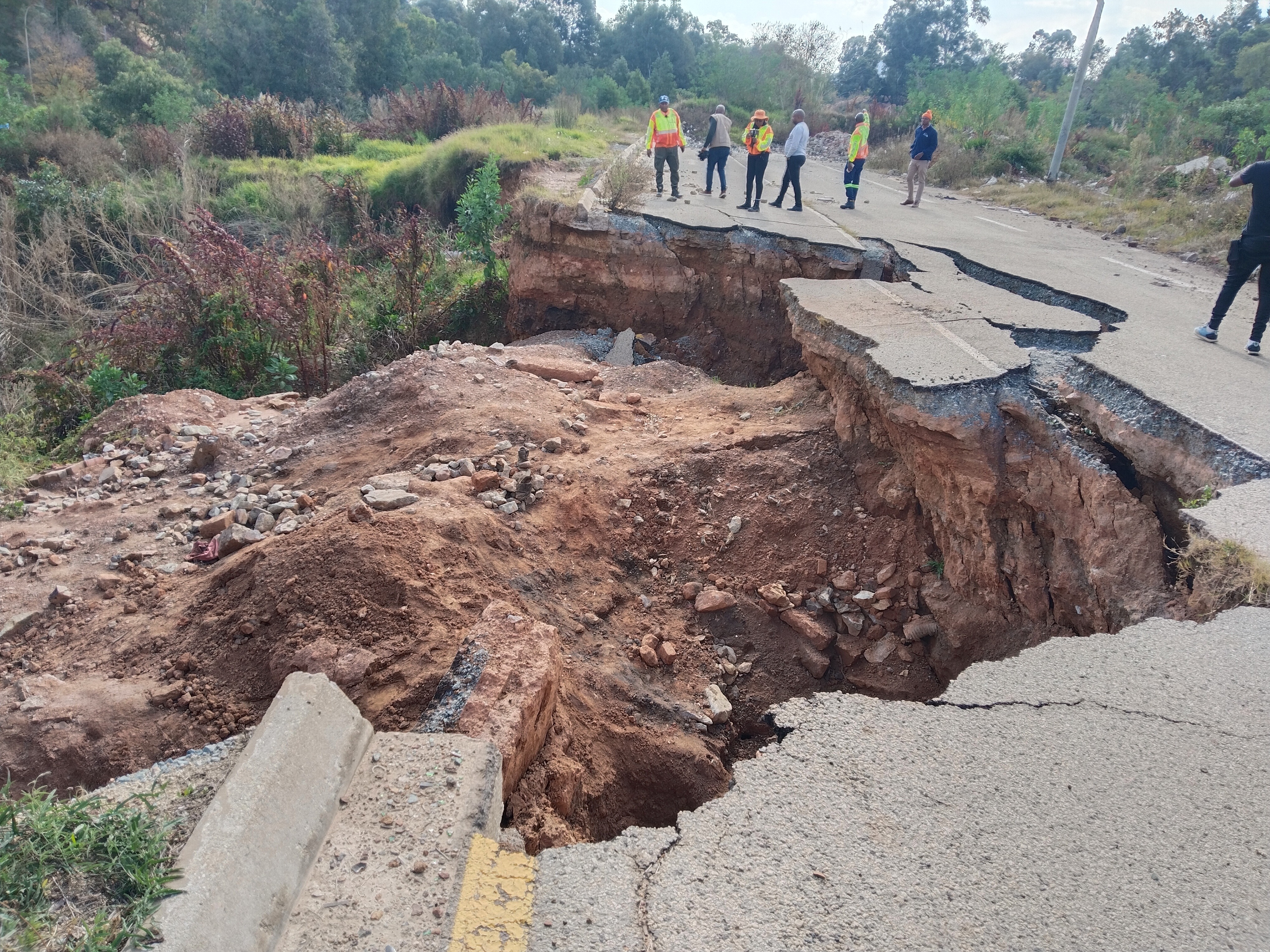
 A section of Wemmer Pan Road which has collapsed as the result of a sinkhole caused by illegal mining. The City of Johannesburg faces infrastructure reconstruction costs likely to run into billions as illegal mining-linked sinkholes undermine roads, business and homes. (Photo: Anna Cox)
Across parts of Johannesburg, roads are collapsing into underground voids, factories are being cut off from transport routes, sinkholes are opening inside residential estates, and businesses in busy commercial corridors are discovering tunnels beneath their premises, as illegal miners strip away the support pillars once designed to stabilise the ground above.
During an oversight tour last week with the Johannesburg Roads Agency (JRA) and Kenny Kunene, the mayoral committee member (MMC) responsible for transport, media visited some of the areas now being destabilised by illegal mining activity beneath the city’s surface.
From Roodepoort and Booysens to Wemmer and Witpoortjie, the damage is spreading far beyond abandoned mine dumps – leaving the City of Johannesburg facing infrastructure reconstruction costs likely to run into billions while residents and businesses warn the crisis is escalating faster than authorities can contain it.
The visit began at Nick Toomey Road in Roodepoort, once a key arterial route linking Main Reef Road and Ontdekkers Road.
/file/attachments/orphans/IMG_20260525_134128_372867.jpg "Nick Toomey Road in Roodepoort, closed since 2019, is completely impassable after years of subsidence linked to illegal mining beneath the area. (Photo: Anna Cox)<br>")
The road has been closed since 2019 and now lies abandoned, overgrown with weeds and completely impassable after years of subsidence linked to illegal mining beneath the area.
Ward 127’s councillor, Keke Tabane, said the closure had crippled traffic flow in the surrounding communities.
“The community around here is very distressed at the closing of Nick Toomey Road. It was a main thoroughfare and now people have to drive around. It is also causing major traffic congestion every day,” he said.
Tabane said sinkholes began developing along the route before tunnelling intensified and infrastructure beneath the road was damaged.
“There was a huge brick factory on the road, and it was forced to relocate because trucks could not get in and out to load bricks. The closure effectively cut off truck access to it and other business on that road.”
The abandoned road has since deteriorated into a crumbling strip of broken tar, overgrown vegetation and overflowing sewage.
Tabane said he had repeatedly raised the issue with the City and that even a 2022 oversight visit failed to produce meaningful intervention.
The illegal miners have also cut through water and sewerage infrastructure in the area, leaving wastewater flowing along both sides of the abandoned road.
‘Not the JRA’s fault’
Kunene said, however, it was not the JRA’s fault that the road cannot be repaired.
“Our depot is ready to repair this road, but City teams are increasingly unable to access this area because they are threatened by heavily armed illegal mining syndicates operating nearby. These criminals are stopping us. They will shoot us if we come on site. We cannot risk the lives of our employees,” he said.
He said the destruction had moved far beyond ordinary road maintenance.
“We cannot just patch or fill potholes on this and other collapsed roads, because they are so badly damaged that they have to be reconstructed from scratch.”
Kunene said illegal miners are now hacking and blasting the actual support pillars left intact by engineers of former mining operations to stabilise historic mine tunnels.
/file/attachments/orphans/IMG_20260525_133836_605306.jpg "A section of Wemmer Pan Road, which has collapsed as a result of a sinkhole caused by illegal mining. (Photo: Anna Cox)")
“These pillars collapse and cause sinkholes, destabilising large sections of surface infrastructure, leaving roads, stormwater systems and surrounding land collapsing,” Kunene said.
He warned that infrastructure was being destroyed faster than the City could repair it and that there was no money to fix it.
/file/attachments/orphans/IMG_20260525_135420_467173.jpg "A section of Wemmer Pan Road which has collapsed as the result of a sinkhole caused by illegal mining. The City of Johannesburg faces infrastructure reconstruction costs likely to run into billions as illegal mining-linked sinkholes undermine roads, business and homes. (Photo: Anna Cox)")
The crisis is now extending into residential areas.
At Witpoortjie Estate, an upmarket gated complex in Roodepoort, a massive sinkhole has opened near the security entrance, forcing residents to use a sandy side access road instead.
Additional sinkholes are now developing near a children’s playground inside the estate.
Resident Thato Letsoko said people were living in fear as the ground continued to deteriorate.
“We can’t use our own driveways. The JRA does nothing. Now the children are endangered from falling into these holes. Also, we keep having burglaries as these zamas come out of the holes during the day and at night to rob us,” he said.
Tunnels used to commit burglaries
In the busy Albertina Sisulu Road, businesses say they are now living with the daily threat of tunnels breaking through into their premises.
Mike Motaung of King’s Butchery said he arrived at work one morning to discover a huge hole in the floor of his shop where illegal miners had broken through from the tunnel below.
“They stole large amounts of meat from the shop,” he said.
A nearby hardware store reportedly suffered a similar incident.
Businesses in the area are now reinforcing and concreting their floors in an attempt to stop further underground access.
Meanwhile, sections of Wemmer Pan Road remain closed following major subsidence linked to illegal mining activity.
A JRA official said the area had become one of the city’s most difficult infrastructure hotspots, with repeated theft and vandalism making it impossible to maintain even basic traffic light systems.
“This forms part of a very busy intersection linking the CBD with the southern suburbs. Already at that intersection we can no longer keep traffic lights operational,” the official said.
“For years we replaced traffic lights, poles and cables. We even installed sensors in the poles linked to a private security company to alert us when infrastructure was being tampered with, but that too became too expensive to maintain. Eventually we simply removed the poles.”
The official said the area had become increasingly dangerous for motorists.
“Nothing can be done at this intersection because of these illegal miners. What was once a successful major intersection has become dark and dangerous to drive through, especially at night. The zama zamas are living in the bushes here.”
Further south, in the Booysens industrial area, worsening sinkholes along sections of John, Webber and Hans Pirow streets forced the closure of major sections of road that saw heavy taxi, freight and industrial traffic.
Joburg businesses fix roads themselves
Frustrated businesses eventually pooled funds to buy concrete and reconstruct a temporary single lane themselves after waiting for intervention from the JRA.
Clint de Bruyn, speaking on behalf of Booysens business owners, said the road had been closed after sinkholes appeared six years ago.
Businesses eventually spent about R320,000 building a temporary one-lane bypass alongside the damaged section of Webber Street to allow taxis through and ease severe congestion in the area.
“The road closure seriously affects businesses. One factory was forced to close. We were forced to open just one lane for taxis, otherwise it takes people 20 minutes just to get through the nearest intersection.”
De Bruyn said businesses had also spent thousands of rands repairing ordinary potholes themselves because of delays by the JRA.
“And now, after the oversight visit, Kunene wants to close our temporary road. It is just ridiculous. More businesses are going to close down,” he said.
Kunene questioned what had happened to rehabilitation funds historically linked to mining activity and called for stronger national intervention.
He said repeated intergovernmental meetings had failed to produce meaningful action, while organised criminal syndicates continued expanding operations beneath parts of Johannesburg.
Kunene calls for army intervention
As the tour progressed, Kunene adopted increasingly inflammatory rhetoric, describing illegal miners as “rats” and “sons of Satan”, while calling for military intervention alongside the South African Police Service (SAPS) and Johannesburg Metro Police Department.
Stressing that zama zamas were, in fact, gangsters just like the Eldorado Park gangs the army was called in to assist with, he added that “the army should not just put on a fashion show with their regalia – they must come here and meet firepower with firepower”.
“These illegals are not only stealing our wealth but are causing millions of rands in damage to our roads, water and electricity infrastructure and also to businesses and residents.”

The increasingly militarised rhetoric also appears to reflect a broader shift inside the City of Johannesburg itself.
Last week, the city announced a joint intervention involving the City, the SAPS and the South African Defence Force (SANDF) aimed at tackling illegal mining syndicates, hijacked buildings, infrastructure vandalism and organised criminal activity across Johannesburg.
City Manager Floyd Brink said presidential authorisation had been secured for SANDF deployment until March 2027.
“This is not business as usual. Johannesburg is saying clearly: no more lawlessness. No more no-go areas. No more surrendering our economic engine to criminal syndicates,” Brink said.
Johannesburg budget allocates R1.8bn for roads
The tougher stance comes as the City attempts to accelerate infrastructure investment through its newly tabled R97.1-billion budget.
The budget allocates R1.8-billion to roads and stormwater operations, with a further R570-million earmarked for capital projects, including road resurfacing, gravel road upgrades, stormwater infrastructure, public transport improvements and township mobility projects.
Finance MMC Loyiso Masuku echoed the harder line in her budget speech, linking illegal mining syndicates directly to the destruction of municipal infrastructure and warning of what she described as “treasonous acts” against the city’s economic and infrastructure systems. DM
Comments
Scroll down to load comments...