




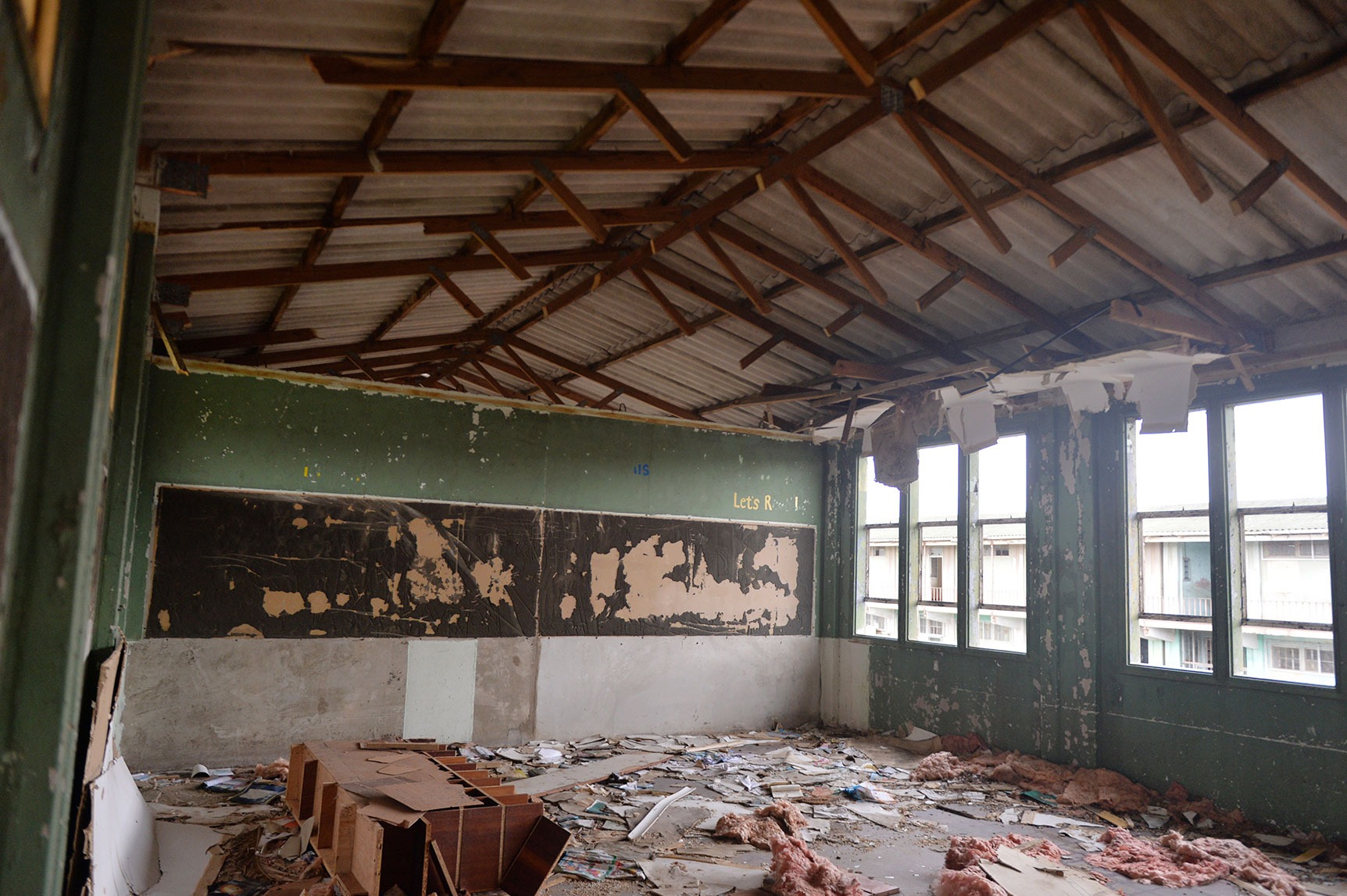
 An abandoned Greenville Primary School classroom, stripped of its blackboards, doors and electrical fittings. Parts of the room have also begun to collapse. (Photo: Deon Ferreira)
For years, Greenville Primary School in Gqeberha has battled vandalism, crumbling infrastructure and chronic neglect. Two of its three classroom blocks stand abandoned, the entire school has no electricity, and the pupils’ toilets are simply too damaged to use.
On Friday, 29 May 2026, teachers and members of the school’s governing body spent the morning preparing for a ministerial visit, hoping it would finally provide an opportunity to air their concerns and allow the minister to tour the school first-hand and see the extent of the long-standing decay, safety issues, vandalism and neglect.
But as the school day wore on, the teachers and governing body members – who for years have been met with one disappointment after another from government authorities – were dealt yet another blow when Basic Education Minister Siviwe Gwarube and her delegation were a no-show.
Greenville, a no-fee primary school in the northern areas of Gqeberha, was quietly removed from the minister’s itinerary during her visit to the city.
Gwarube was in Gqeberha to conduct a school safety visits as part of ongoing efforts to strengthen learner and teacher safety and well-being in schools.
She was accompanied by several of her DA colleagues, including Eastern Cape leader and MP Andrew Whitfield, Nelson Mandela Bay mayoral candidate Retief Odendaal, local councillors and provincial legislature members.
/file/attachments/orphans/Photo-12_943092.jpg "A pupil runs down an uneven corridor past a vandalised fire hydrant at Greenville Primary School. In the event of a fire, teachers and learners would be unable to respond effectively because no visible, working fire extinguishers or fire hoses are available on the premises. (Photo: Deon Ferreira)")
Gwarube has rejected any suggestion that Greenville was deliberately overlooked, saying she had already received reports detailing the school’s condition and that officials would follow up.
/file/attachments/orphans/Photo-1_719273.jpg "Basic Education Minister Siviwe Gwarube conducted a series of school safety visits in Gqeberha on 29 May 2026. One of the schools Gwarube had planned to visit was the severely run down and vandalised Greenville Primary School. However, the minister’s programme changed at the last minute, leaving members of the school community disappointed. (Photo: Deon Ferreira)")
The school that Gwarube did visit, where she and her colleagues praised principals and teachers for maintaining well-run schools, stood in stark contrast to Greenville, where the scale of decay and the ongoing violation of learners’ basic human rights were far more severe.
Human rights concerns were first raised in 2022, when Chris Nissen of the Human Rights Commission visited the school. Nissen at the time expressed concern about the poor conditions teachers and learners were subjected to.
A school in decline
While members of the school governing body declined to comment officially, they allowed a Daily Maverick team to tour the school and document the extent of its deterioration.
Only one of the school’s three classroom blocks remains in use. The others stand largely abandoned and visibly run down. In functioning classrooms, shattered windows leave teachers and pupils exposed to bitter winter temperatures.
The administration building — home to the principal’s office, secretary’s office and staff room — has no electricity. Teachers requiring photocopies reportedly rely on a nearby house because the school’s equipment cannot be properly used. There is also no internet access.
/file/attachments/orphans/Photo-4_364829.jpg "The run-down and unsafe toilet facilities intended for boys at the school. The girls’ facilities are in a similar condition. In the background is a second block of empty, vandalised classrooms. (Photo: Deon Ferreira)<br>")
School grounds are similarly neglected, with overgrown grass surrounding uneven concrete spaces where children now play. Storerooms have effectively become dumping sites, while no visible refuse bins appear to service the premises.
Repeated vandalism and theft have stripped the school of basic functionality. Earlier this year, shortly before schools reopened in January, burglars gained entry through the roof of the administration block. A large hole in the ceiling remains above offices used by staff.
The school also lacks visible firefighting equipment such as extinguishers, hoses or hydrants — raising concerns about emergency preparedness.
A changed itinerary
According to an advisory issued by the Department of Basic Education on Thursday, Gwarube was scheduled to visit Dr AW Habelgaarn Primary School, Greenville Primary and later BJ Mnyanda Primary School.
However, after visiting Habelgaarn, the minister instead stopped at Kroneberg Primary School, which was not listed on the original programme, before proceeding to BJ Mnyanda Primary.
Officials from Greenville said during Daily Maverick’s visit that the school had been informed on Thursday that they should expect the minister.
/file/attachments/orphans/Photo-11_654764.jpg "The staff room at Greenville Primary School was prepared for Basic Education Minister Siviwe Gwarube’s visit on 29 May 2026. Teachers and members of the school governing body had hoped to take Gwarube on a tour of the school to give her an insight into the conditions faced by learners and staff. However, the minister and her team did not arrive. (Photo: Kyran Blaauw)")
During our visit to the school on Friday, staff and members of the school governing body indicated they had prepared for the engagement and hoped to raise longstanding concerns around infrastructure, safety and resources.
By Friday afternoon, school officials were unaware that plans had changed.
‘Nobody is being snubbed’
Speaking to journalists at her last stop at BJ Mnyanda Primary, Gwarube dismissed suggestions that Greenville had been intentionally skipped.
“It would be deeply unfortunate to say that I would have snubbed a school,” she said.
The minister said schools on the programme had been selected to allow her to assess varying conditions, particularly in communities grappling with gangsterism, substance abuse and infrastructure pressures.
“I have 24,000 schools, so I’m not in one day going to be able to go to all of them,” she said. Gwarube said that the school visits formed part of efforts to understand how safety protocols signed between the department and the South African Police Service were functioning on the ground.
/file/attachments/orphans/Photo-6_636400.jpg "What was once a storeroom is now used as a makeshift rubbish dump because of a lack of bins on the school premises. Teachers and learners have to walk past the site to access classrooms on the upper floor. (Photo: Deon Ferreira)")
Gwarube said she had already received reports from Parliament’s select committee and colleagues detailing Greenville’s infrastructure challenges.
“At the very least, I already have a report that is going to be reported directly to the MEC on some of the things that need to be fixed, and fixed urgently,” she said.
She said that visiting schools without prior reports represented a more prudent use of time.
Her spokesperson, Lukhanyo Vangqa, said the department’s infrastructure unit would visit Greenville Primary on Saturday. When asked if Saturday’s visit had happened, Vanqa said she would only be able to confirm this on Monday, 1 June.
Infrastructure pressure under scrutiny
The minister’s explanation comes against the backdrop of deep infrastructure pressures across the education system.
A report by Equal Education has found that South Africa’s school infrastructure delivery system is effectively paralysed due to a fragmented outsourcing model, severe austerity-driven budgeting and an entrenched culture of impunity.
Gwarube said Parliament had this week tabled an education budget that includes R16-billion in conditional grants earmarked for school infrastructure in provinces.
She said provinces should not underspend allocations intended for repairs and upgrades, particularly amid what she described as an infrastructure backlog that exceeded R140-billion nationally.
/file/attachments/orphans/Photo-2_799507.jpg "The boys’ toilet facilities at Greenville Primary School in Bethelsdorp, Gqeberha, have been stripped and vandalised over the past few years. Security at the school no longer exists, and learners now use the teachers’ toilets. (Photo: Deon Ferreira)<br>")
“There are communities like those who are served by schools like Greenville and many others. So, really, the infrastructure backlog in this country is massive. It’s R140-billion worth, one that we’re not going to fix overnight. But what I do expect provinces to do is that the money that they’re allocated to deal with infrastructure problems, none of them should ever underspend on infrastructure because the need is too great and people are waiting,” she said.
Responding to a question on when the national department would intervene to compel provincial departments to fulfil their obligations, Gwarube said the Constitution limited the extent to which national departments could step into provincial matters.
“The Constitution is quite clear. The only way that national government can interfere in a province is through a Section 100 intervention,” she said.
Gwarube said that the Eastern Cape had already undergone two Section 100 interventions, but questioned their effectiveness.
However, Gwarube said the national government could still enforce accountability by ensuring provinces spent conditional grants for their intended purpose in line with Treasury rules.
“We have to make sure that it is spent and it’s spent well and where it’s meant to be, that it’s not stolen,” she said.
/file/attachments/orphans/Photo-9_720576.jpg "A hole in the ceiling of the principal’s office, caused during a break-in at the school in January, shortly before schools reopened. (Photo: Deon Ferreira)")
Gwarube said that she had instructed all nine provincial MECs against underspending on conditional grants, warning that pressure on the education system left little room for delays.
“The education system is under strain. Our children are waiting — 13.7 million children in South Africa are expecting us to do our job. All of us must put our shoulder to the wheel,” she said.
/file/attachments/orphans/Photo-5_565597.jpg "An unsafe staircase used by teachers and learners at the school. Several run-down staircases and open manholes are scattered across the school premises. (Photo: Deon Ferreira)")
Daily Maverick understands that plans for refurbishment or improvements may be considered in the coming months, although timelines and funding commitments remain unclear.
Spokesperson for the Eastern Cape Department of Education Malibongwe Mtima did not respond to questions on whether specific refurbishment plans or interventions were already in place for Greenville Primary. DM
Comments
Scroll down to load comments...