




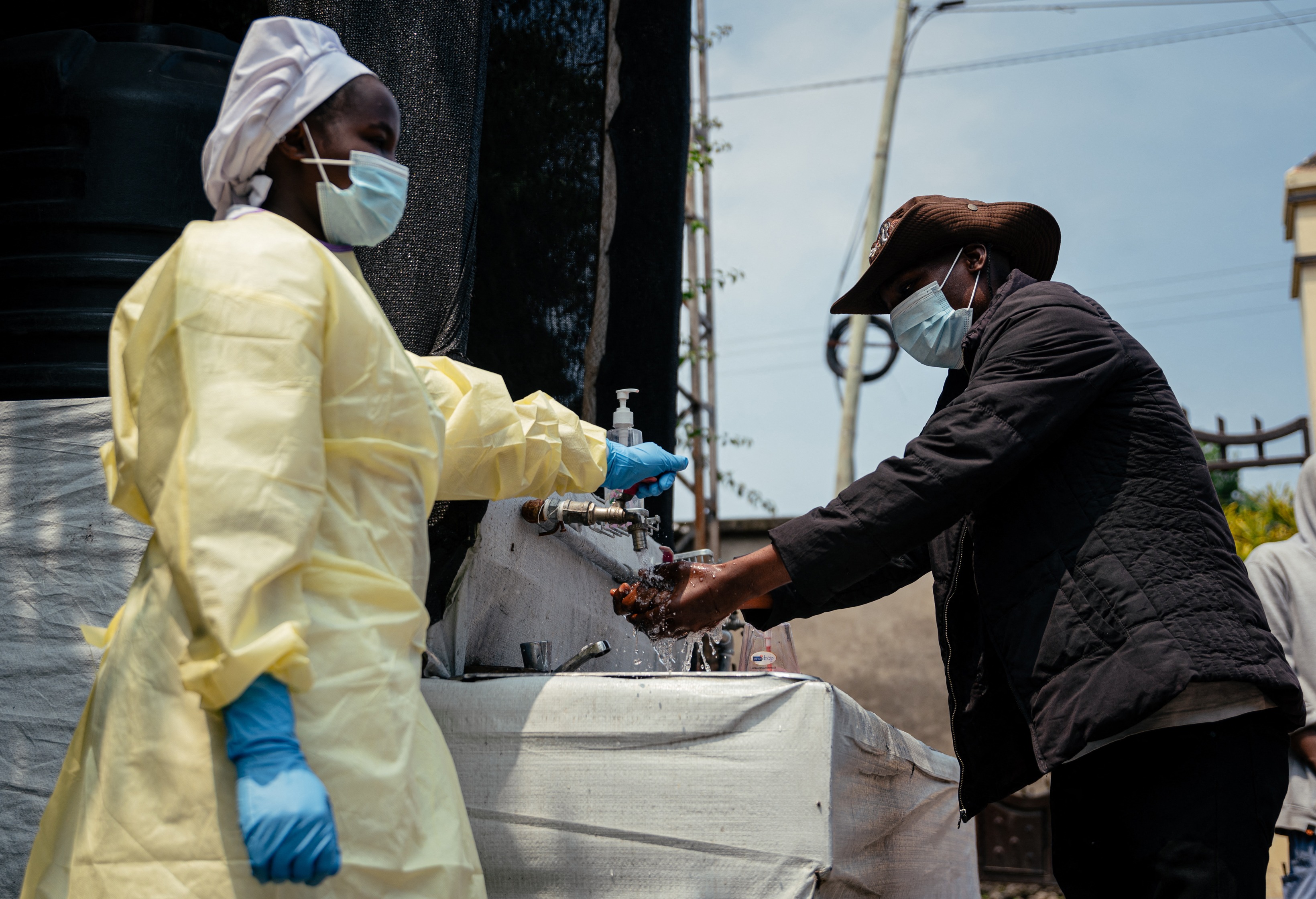
 A visitor washes his hands before entering Kyeshero Hospital in Goma, Democratic Republic of Congo, on 18 May 2026, after a first Ebola case was reported in the city. (Photo: Jospin Mwisha / AFP)
At least three weeks passed between the first deaths in Ituri province and laboratory confirmation of Bundibugyo Ebola in May 2026. Three weeks in which the virus claimed 80 lives, infected 246 people and crossed from the Democratic Republic of Congo into Uganda’s capital, Kampala. Biosecurity risks have been on the global agenda for decades, from naturally occurring epidemics like the 2014-2016 Ebola Zaire outbreak that killed more than 11,000 people across west Africa and revealed major costs of underinvestment in health security capacity, to the 2001 anthrax attacks in America that exposed the vulnerability of even well-resourced public health systems to deliberate biological threats. Each crisis has generated new commitments and real gains. However, key gaps have remained.
The 2014-2016 Ebola outbreak accelerated efforts to build a continental response architecture. The Africa Centres for Disease Control and Prevention (Africa CDC) was established in 2017 to build capacity to prevent, detect and respond to health threats and build capacity to implement the International Health Regulations. As a part of this effort, in 2019, Africa CDC unveiled its biosafety and biosecurity strategy, including a novel Biosafety and Biosecurity Initiative (BBI). This initiative was supported by Global Affairs Canada’s Weapons Threat Reduction Program, the Nuclear Threat Initiative (NTI) biosecurity programme, the Open Philanthropy Project, US Centers for Disease Control and Prevention and the US Defense Threat Reduction Agency. BBI works to strengthen biosafety and biosecurity systems across all African Union member states in compliance with the International Health Regulations and the Biological Weapons Convention, protecting against both accidental and deliberate releases of dangerous biological agents. What BBI cannot do alone is build the leadership pipeline needed to sustain and govern those systems over time and to address emerging regional and global risks.
The urgency of closing that gap has only grown as the threat landscape has widened. In 2023, armed groups seized Sudan’s National Public Health Laboratory in Khartoum, raising fears of pathogen escape from a facility housing polio, measles and cholera isolates. In June 2024, a ransomware attack on South Africa’s National Health Laboratory Service by the BlackSuit syndicate rendered its laboratory information system unusable for six weeks, forcing staff to switch to manual systems, WhatsApp groups and paper records to deliver results. Turnaround times for tests doubled, and decades of historical medical data were put at risk. Meanwhile, rapid advances in synthetic biology and artificial intelligence are making it easier to engineer pathogens, raising critical questions about dual-use research risks and the deliberate misuse of biological technology. Africa’s biosecurity workforce needs to be equipped to grapple with all of these threats, not only the ones it has faced before.
Beyond these incidents, emerging technologies are creating biosecurity challenges that existing governance systems are not prepared to manage. Advances in artificial intelligence are lowering the barriers to pathogen design and expanding access to capabilities once limited to state programmes. Dual-use research of concern still lacks effective international oversight, while disinformation and weak surveillance systems can delay outbreak detection and complicate attribution. Emerging fields such as synthetic biology and risks posed by the potential to create mirror life, involving synthetic organisms that may evade natural immune responses and existing detection tools, present risks for which no regulatory frameworks currently exist. As these and other biotechnologies evolve, Africa’s next generation of biosecurity and biosafety leaders will need to be alert to the development and implementation of new policies and decisions that can guide the next generation of technical solutions to these challenges. Building this pipeline of decision-makers, and equipping them with operational training and experiential learning, is essential.
A growing number of programmes are investing in Africa’s biosecurity workforce. The Global Partnership Initiated Biosecurity Academia for Controlling Health Threats, ICGEB Fellowships in Pathogen Detection and Biosecurity, the African STARS Fellowship Programme, and the Epidemic Science Leadership & Innovation Networks Initiative are building technical expertise, connecting African professionals to international biosecurity networks, and strengthening the continent’s scientific capacity for pathogen detection and response.
To contribute to this effort, working closely together with African organisations like Africa CDC, the Science for Africa Foundation and with other key partners, the Brown University Pandemic Center designed the Biosecurity Game Changers Initiative and Biosecurity Threat Education Course and Fellowship. Launched with a first workshop in Addis Ababa in September 2024, the initiative brings together early- to mid-career professionals from across Africa for intensive policy and leadership experiences in biosecurity decision-making. The first iteration of the initiative was funded by Sentinel Bio, and in 2026, the New York-based Carnegie Corporation made a generous grant to the Pandemic Center to begin to scale the initiative over three years. The grant annually funds more than 30 African early- to mid-career professionals to conduct deep dives into biological threat reduction policy, with five to seven selected for a year-long fellowship placement in operational and decision-making roles with organisations including Africa CDC, the Coalition for Epidemic Preparedness Innovations, the Biological Weapons Convention Implementation Support Unit and the International Biosecurity and Biosafety Initiative for Science.
“Biological threats represent an urgent security challenge in Africa,” said Tade Akin Aina, senior programme director with the International Program at the Carnegie Corporation of New York. “This grant supports the infrastructure for the development of up to 30 African biosecurity leaders over three years to strengthen continental preparedness to prevent and manage these threats.”
The current 2026 cohort consists of 36 rising leaders, drawn from more than 15 countries and five African sub-regions, reflecting the breadth of expertise the field of biosecurity and biosafety decision-making requires. Their professional backgrounds range from epidemiology, public health and laboratory science, to law, engineering, veterinary medicine, bioinformatics, biophysics and public policy. What unites them is not a common discipline but a shared interest in the challenge of understanding and managing biological risks that do not respect borders or sectors, or the boundaries between natural, accidental and deliberate threats.
As natural outbreaks, laboratory accidents and the deliberate misuse of biological agents converge into an increasingly complex threat environment, Africa’s ability to prevent, detect and respond to those threats will depend less on any single institution or piece of infrastructure than on a sustained investment in the people capable of preventing, detecting and responding to these threats. Building a workforce that is rigorously trained, regionally networked and oriented towards policy as much as science is not a peripheral priority. It is, above all, the condition on which every other element of Africa’s biosecurity response depends. DM
Dr Wilmot James is professor of the practice and senior adviser, Dr Beth Cameron is professor of the practice and senior adviser and Dr Oluwatosin Akande is a fellow and adjunct professor at the Pandemic Center, Brown University School of Public Health.
Comments
Scroll down to load comments...