




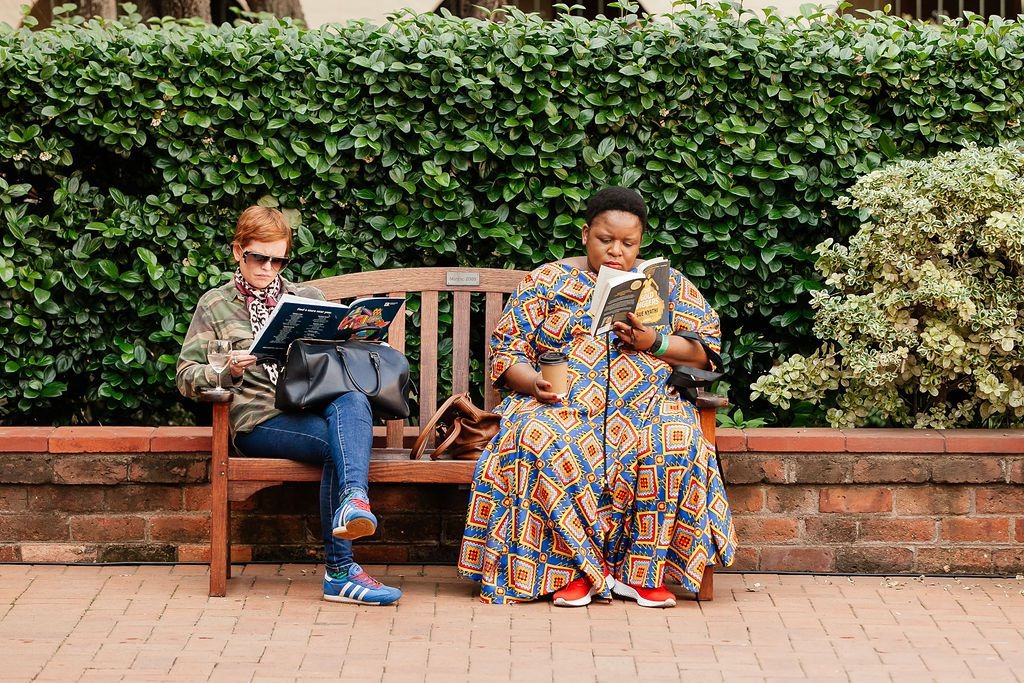
 Two readers at Kingsmead Book Fair 2023. Panel discussions at this year’s event featured authors like Jackie Phamotse, who presented her novel about a dangerous nurse, providing a gripping narrative and unconventional dating insights. (Photo: Kingsmead Book Fair)
 Attending the Kingsmead Book Festival in Johannesburg is a lesson in the delicate art of author management. My journey began with a peace offering that any bibliophile would recognise: a copy of Jung Chang’s Fly, Wild Swans: My Mother, Myself and China.
It was a gift and a strategic move by my publicist, Janè, who has since learned that managing an author at a literary festival is less about PR and more about crisis containment. Our professional relationship, which began in January, has been a steady descent into what I can only describe as my natural state of chaos. By the time we reached Kingsmead, Janè had accepted her role as my “looker-after”, which as it turned out, involved a surprising amount of coordination and patience.
The reality is that book festivals are environments designed to distract book people from whatever they are actually supposed to be doing. Surrounded by writers, overstimulated by gossip near the coffee stations, and drifting through clouds of intellectual chatter, one loses all sense of time and proportion. For the publicist, it can be a logistical nightmare; for the author, it is a slow, happy drift into total disorientation.
But I did eventually find my way to my first panel discussion at Kingsmead.
It was chaired by the incredible Hannah Botis, author of A Clergyman’s Daughter, and featured Jackie Phamotse, author of The Tea Merchant, and Ntombi Nkabinde, author of In the Late of Night. We spoke about the enduring allure of men who are catastrophically unsuited to relationships, which frankly feels less like a literary theme and more like a public health crisis. I want, however, to focus on the critical life lessons imparted by Jackie.
Jackie arrived carrying exactly the kind of energy one wants from a writer: slightly dangerous, deeply entertaining and entirely unconcerned with whether anyone in the room felt psychologically safe afterwards.
During the discussion, she spoke about her novel, which centres on a psychopathic nurse who murders a doctor while remaining utterly convinced that she has done the world a favour. Which, frankly, is already a compelling argument for buying the book.
At the centre of The Tea Merchant is Luna Parks, a young nurse whose calm, polished exterior conceals a dangerous capacity for violence and manipulation. Early in the story, Luna and fellow nurse Amora become implicated in a murder after what begins as an ordinary clinic interview in Bellville, before fleeing to a rural clinic in Clanwilliam to escape the consequences of their actions.
From there, Luna gradually inserts herself into the life of naval officer Cameron Coal, his daughter Mia, and their grieving, fractured family, all while carefully concealing the crimes and secrets trailing behind her.
But perhaps even more memorable than the conversation was Jackie’s dating standards, which she shared with the audience.
Before every date, she deliberately makes sure her car is as dirty as possible; she then arranges to meet the man somewhere he will inevitably see it. The test is simple: if he notices the dirt and says nothing, she immediately concludes that he himself is dirty. Date over before it has properly begun. The audience, naturally, agreed that this was the single biggest takeaway of the session.
My second panel was a conversation I hosted with Mandy Wiener, author of The Deal and Tara Roos, author of Where to From Here? on the future of South Africa, which, judging by the sold-out room, is currently a topic producing roughly equal amounts of political analysis and group therapy.
What struck me most during the discussion was not only how deeply invested people remain in SA’s future, but how hungry they are for political conversations that move beyond slogans and recycled outrage.
The audience leaned in. People wanted complexity. They wanted honesty. They wanted some way of understanding how we arrived at this strange political moment where coalition politics, mistrust, compromise and institutional fragility have become our daily reality.
At one point during the discussion, I realised that the Government of National Unity (GNU) now gets discussed by South Africans with the exact same tone people use when describing a couple they know socially who are “going through a difficult patch but are committed to making it work”. Nobody is fully convinced, but everyone is desperately wanting a happily-ever-after.
Wiener spoke powerfully about the extraordinary tension and human drama underpinning the negotiations that produced the GNU, while Roos unpacked the longer political currents reshaping voter behaviour, party support and public trust.
Between them, the conversation became less about party politics in the narrow sense and more about something larger: the difficulty of building a collective national project in a country where so many people no longer experience the state as coherent, trustworthy or emotionally legible.
I will say this: if the government showed up with even half the attentiveness, curiosity and willingness to engage that the audience in that room did on a Saturday afternoon, we would absolutely be flying as a country.
I also managed to catch up with Sam Herbst, cohost of The Great Equaliser Podcast. Asked about two books she recently read and loved, she responded, Wild Dark Shore by Charlotte McConaghy. She says that the book “took [her] on an adventure and gave [her] insight into climate change that [she] didn’t know [she] needed”. “It made me see climate change differently, through the lens of fiction.”
Her second favourite was A Mouthful of Air by Amy Koppelman, which explores postpartum mental health. “Amy was so raw and vulnerable with that novel and it has so many strange parallels to my own journey as a parent. It was such a chance that she took,” Sam told me. But then she added: “I was very tempted to list your book, but I didn’t want to look like I was sucking up.”
Perhaps that is what I increasingly love about festivals like Kingsmead. Not only the formal conversations on stage, but the strange collisions that happen around them.
One moment you are discussing democratic collapse and coalition governance. The next, someone is explaining how to identify morally compromised men through the state of your car seats. Somewhere in between, writers reveal themselves to be exactly what one suspects they are: observant, obsessive, slightly unhinged and endlessly entertaining. DM
Joy Watson is the Books Editor-at-Large at Daily Maverick.
Comments
Scroll down to load comments...