




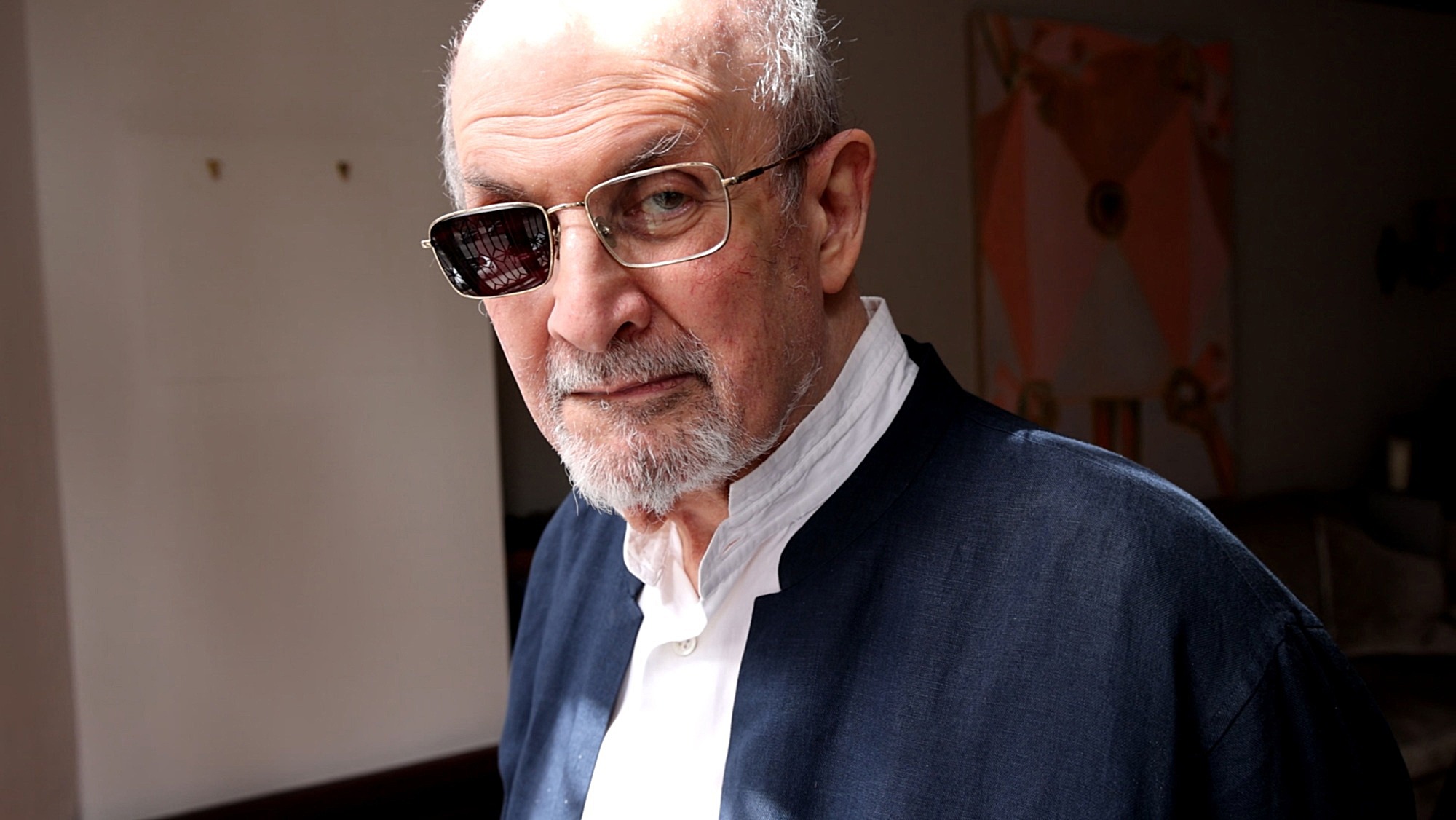
 A new documentary follows the recovery of author Salman Rushdie following a near-fatal attack in 2022. (Photo: Jigsaw Productions)
 “We want to make a record,” Salman Rushdie tells his wife, Rachel “Eliza” Griffiths, while lying in a hospital bed. “Because it’s not just about me, you know. It’s about freedom. It’s about the ability to say your truth.”
The camera is zoomed in on his neck, which is darkened by a strangulation of purple-red bruising, while staples hold together a wound from his neck to his cheek. A white patch covers his right eye.
In another shot, the patch is removed to reveal an eyeball protruding from its socket, swollen to about three times its size and encased in blood. The camera is unwavering in its focus, giving the viewer no choice but to hold the gaze of the result of a horrific act of violence against another human being.
On 12 August 2022, a 24-year-old man attacked 75-year-old Salman Rushdie, the prolific author of Midnight’s Children, The Satanic Verses and Quichotte, among many others, on stage at the Chautauqua Institution, where the author was set to deliver a lecture about the US as a safe haven for exiled writers.
Suffering from 15 stab wounds, Rushdie was in hospital for about six weeks during which Eliza Griffiths documented his recovery, rehabilitation and reflections in video diaries, which would become the basis of the documentary Knife: The Attempted Murder of Salman Rushdie.
The documentary, directed by Alex Gibney, is inspired not only by Rushdie’s memoir published two years after the attack, but also contextualises the wider scope of Rushdie’s career and its backlash – specifically in response to The Satanic Verses – which ultimately culminated in the assault on free speech and expression that took place at the Chautauqua Institution.
But Knife is not a true crime documentary.
/file/attachments/orphans/ThedocumentaryisinspiredbyRushdiesmemoirKnife_JigsawProductions_484351.jpg "The documentary is inspired by Rushdie's memoir, Knife. (Photo: Jigsaw Productions)")
Knife: The Attempted Murder of Salman Rushdie does not focus on the criminal act itself. It is, instead, a story situated at an intersection of trauma and the devoted caregiving needed to survive it – making for a profoundly humanising portrait of a writer whose controversies have perhaps come to eclipse the writing itself.
That being said, when the film does examine the events of 12 August 2022, it’s through a re-enactment that places the viewer in a near first-person perspective of Rushdie’s experience.
Naturally, it’s an unsettling point of view that arguably dramatises Rushdie’s considering how knife violence, as opposed to a gun that can be used from a distance, has an “intimacy”. But the film’s portrayal of this through a rather sensationalist style, together with its occasional animated scenes bringing Rushdie’s fiction to life, undermines the documentary’s overall pensive quality.
Where the symbol of the film’s titular “knife” is most striking is in Rushdie’s own words, taken from his memoir.
“During those empty, sleepless nights, I thought a lot about the knife as an idea,” Rushdie narrates as the documentary’s voiceover. “A knife was a tool, and acquired meaning from the use we made of it. Language, too, was a knife.
“I could cut open the world and reveal its meaning, its inner workings, its secrets, its truths. It could cut through from one reality to another. It could call bullshit, open people’s eyes, create beauty. Language was my knife. If I had unexpectedly been caught in an unwanted knife fight, maybe this was the knife I could use to fight back.”
In Knife: The Attempted Murder of Salman Rushdie, select archival recordings, particularly speeches and interviews from Rushdie’s 50-year-long writing career, trace the author’s core impulses as a writer as well as the public’s polarised responses to his work.
Clips from fictional films such as The Seventh Seal, West Side Story and 12 Angry Men are another visual feature interspersed throughout the documentary.
At first, they appear out of place in the narrative, but are eventually framed by narrator Rushdie, who connects them to the themes of his reflections, such as death, hatred and the symbol of the knife. These clips serve as a testament to the value of stories in shepherding one through the nature of being human in all its pleasures and grievances.
/file/attachments/orphans/SalmanRushdiereturnstothesiteoftheattemptedmurder_JigsawProductions_486524.jpg "Salman Rushdie returns to the site of the knife attack. (Photo: Jigsaw Productions)")
Director Alex Gibney emphasises that he aimed to emulate the memoir’s “free association” between the present and the past by interlacing this variety of footage. Though it does create a robust narrative, it can come across as superfluous – its range of styles detracting, at times, from the intellectualism at the core of its subject.
Despite its disparate narrative techniques, Knife: The Attempted Murder of Salman Rushdie reinforces its emotional impact through a cyclical structure that sees Rushdie returning to the site of the attempted murder.
Standing on the stage, Rushdie relays his memory of the course of events that day in 2022, while the documentary intercuts to footage of the stabbing.
“I think people should see what terrorism looks like,” Rushdie tells Variety, describing that he had no doubt about including the video of the attack in the film.
These concluding scenes can leave viewers feeling ill – an ache in the pit of the stomach to witness, even through a screen, the unfathomable horror of an individual inflicting such unyielding brutality on another human.
“By his own admission,” Rushdie narrates, “[the assailant] had read barely two pages of my writing.” DM
Knife: The Attempted Murder of Salman Rushdie is part of Encounters International Documentary Festival. It’s screening on 7 June at Rosebank Nouveau in Johannesburg and 12 June at Ster-Kinekor V&A in Cape Town.