




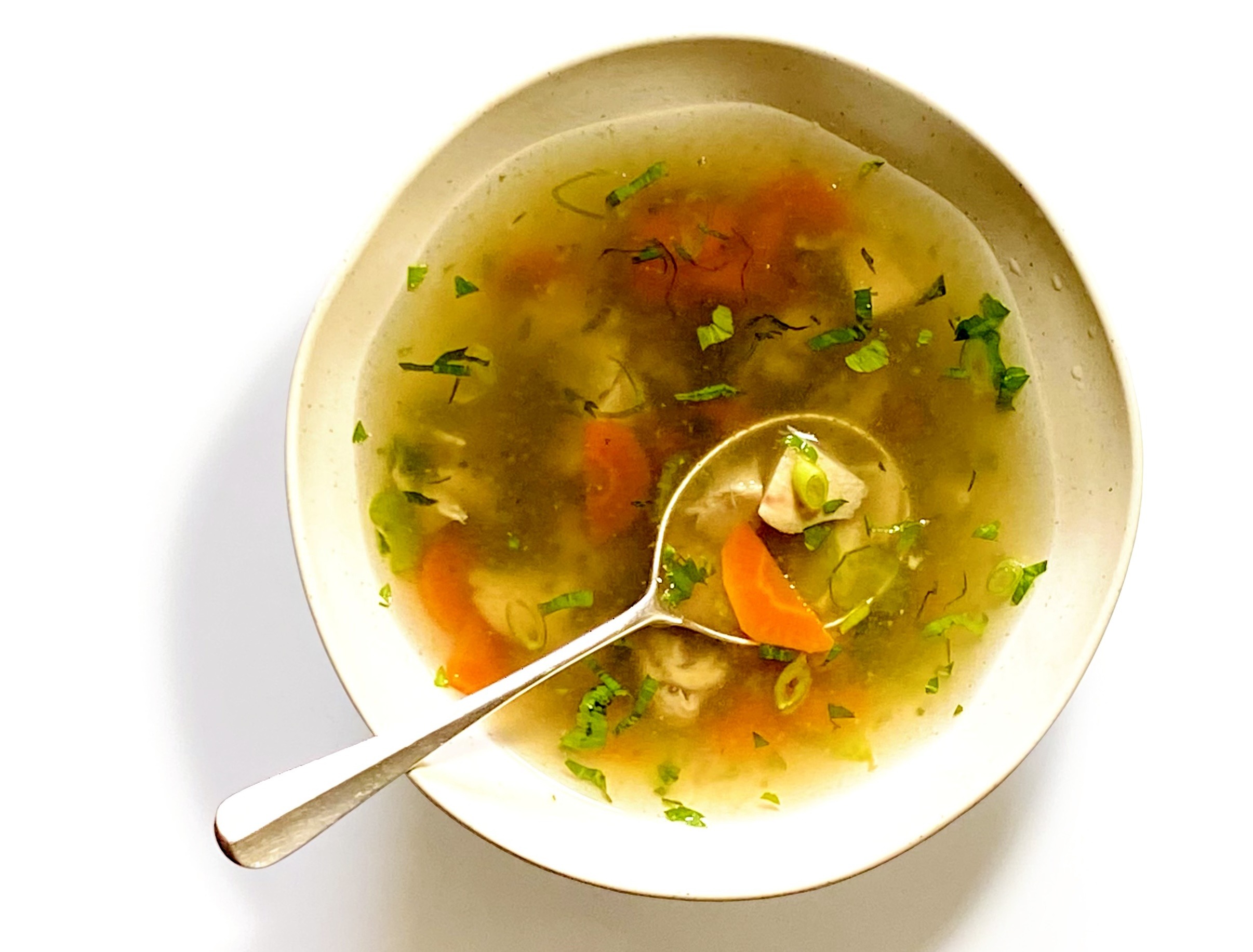
 Andrea Burgener’s chicken soup. (Photo supplied by The Leopard)
 All over the world, millions of mothers swear by chicken soup as a home remedy for the cacophony of coughs, snotty noses, sore throats and mild fevers that is known as the common cold.
Whether you want Burmese ohn-no khao swè made with chicken stock, ginger and coconut milk, Georgian chikhirtma (which combines slow-cooked bouillon with egg yolks and oregano), Yucatán sopa de lima, where shredded chicken makes magic with lime juice and crisp tortilla strips, or the “Jewish penicillin” of an Ashkenazi chicken soup, there is a bowl of broth to suit every ailment and ancestry.
Those currently claiming to cure colds with chicken soup clearly lack ambition. An assortment of eminent ancients believed that the same poultry potion could defeat everything from constipation to leprosy. Chinese doctors from 2BC relied on the Huangdi Neijing (roughly translated as the Inner Canon of the Yellow Emperor), which ascribed chicken soup’s healing powers to its “yang” warming-food status. Warming was not a reference to the liquid’s literal temperature but rather an energetic property that restored depleted qi (vitality). In addition to flavoursome fowl, the ancient recipe/remedy called for ginger, jujube red dates, goji berries and huang qi (astragalus) root.
History of chicken soup
In 60AD Pedanius Dioscorides, an army surgeon who served under the Roman emperor Nero, prescribed chicken soup for all manner of misfortunes. His five-volume medical encyclopaedia (which was consulted by subsequent healers for more than a millennium) stated that a rooster-based avian infusion could cure leprosy, malaria, respiratory disease and constipation. Dioscorides insisted that it had to be a boy bird. Apparently, hens lacked the requisite medicinal machismo to perform heroic healing labour.
In mediaeval Persia, the sex of the chicken was not deemed relevant to its therapeutic powers. Eleventh-century physician and philosopher Ibn Sina writes in his book The Canon of Medicine that “hens or roosters, and especially their broth will rectif corrupted humours, particularly black bile”. His 12th-century, Cordoba-based colleague Moses ben Maimon also praised chicken soup for its ability to cure fever, breathing difficulties and haemorrhoids.
What does modern medicine say on the subject? Can chicken soup really cure a cold? If the word “cure” is being used to mean killing a rhinovirus then the answer is not really. There is some scientific evidence that it may have a mild anti-inflammatory effect. Renard et al (2000) published a paper in which they tested a traditional chicken soup in vitro and found that it inhibited neutrophil chemotaxis, meaning that it slowed the movement of certain inflammatory white blood cells in a laboratory model.
Healthy eating at its best
Rustenburg-based, registered dietician Mpho Tshukudu (author of Your Health Starts in Your Gut) says: “Clearly no two soups are the same, and the health benefits will depend on its specific recipe but broadly speaking the ingredients found in most chicken soup recipes are beneficial. They are full of vitamins and antioxidants, which can support recovery and recuperation. Soups tend to start with frying off onions and garlic, which have anti-inflammatory properties. Obviously not too much oil. Carrots come next, which are a source of vitamin A. Chicken stock when properly made with real bones – not with a stock cube – maintains hydration and will provide potassium and phosphorus. If you add spices and herbs, then there will be additional gut health benefits (about 70% of your immune cells are housed in the gut) and anti-inflammatory properties.”
/file/attachments/2992/MphoTshukudu_744886.jpg "Mpho Tshukudu. (Photo: Supplied)")
The laboratory scientists are cautious in their claims, but we all know that a bowl of chicken soup can improve the experience of having a cold. Who among us has not felt the positive effects of warm, umami-intense fluids soothing sore throats and loosening nasal mucus. It definitely makes enduring the ailment less awful. And maybe more…
In 1978, Saketkoo et al published a paper charmingly titled “Effects of Drinking Hot Water, Cold Water, and Chicken Soup on Nasal Mucus Velocity and Nasal Airflow Resistance”, which proved that while the third option didn’t vanquish rhinovirus, it did relieve a runny and/ or blocked nose better than hot or cold water. This scholarly finding must surely have elicited a million Homer Simpson-style “D’oh!” noises from readers around the world.
And then there is the emotional impact that goes beyond the microbiology of broth. In almost every culture, chicken soup is served in a context of being loved and looked after. There is something soothing about being tucked up in bed and hearing other people picking up pots and wooden spoons to make soup. The aroma of onions, the feeling that someone else is in charge, and that no one needs you to be strong today.
Often there is recovery cooked into the repetition of a family chicken soup recipe. Many have been handed from mother to daughter since time immemorial. Each incarnation affirms an ancestral support system. Every spoon speaks reassuringly of sick days survived. Of a (predominantly) female epicurean apostolic succession – someone once made this for them and now they are making it for you. Care is infused into the continuity.
Clearly homemade soup is the ideal. Not only because of the ladles of love, but also because it allows the cook and the soup sipper to control ingredients. As dietician Mpho Tshukudu observed above, no two soups are the same and the salt content of shop-bought broth is often excessive. For those who have not been blessed with chicken soup-making mothers and are too sick to stir their own pot, a trustworthy, health-conscious chef is the next best thing. Which is where chef Andrea Burgener and her kitchen manager, Amanda Maposa, at the Leopard Food Company come in.
/file/attachments/2992/AndreaBurgenerLeopardFoodCompanyJohannesburg_169034.jpg "Andrew Burgener juggles her pots. (Photo: Theana Breugem)")
This talented team makes lovely low sodium, high protein, mineral-rich, collagen dense, organic and fabulously flavoured chicken soup. Deeply nourishing, hydrating and gentle on delicate digestions, it can be ordered online via www.leopardfoodcompany.com, and they will deliver within 15km of their Greenside, Johannesburg store. For those seeking sustenance beyond that radius, the very kind chef has provided us with the recipe.
The Leopard’s Lovely Chicken Soup
(Serves 4 - 6)
Ingredients
2 whole chickens
3 litres water
1 large onion, peeled and halved
5 carrots, peeled and sliced
2 celery sticks, sliced
1 fennel bulb, sliced
1 bay leaf
A few peppercorns
Handful of parsley, finely chopped
Method
Put the chicken into a large pot with the water, onion, celery, bay leaf and peppercorns. Then add 2 of the carrots and half the fennel. Bring the liquid to a gentle simmer. Keep the soup at this low simmer rather than a hard boil throughout the process, so that the broth stays clear and the chicken remains tender.
Periodically skim off any foam that comes to the top. Simmer for about 2 hours. The liquid will reduce by about a third, the chicken will be fully cooked and so soft that it is coming away from the bone.
Remove the chicken from the pot. When the bird is cool enough to handle, remove the skin and take the meat off the bones. Shred or cut the chicken meat into bite-sized pieces. Discard the bones and skin.
While the chicken is cooling enough to touch, strain the broth. Discard the onion, carrots, fennel, celery, bay leaf and peppercorns. You will now have a flavoursome clear chicken stock.
Return the shredded chicken to the chicken stock and add the other half of the finely sliced fennel and the 3 remaining uncooked carrots. Simmer until the vegetables are cooked through and soft (about 10 minutes). Season to taste. Sprinkle with the finely chopped parsley and serve hot.
For an optional finishing touch, squeeze a little lemon juice at the end to brighten the flavour, especially if the soup is being served to someone with a cold. DM