



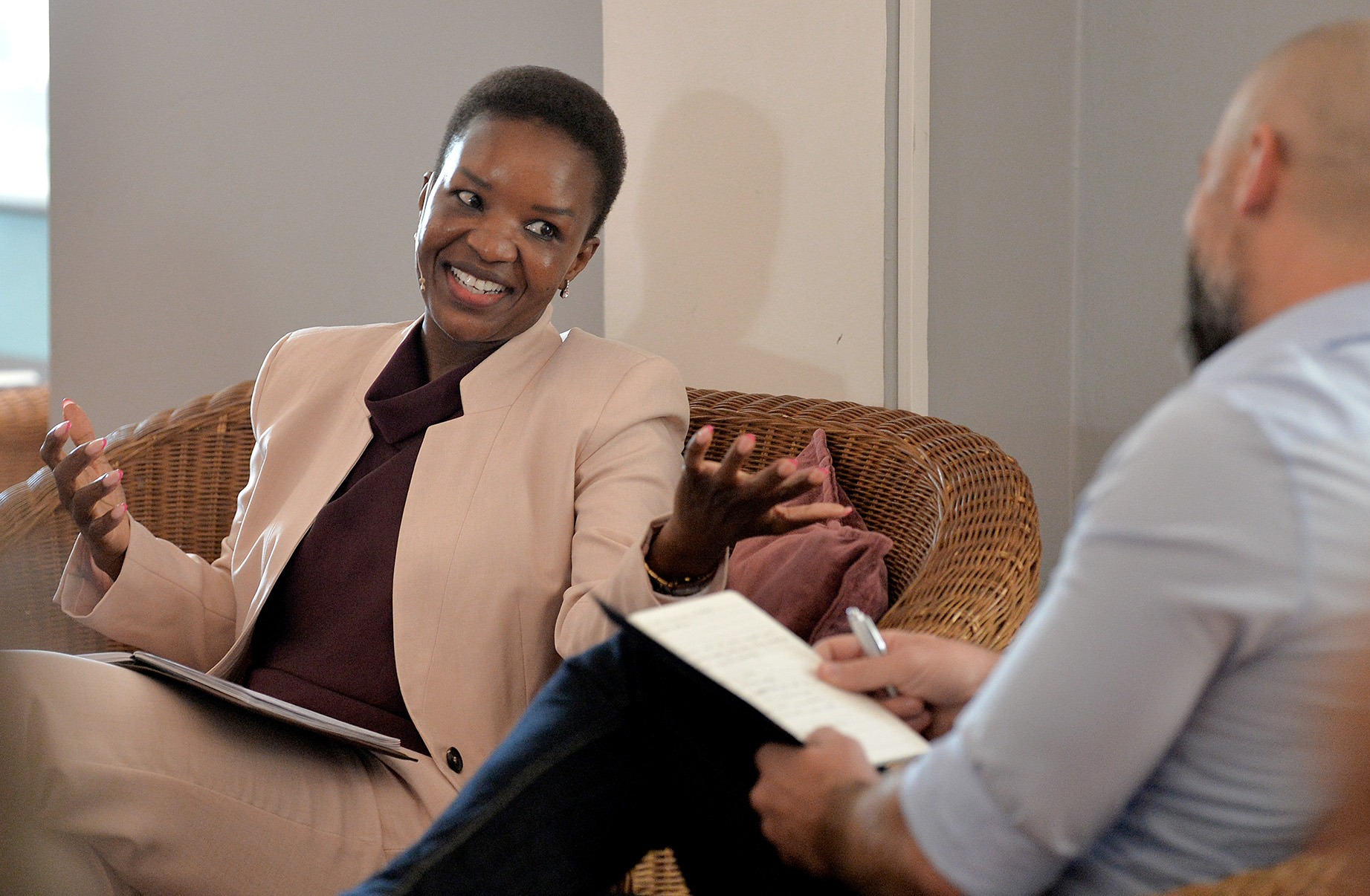
 Business Leadership South Africa CEO Busisiwe Mavuso at a Daily Maverick business breakfast in Nelson Mandela Bay on Thursday, 28 May. (Photo: Deon Ferreira)
Organised business in South Africa is getting things done — but at the risk of letting government off the hook.
That was the uncomfortable message from Business Leadership South Africa CEO Busisiwe Mavuso at two Nelson Mandela Bay business events this week, where she warned that private companies stepping in to fix potholes, leaks and failing infrastructure risks creating a dependency that lets government abandon its obligations entirely.
“You will adopt leaks and schools and potholes until you are blue in the face,” Mavuso said. “If you are not going to fix the political situation, the picture will never change.”
While some companies have already buckled under the pressure of South Africa’s economic and governance crises, those that remain are increasingly being forced to work alongside government to keep the economy functioning and create conditions for growth.
“If government fails, the economy fails, and if the economy fails, business fails. But there has been a lot of business-government partnership recently that shows business understands that if they don’t help government to ensure the country has a capable state, then we too will be at a disadvantage,” Mavuso said.
It’s a situation that Volkswagen Group Africa knows all too well. The company — the metro’s largest employer, with 3,900 direct jobs and upwards of 50,000 indirect employment opportunities through its component suppliers — spent R900,000 repairing its fleet, mainly due to pothole damage, on top of millions more in securing a reliable electricity supply to its plant in Kariega.
Plague of systemic issues
Speaking at a business breakfast in Nelson Mandela Bay, hosted by Daily Maverick on Thursday, Mavuso highlighted that the major challenges facing residents of Gqeberha and surrounds were not unique to the metro, but they were part of systemic issues plaguing the country as a whole.
On Wednesday, Mavuso shared the stage with Volkswagen Group Africa’s (VWGA) chairperson and managing director, Martina Biene, where NMB Business Chamber chief executive Denise van Huyssteen led them in a discussion during the Chamber’s annual general meeting.
They explored the difficulties companies have had to overcome in recent years and unpacked new obstacles that have evolved from past failures – and placed the blame for these faults squarely on the shoulders of bad governance.
Using load shedding as an example, Mavuso said power supply was no longer the problem as the country was generating more electricity than it needed. The new challenge lay in delivering that electricity to the end users, as distribution infrastructure, such as substations and powerlines, had become dysfunctional due to bad planning and lack of maintenance.
Similarly, Van Huyssteen referred to the latest reports on the Bay’s water supply system, where more than 60% of the city’s water goes to waste due to leaks and ailing infrastructure.
“The city’s water concerns are not because of drought, but because of a management crisis,” Van Huyssteen said.
As a further example of the city’s management crisis, Van Huysteen also alluded to the revolving door of city managers, with 18 people having occupied the crucial position since 2020.
/file/attachments/2986/Screenshot2025-12-15at145231_514674.png "Nelson Mandela Bay Business Chamber chief executive Denise van Huyssteen. (Photo: Facebook)")
Concerning infrastructure, Volkswagen Group Africa continues to absorb significant costs to ensure a stable electricity supply to its Kariega operations.
The cumulative impact of these infrastructure failures raised broader questions about long-term investment confidence in Nelson Mandela Bay.
Reiterating a scenario Biene raised at the Business Chamber AGM, Mavuso said a company like VW could easily move its operations out of Kariega should it become too challenging to navigate local obstacles. It had been up to Biene and her local team, with their understanding of the local landscape, to create and maintain favourable operational conditions.
/file/dailymaverick/wp-content/uploads/2024/12/VWSA-plant-solar-car-park-QuickPic.jpg "At its production plant in Kariega, VWGA had to invest heavily in solar electricity to overcome production losses due to repeated power outages. (Photo: QuickPic)")
“Capital is like water. It will always follow the path of least resistance. They are not going to perpetually understand the mess and the managing around the problem that is actually happening here.
“Capital is about fixing the basic problem. Foreign investments will come here because the environment within which we are operating makes sense to them. And I worry about how difficult it remains to drive this point home with our political leadership.”
Taking these and other obstacles into account, Mavuso told the city’s business leaders, at both events, that all fingers pointed towards incompetent leadership – people appointed to lead the city not because of their qualifications and abilities, but because of their political affiliations.
Lobishe slammed
She did not mince her words, naming NMB mayor Babalwa Lobishe as one of the main culprits, and saying the city, and the country as a whole, deserved better leadership.
She praised the Business Chamber and its partners for initiatives whereby private companies could adopt certain infrastructure assets to assist in their repair and maintenance, which showed a willingness of “patriotic business” to create better working conditions.
“Nelson Mandela Bay’s strategic importance in the manufacturing and agricultural sectors cannot be overlooked, and you have an organised business community that is willing to roll up its sleeves and assist government to get the basics right. This is one of the easiest metros to fix,” Mavuso said.
However, her warning against creating government dependence still held, where the state would begin to expect private business to assume some of its obligations.
“I worry that we, as organised business, have made a fundamental mistake of having created this dependency from government”. DM
Comments
Scroll down to load comments...