




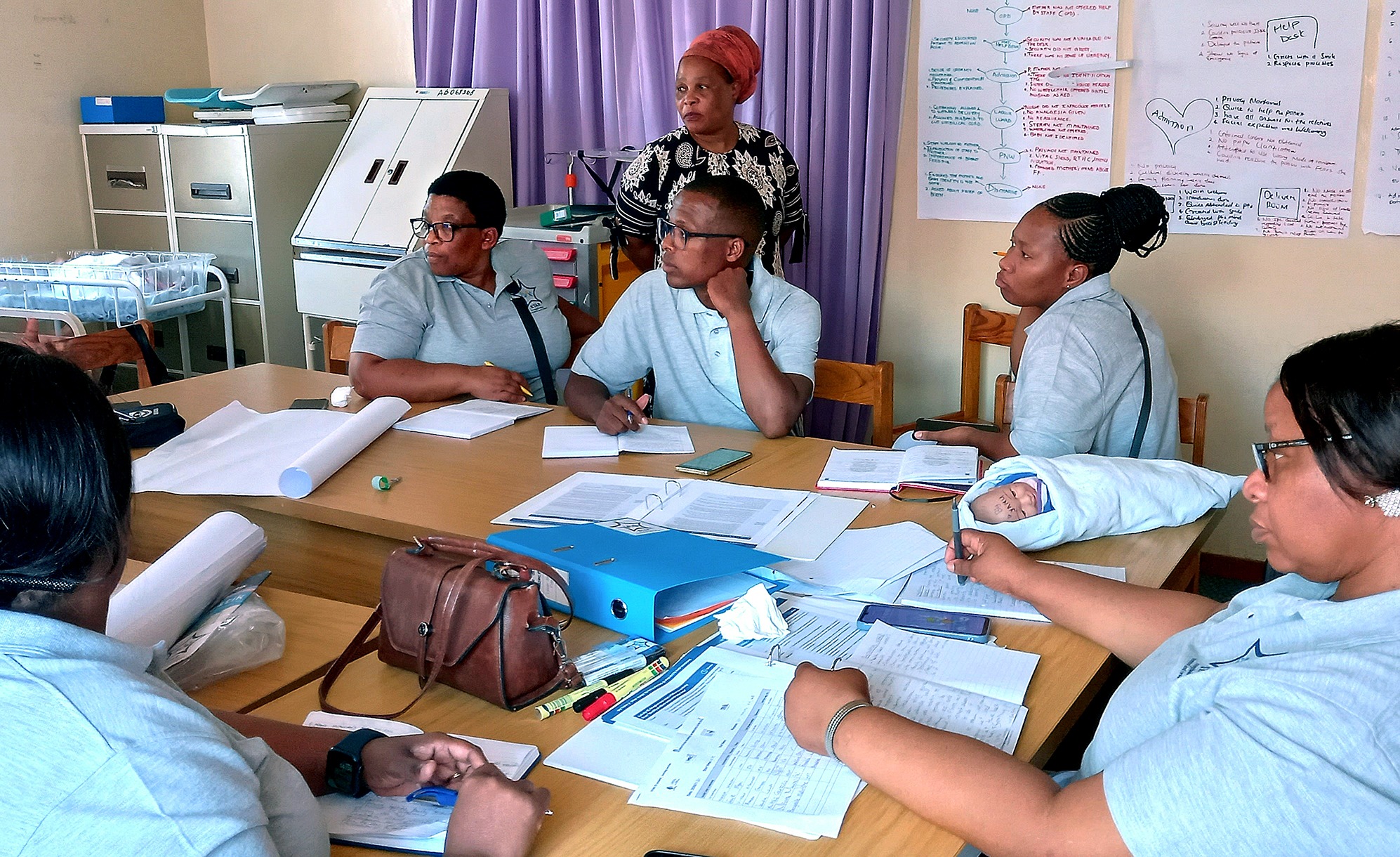
 Maternity unit staff from a STAR study hospital take part in a group learning session to reflect on and improve the care women receive during childbirth.
(Photo: Mr Mfundo Magoso)
Maternity unit staff from a STAR study hospital take part in a group learning session to reflect on and improve the care women receive during childbirth.
(Photo: Mr Mfundo Magoso)Every day, thousands of women across South Africa enter health facilities to give birth. This should be a joyful event for the woman and her family, defined by supportive care in a setting where she feels safe and is treated with dignity and respect. Instead, for too many women, it is a frightening experience marked by poor communication, lack of support and sometimes disrespect, which has been documented in South Africa for several decades.
Women report that health workers are rude, their concerns are not addressed and at times they are shouted at or even slapped if they do not obey instructions. These experiences are not incidental. They shape whether women trust the health system, whether they return for care in future pregnancies and ultimately, whether mothers and newborns survive and thrive.
When faced with these realities, the instinct is often to focus on individual health workers. To recommend more training or guidelines. While these responses are important, they are incomplete. They overlook a fundamental truth: midwives, nurses and doctors don’t go to work intending to cause harm to women in labour, but overwork and burnout drive these behaviours which become normalised within health worker teams. Maternity units are complex, high-pressure environments. They are often understaffed, with heavy workloads and competing demands. Hierarchies can be rigid, communication fragmented and accountability unclear. In such conditions, even the most committed and compassionate health worker can struggle to consistently provide respectful, supportive care.
Improving women’s maternity care experiences requires moving beyond focusing only on individual health worker behaviour and paying closer attention to how teams function and how organisational culture can support, or hinder, good care.
From training individuals to strengthening teams
This was the starting point for our recent study, published in Lancet Regional Health-Africa. Instead of intervening to change individual behaviour, we sought to determine whether strengthening teamwork and organisational culture could improve care.
A team including expertise in adult education and organisational psychology from the South African Medical Research Council and University of KwaZulu-Natal designed and tested a participatory intervention, Strengthening Teamwork and Respect (STAR), in nine district hospitals in rural KwaZulu-Natal. The approach was fundamentally different from traditional health system interventions. Rather than imposing external solutions, it created structured opportunities for health workers themselves to reflect on their work environment, identify challenges and develop practical responses.
Maternity staff (including nurses, midwives, doctors, managers and non-clinical staff) came together in regular learning sessions led by peer champions selected from within the maternity teams. These sessions encouraged open discussion across professional hierarchies, allowing staff to share their experiences of how care is delivered during labour and delivery and to consider how it is perceived by women.
What followed was not a standardised set of solutions, but a range of locally led changes. In some hospitals, teams focused on improving communication, ensuring that women were informed at all times about what was happening and their permission was requested before any examinations or procedures. In others, staff worked to overcome barriers to allowing birth companions, usually partners or family members, to accompany women during childbirth, a practice widely recommended but which has proven difficult to implement. Some teams turned their attention inward, addressing staff absenteeism and burnout, recognising that respectful care for patients is closely linked to how health workers are coping.
Crucially, these changes did not depend on additional resources or new technologies. They were implemented within existing constraints, drawing on the knowledge, creativity and initiative of frontline staff. What emerged was a reminder that frontline health workers often already know what needs to change. What they frequently lack is the organisational support, leadership and protected space to reflect collectively and implement those changes.
Small changes, meaningful differences
Surveys with postpartum women and maternity staff before and after the intervention assessed changes in care experiences and organisational learning culture within maternity units. The results were encouraging. Women reported improvements in how they were treated during childbirth, particularly in communication, autonomy and the level of support they received. Importantly, the greatest improvements were seen among women from poorer households and those who had attended fewer antenatal visits, groups who are often most vulnerable to neglect or mistreatment. This suggests that strengthening teamwork and organisational culture can contribute not only to better care, but to more equitable care.
We also observed improvements in how maternity teams functioned. Staff reported stronger teamwork, greater opportunities for reflection and increased support for learning and taking initiative. The improvements observed in the study may appear modest statistically (4% increase in the overall person-centered maternity care scale from 62% to 66%) but were achieved over a short period of only 12 months. In settings where disrespectful care has become normalised, even relatively small shifts in provider behaviour can fundamentally change women’s experiences of childbirth. Being informed before a procedure, being spoken to respectfully or having a supportive companion present during labour can shape whether a woman experiences childbirth as safe and dignified, or frightening and dehumanising.
Bridging the gap between policy and practice
South Africa has made important strides in recognising respectful maternity care in policy. National and provincial guidelines emphasise dignity, communication and women’s rights. But experience shows that policy alone does not change practice. Implementation is shaped by local conditions, staffing levels, organisational culture and the everyday realities of service delivery. The STAR study highlighted an uncomfortable reality: respectful care cannot be separated from the conditions under which healthcare workers are expected to function.
Participatory approaches like STAR offer a practical way forward. By creating space for frontline teams to reflect and identify their own priorities for change, they enable improvements that are both grounded in reality and more likely to be sustainable. They foster ownership and accountability, helping ensure that change is not only initiated, but sustained.
This is not about replacing top-down leadership, but about complementing it. Supportive management and a conducive policy environment remain critical. But real change often happens at the frontline, where care is delivered, and where health workers must navigate complex challenges daily.
A shift in how we strengthen health systems
The lessons from the STAR study extend beyond maternity care. They highlight a broader issue in health system reform, the need to focus not only on resources and infrastructure, but also on the relationships and environments that shape care. Too often, strengthening the health system is equated with building facilities, or procuring equipment. While these are essential, they are not sufficient. We must also invest in the less-visible elements, teamwork, leadership, communication and organisational culture, that determine how care is actually delivered. At a time when South Africa is debating the future of healthcare through the National Health Insurance and Treasury is paying out more than R1-billion in negligence claims stemming largely from obstetric cases, we need to ask not only how to make services more available, but also how patients and health professionals experience them.
Creating space for reflection, dialogue and collective problem-solving is not an optional extra. It is central to improving both patient experience and health outcomes.
Respectful care is a matter of justice
Respectful maternity care is not a luxury. It is a core component of quality health services and a matter of human rights. Every woman has the right to be treated with dignity and respect when she gives birth. South Africa has made significant progress in expanding access to facility-based deliveries. But access alone is not enough. Ensuring that care is respectful, supportive and person-centred must be a priority.
This study shows that change is possible, even within existing constraints. It requires a shift in mindset, from blaming individuals to understanding and improving the systems in which they work. When we strengthen teams, create supportive environments and enable health workers to reflect and act, we create the conditions for better care. And when that happens, it is not only health workers who benefit, but the women and families who rely on the health system at one of the most vulnerable moments of their lives. DM
Professor Tanya Doherty is a chief specialist scientist at the South African Medical Research Council and lead author of the STAR study. Dr Christiane Horwood is a senior researcher at the Centre for Research in Health Systems at the University of KwaZulu-Natal and co-lead on the study.
Comments
Scroll down to load comments...