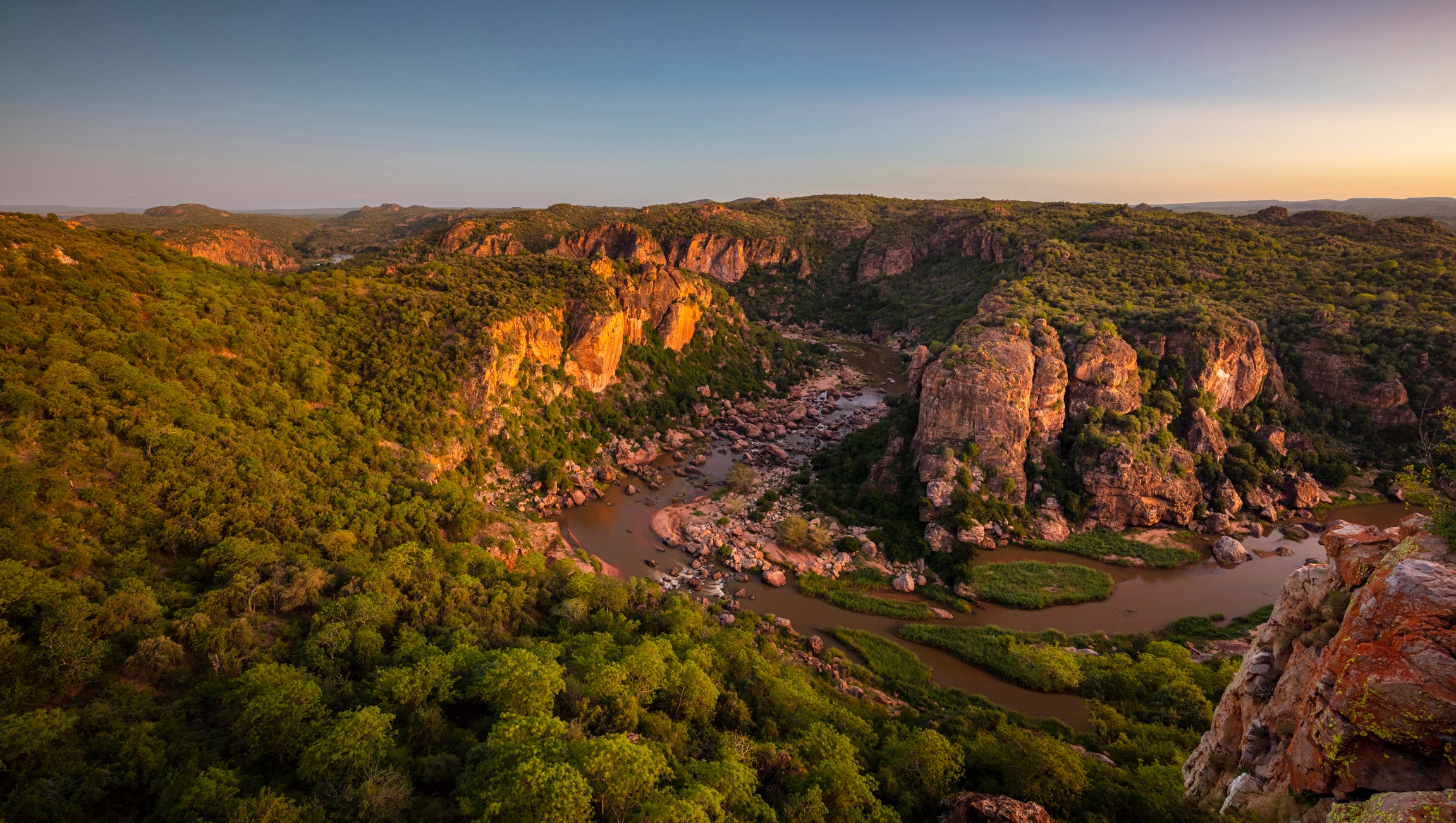
 Lanner Gorge was formed by the Luvuvhu River in the Makuleke Concession, in the Pafuri region of Kruger National Park. The writer’s favourite experience on foot in Kruger was walking barefoot through the shallow waters of the gorge. (Photo: iStock)
 Every time I drive through a park gate, I take a deep and deliberate, chest-swelling breath of “Kruger air”. I immediately relax. It feels like coming home.
I know I am not alone in this feeling. Countless people have made lifetime memories in Kruger, some life-changing and even life-shaping. This is how this grand old national park has become woven into my story.
Children are often asked: “What do you want to be when you grow up?” My answer was never “an astronaut” or “a doctor” or “the president”. It was consistently, and childishly, emphatic: A “game ranger.”
This ambition stemmed from family trips into nature. Weekends away ranged from the rugged mountains of the Kouebokkeveld to the Overberg coastline. About once a year, however, we kids (originally one, then two, and a bit later three) would be squeezed between cooler boxes and charcoal into our cherry-red Toyota Venture for a longer holiday. The destination was always a nature reserve or national park, but our most memorable and eagerly anticipated trips were always to Kruger.
We drove. And drove. And then drove some more. And we kids were entirely on board with it.
From where I grew up in Cape Town, it is a long, multiday drive. In fact, if you draw a line from Cape Point to Pafuri it is probably the furthest straight-line distance across the country. But that did not deter my parents, and the distance and effort to get there added to the mystique and awe of the place in the minds of those of us in the back seats.
We did not experience Kruger the way many foreign tourists do – khaki-clad Jeep jockeys chauffeuring you from sighting to sighting, relaxing middays at the pool or in the spa, and well-catered sundowners. We drove. And drove. And then drove some more. And we kids were entirely on board with it. You see, my parents had devised a genius system of rewards for sightings, paid out at the end of each day in Smarties and Jelly Tots. For the more common species, it was the first spot of the day that earned you that sweet prize. First impala? One Jelly Tot. Warthog? Have two. Kudu, nyala and bushbuck bagged you three. For the rarer animals, it was a per-sighting reward. Hyenas could be worth five, but a big cat would get you 10! I developed an intense set of “bush eyes” and my parents were spared from us getting bored or tired with sweets on the line. Maybe one of the reasons I still keep going back to the bush over and over is the now-hardwired endorphin hit I get with each sighting, even if I am no longer so easily bribed with sugar.
Those early trips to Kruger instilled in me an appreciation for the intrinsic value of nature. That value has persisted through my personal life, academic training and career. To this day, I seek out natural spaces for respite and recharging. I also firmly believe that we should be conserving natural areas and systems for their own sake, apart from the benefits we derive from them as people.
/file/attachments/orphans/103349855_335819.jpg "A vulture in the Edeni Game Reserve – a 21,000-acre wilderness area with an abundance of game and birdlife near Kruger National Park. (Photo: Cameron Spencer / Getty Images)")
My connection to Kruger did not fade in adulthood. I have made it a mission to visit the park at least once a year since turning 21 in 2013.
As you get older and look back on life, you can identify pivotal moments that determine your life’s direction in one way or another. It was in 2013 that I had one of my more influential experiences – in Kruger, of course.
Holding Africa’s largest eagle in the heart of the continent’s premier reserve felt momentous. Something shifted in me
While in my third year of studying biology at the University of Cape Town, we had to select a literature review from a list of topics. I chose the conservation crisis unfolding for African vultures, which was marked by Dr Arjun Amar as one of the resident academics within the FitzPatrick Institute of African Ornithology. I gravitated towards that topic because of my blossoming interest in birds, a passion that Arjun identified in my submission and chose to foster. He invited me to join his doctoral student, Rowen van Eeden, for his research fieldwork in Kruger. Rowen was GPS-tagging Martial eagles and mapping their territory sizes, distribution and spatial use in Kruger. A funded trip to Kruger was an easy sell.
The methodology was simple: drive until you spotted a Martial eagle, set a baited trap within sight, then park 50m to 100m away and wait. The anticipation felt eternal after the initial excitement of finding a bird and setting the trap. It took a couple of days before the first eagle took the bait – Rowen moved in quickly to secure the bird, restrain its talons, and then handed it to me. I held the bird tightly into my chest, with it facing away from me, my arms holding its wings closed and hands clasped around the feet. Rowen turned back to the bakkie to fetch his equipment, leaving the two of us alone for a moment. The bird, a male, looked over its shoulder and we made eye contact. It wasn’t a look of fear I saw, but rather seething anger, as if to ask: “How dare you, mere mortal, constrain the lord of the skies in such indignity?” Holding Africa’s largest eagle in the heart of the continent’s premier reserve felt momentous. Something shifted in me, which I now realise cemented my commitment to environmental work, both personally and professionally.
The next year, I registered for my postgraduate honours degree. UCT has a relationship with the US-based Organization for Tropical Studies to allow for two South African honours-level students to join their semester abroad programme studying ecology and conservation in South Africa. The course travels extensively for 100 days throughout the country but is based out of Skukuza, Kruger’s main camp. I think my eagerness was quite evident, and I was selected.
The time spent on the course being taught by resident staff as well as guest academics and SANParks officials greatly enriched my appreciation for Kruger’s complexity. Living in the Skukuza staff village gave me a sense of being a “resident” rather than a “visitor”. We participated in long-running research programmes monitoring everything from river health to small mammals, to fire and herbivore exclusion experiments. In lectures, we were taught about adaptive management, savanna ecology and the rainfall and geological gradients that determine the macrohabitats across the park. Armed with this fresh understanding, the park really came alive. Game drives became less sightings-driven as my “bush eyes” matured to a deeper level of interpretation of the environment – changing landscapes, patterns of animal behaviour and interactions between the physical environment and biodiversity gave new depth to journeys by road or, as an occasional treat, on foot.
At one point, a spotted hyena dissected the line of runners with a loping charge towards the Nwasitshaka River.
My favourite experience on foot in Kruger was walking barefoot through the shallow waters of Lanner Gorge in the Pafuri region. After graduating my master’s degree (through the FitzPatrick Institute at UCT), I began working for BirdLife South Africa which, at the time, had a registered project to monitor the black stork population. Despite my work focusing on African penguins at the time, the research team invited me to join the annual survey. Although we found pitifully few storks (the rivers running into Kruger are, sadly, increasingly polluted), the experience of looking down at my submerged toes and then up at the sheer cliffs was another “pinch me” moment. I felt deeply connected to Kruger in that moment – away from tourist roads and grounded with bare soles in a secluded, truly wild corner of the park. Of course, I could not gawk upwards at the cliffs for too long while I remained potential croc bait.
After swapping penguins for birding tourism projects and moving to Johannesburg, trips to Kruger could be done in a weekend rather than a week. Any excuse would do, especially if work could cover the cost. I attended a course in Letaba under the late, great Joe Grosel, convinced my colleagues to host a team strategy session in Skukuza, joined a Vulture Safe Zone roadshow, and got the organisation listed as a beneficiary of a trail run just outside Kruger Gate. Outside of work, there were trips with friends, girlfriends and family. Both my and my partner’s moms celebrated milestone birthdays with gatherings in Letaba. There were also a couple of special trips with my brother, including a sighting of four lionesses chasing a leopard up a tree and an ambitious attempt to see 200 birds in 24 hours on Birding Big Day (we ended up about 10 short). I even allowed myself, against better judgement, to be entered into the Skukuza half marathon, my first 21km race. Running through the park was a rare privilege. At one point, a spotted hyena dissected the line of runners with a loping charge towards the Nwasitshaka River. The adrenalin is, I think, what carried me eventually to the finish line just within the cutoff time.
I will never forget the abject horror of driving into Kruger with a blue light brigade.
In 2024, my life changed remarkably when I made the rather unique career move from conservation into politics. I was elected to the National Assembly as a member of Parliament for the Democratic Alliance. You would think this might hamper my ability to get to Kruger (politicians who take their work seriously are incredibly busy, contrary to popular perceptions). However, I was able to motivate for my selection to the Portfolio Committee on Forestry, Fisheries and Environment, which was a somewhat comfortable home ground in this new and intimidating political world. One of the entities that answers to this committee is South African National Parks – a prescient coincidence. Our very first committee oversight trip took me back to Kruger to engage in novel operational issues that I had never considered – land claims, anti-poaching and infrastructure renewal.
/file/attachments/orphans/1-1_292345.jpg "Before serving as a member of Parliament Andrew de Blocq worked as a Coastal Seabird Conservation Project Officer and avitourism project manager at BirdLife South Africa. (Photo: Supplied)")
I will never forget the abject horror of driving into Kruger with a blue light brigade. Despite my protestations, the police escort insisted that the lights must stay on but conceded that the sirens could be turned off. They tried to speed us through the park, which I found completely unacceptable. First, I think it is plain wrong for the police and government officials to believe that rules, such as speed limits, apply to some and not others. Second, it was the first visit to the park for most of our committee members who, unlike me, did not have an environmental background. I wanted them to at least be able to stop and experience bits and pieces of Kruger for themselves – an elephant herd grazing on the roadside, a giraffe trimming the top of an acacia (sic. – I refuse to use any other name). It was crucially important for their buy-in for future committee support for Kruger and SANParks more generally. Luckily, the entourage agreed after my complaints to limited stops and a reasonable, legal speed.
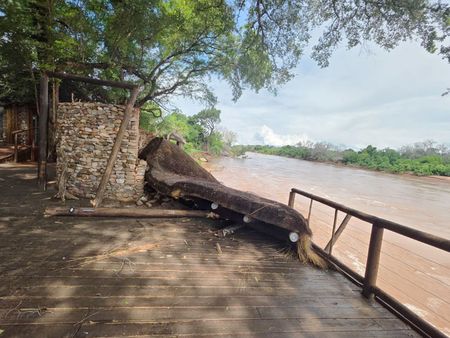
This experience was later important in securing a unanimous buy-in from the portfolio committee for the Kruger Recovery Fund, set up to fundraise for the crisis response in the wake of the devastating 2026 floods. Although animals instinctively sought safety, the deluge washed away roads and caused more than R1-billion in infrastructure damage. To SANParks’ credit, their evacuation plan was superbly executed – not a single staff member nor visitor was injured or killed during the unprecedented natural disaster. However, it will now be a long and expensive rebuilding phase, especially with the floods having wiped out significant earning potential for SANParks.
On 31 May 1926, the then minister of lands, PG Grobler, proposed the National Parks Act to Parliament. It was seconded in a rare display of political unity by the leader of the opposition, General Jannie Smuts. The signing of the Act brought the Kruger into being as the first national park in South Africa, and only the fourth worldwide. It is a surreal privilege for me to sit in Parliament 100 years later and to be invited to the centenary celebrations taking place this coming weekend in Skukuza.
As we mark 100 years of Kruger and reflect on its complex history and our own connections to it, I encourage support for the Kruger Recovery Fund by donating or sharing its message. For a century Kruger has given people from around the country and the world profound and lifetime memories. In the time of its greatest need, it is time that we give it some love in return.
I would be a very different person without Kruger’s influence, and I hope that many generations of others will continue to benefit for the next 100 years and beyond. DM
Andrew de Blocq MP is the DA’s national spokesperson on forestry, fisheries and the environment.