




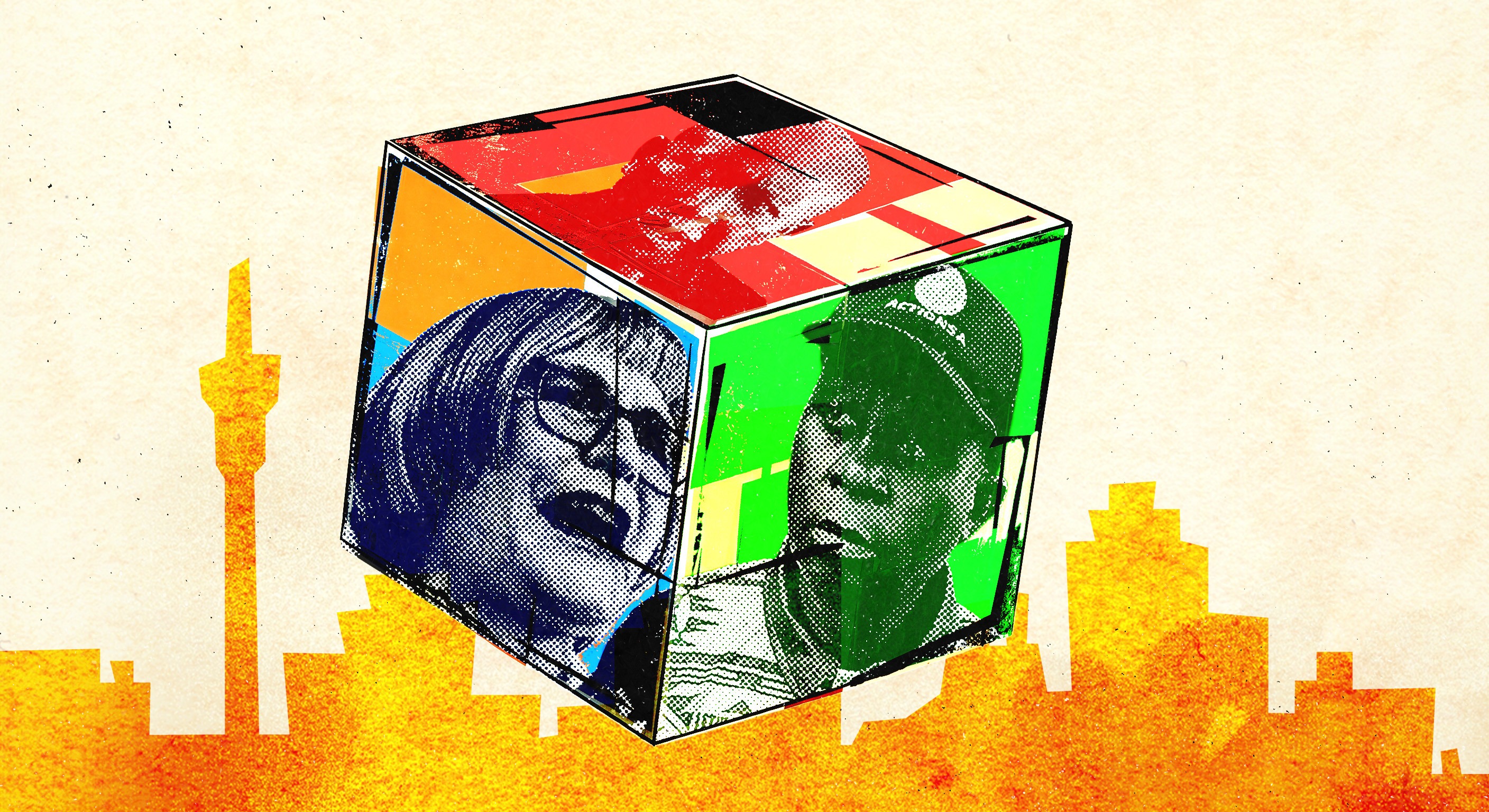
 Illustrative image: EFF leader Julius Malema. (Photo: Gallo Images / Randell Roskruge) | ActionSA leader Herman Mashaba (Photo: Bheki Simelane) | Democratic Alliance mayoral candidate for Johannesburg Helen Zille (Photo: Per-Anders Pettersson / Getty Images)
/file/attachments/orphans/Election2026LogoInarticle_260133.jpg)
It is in the nature of politics that candidates try to frame the choice voters face. They will then argue that unless you vote for them, armageddon will ensue.
This is why the DA will argue that Joburg will simply continue its decline if the ANC wins, while the ANC will argue, in some coded form, that the DA wants to bring back apartheid.
But the choice facing voters in Joburg is much more nuanced than that. And the voting patterns show that the final picture will be nuanced, too.
While the campaigning phase will probably be dominated by the DA and the ANC (if it is ever able to find a candidate), the days after the voting are likely to be fairly confusing.
This is because other players such as the MK party, ActionSA and the EFF will probably win significant shares of the vote.
Of the people who voted in the Johannesburg council region in the Gauteng provincial elections in 2024, 6.22% voted for ActionSA, 12.46% voted for the EFF and 12.22% for MK.
This means that if this had been an election in Joburg, the three together would have won just under 30% of the vote. That could be more than the ANC will win and possibly more than the DA, too.
This is why the various combinations are so interesting.
One of Helen Zille’s main arguments to her constituency is that the DA needs a mandate to govern on its own. She claims that would make it easier for them to “reform” Joburg.
/file/attachments/orphans/ED_599291_296231.jpg "DA mayoral candidate for Johannesburg, Helen Zille. (Photo: Gallo Images / Sharon Seretlo)")
While this is possible, it would seem, for the moment at least, unlikely. No party has won a majority in Joburg since the ANC won in 2011.
This means that some form of coalition will be needed. Based on those 2024 figures (just two years ago), the EFF, MK and perhaps Action SA would all play a deciding role.
ActionSA and MK’s influence
This is where the dynamics of the various parties become important.
The EFF is already in coalition with the ANC in Joburg and more recently has seen its Gauteng leader appointed as finance MEC in Gauteng, again with the ANC.
Action SA has moved from one party to the other. While its leader (and apparently only decision-maker) Herman Mashaba was previously a Johannesburg mayor for the DA, who said he entered politics primarily to remove the ANC from power, he has now worked with the ANC.
The party’s Nasiphi Moya is the mayor of Tshwane, kept in place with support from the ANC (and primarily the deputy mayor there, ANC Tshwane leader Eugene Modise, who has been found to have benefited from security contracts with the council).
Also, Mashaba seems to have a personal animus against Zille, taking every opportunity to insult her. As he is Action SA’s mayoral candidate while she is the DA’s candidate, it seems impossible to imagine one working under the other.
/file/attachments/orphans/ED_597090_291417.jpg "ActionSA leader and Johannesburg mayoral candidate, Herman Mashaba. (Photo: Gallo Images / Fani Mahuntsi)")
MK also presents a complex picture.
It is probably safe to assume that this party and the DA will never work together, if only because the DA would not be able to explain that decision to its constituency. MK too needs an enemy, and while the ANC plays that role, the DA might be a useful target, too.
However, that does not mean MK can work easily with the ANC, particularly in Gauteng.
Former president Jacob Zuma created MK particularly out of his hatred for President Cyril Ramaphosa. This is why the party so regularly criticises Ramaphosa rather than the ANC.
But the person who is still most likely to take over from Ramaphosa, Deputy President Paul Mashatile, also has a difficult history with Zuma.
Mashatile led the Gauteng ANC in its campaign against Zuma in 2012 and then continued to fly the flag against him during the State Capture era.
When big business and civil society groups held mass protests against Zuma, it was Mashatile’s stance that gave them some legitimacy.
This history might become important in the upcoming local elections.
This might mean that a coalition involving the ANC and MK will be much more difficult than the present coalition that includes the ANC and the EFF.
Turnout key
All this means that in reality, the final tally may come down to the ANC and the EFF (and a few other smaller parties such as the Patriotic Alliance and Al Jama-ah) on one side, the DA and whoever supports it on the other (these would presumably include the FF+, the ACDP and several others).
In that scenario, MK might not be a factor. This would then make the performance of ActionSA key. Strangely, Mashaba could be the critical decision-maker.
However, while the Joburg figures on the 2024 Gauteng election are a useful guide, they are still the past. More voters are changing their choices in our democracy than ever before, and much can still change.
As always in local elections, turnout will be key.
In the past, this has benefited the DA as its constituency has a higher rate of turnout in local elections.
This points to one of the sadnesses of our elections. While there is much regional diversity in terms of voting numbers, it appears that wealthier people in the suburbs might be more likely to vote than poorer people in townships.
Considering that the ANC is highly likely to battle to get its former voters to the ballot box, this dynamic might radically alter the election’s outcome.
The EFF might also find that its voting share continues to slide. Certainly, Julius Malema’s use of his firearm trial as a campaigning tool might show an element of desperation.
/file/attachments/orphans/ED_608022_289636.jpg "EFF leader Julius Malema. (Photo: Gallo Images / Luba Lesolle)")
And once again, the biggest variable is MK.
While it appeared to almost come out of nowhere in 2024, it is difficult to precisely predict whether it has built momentum from there.
Instead, recent developments point to a party happy to wallow in perpetual chaos.
This leads to what might, in the election aftermath, become the most obvious combination.
ANC-DA blueprint
It seems likely that the ANC and the DA together should be able to win at least 60% of the vote. And, as with the situation in national government, that might well provide the most compelling option.
This would depend on the ANC being prepared to work under Zille as mayor.
But considering that the ANC’s current leaders in Joburg appear to lack legitimacy, the party might well decide this is its best option. The DA’s leadership might sell this to their constituency as an opportunity to reverse the current power relationship between the two parties and serve as a blueprint for what they would like to happen in national politics in 2029.
This may seem like pure fantasy at the moment, but become closer to science fiction by the time the results are clear on the morning of 6 November. DM
Comments
Scroll down to load comments...