



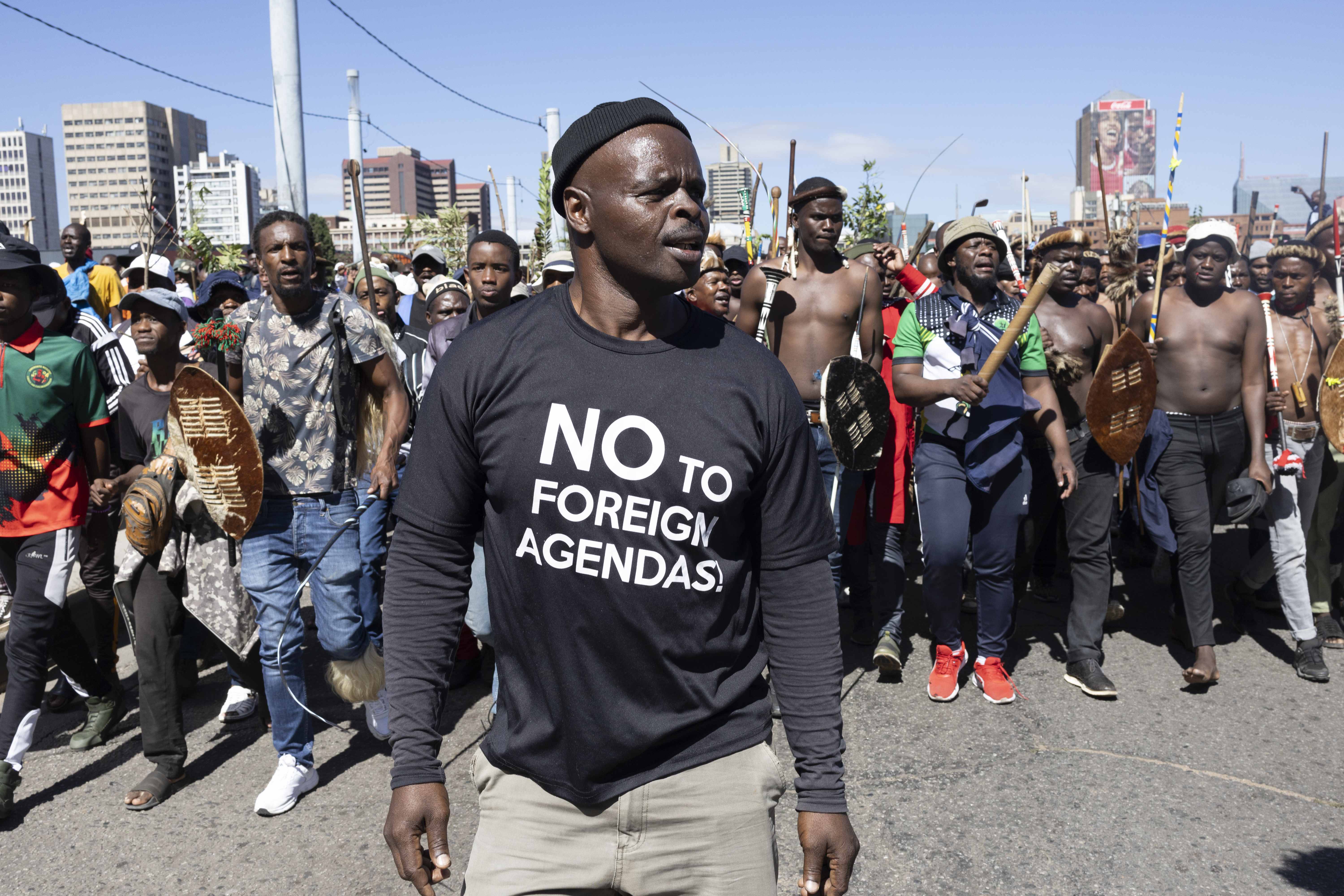
 Protesters march through the streets of Johannesburg on 29 April in a March and March demonstration calling for all illegal foreign immigrants to leave South Africa. (Photo: Kim Ludbrooke / EPA)
Close to 300 Ghanaians fleeing growing xenophobic tensions and violence in South Africa boarded a repatriation flight on Wednesday that was organised by the Ghanaian government.
It was the first of two repatriation flights; on Sunday, another 300 Ghanaians will be flown out, said the Ghanaian high commissioner to South Africa, Benjamin Quashie.
The two repatriation flights have aggravated tensions between the countries over xenophobic attacks. Contentious disagreements remain regarding both the legal status of the Ghanaians seeking repatriation and the official tally of passengers who departed.
SA officials told Daily Maverick that only 10 of the 300 Ghanaians who were to board the flight on Wednesday were properly documented.
“The remaining 290 are undocumented, including 26 deportees who were held at Lindela [a repatriation centre in Gauteng]”, said Chrispin Phiri, the spokesperson for International Relations and Cooperation Minister Ronald Lamola.
The Border Management Authority (BMA), which conducted the check-in process, said that the Ghanaian embassy had issued the passengers with emergency travel certificates — a one-way, single-page document that allows a traveller to return to their country.
“Most of the travellers were found to have overstayed [by] more than 30 days, whilst some overstayed by a year or more. As a result, they were declared undesirable in terms of Sec 30 of the Immigration Act, [with] regulation 27(3)(c) of the Immigration Regulations,” said the BMA.
However, Quashie denied this, saying: “Eighty percent of the 300 people we took to the airport were documented migrants. I’ve asked them [the SA government] to come with the documents to show otherwise.”
/file/attachments/orphans/6799100407c4e1738084356_392358.jpg "Ghana's high commissioner to South Africa, Benjamin Quashie, (Photo: peaceFM online / Wikipedia)")
The BMA said that 295 Ghanaians were finally allowed to board.
Of the five who were not allowed on the aircraft, according to the BMA, one passenger had a valid asylum-seeker permit, which they are required to cancel their application for protection before returning to the country they had fled from.
Another passenger was in possession of an expired passport and hadn’t been issued with an emergency travel certificate.
The BMA said a third person was intercepted trying to depart with two minor children believed to be her nieces or nephews. She lacked documentation proving her relationship to the children and the required written consent from her sister.
“The travellers who were denied departure ... were handed back to the Ghanaian high commissioner for future repatriation should they meet the relevant immigration requirements for departure.”
Quashie, however, said the only problem that had arisen was that one woman set to fly on the aircraft had no birth certificates for her two children, so the Ghanaian authorities would not let them on the flight. According to him, 297 returnees boarded the flight.
He said the Sunday flight might take off from Lanseria airport west of Johannesburg. “Because of the logistics,” he said, “we had a lot of delays at ORT today. So they are telling us that if possible, they might give us the Lanseria airport, where there will be better coordination, and everything will go on smoothly.”
‘Very disheartening’
Asked how he felt about his citizens being forced to flee South Africa under such conditions, Quashie said, “That is what happens when you have a country whose institutions are not working. When you have a country where individuals take the law into their own hands.
“Of course, it is very disheartening. It is very, very sad that in a community of nations as Africans that we are, we have to be doing this to each other. It is so sad.”
Quashie confirmed that his government intended to bring up the issue of xenophobia in South Africa at the mid-year summit of the African Union next month, as it had vowed to do a few weeks ago.
“Of course. We are not changing our minds on the AU. We even decided to go to other agencies, of the UN, to report this matter. The treatment is not right, and we have to make sure that these things stop.”
He told the BBC, “The Ghanaian government listened to the plight of its citizens in South Africa, who felt that their lives were in danger, who felt like the economic activity that they were engaging in had come to a standstill, who felt unwelcome in this country, and it is the responsibility of every government to ensure that its citizens are taken care of both home and abroad.”
The SA government’s justice, crime prevention and security cluster of ministers on Monday met leaders of the March and March movement — which has been organising marches against illegal immigration — as well as political parties and NGOs, to discuss the crisis.
/file/attachments/2991/20260429_141352_950763.jpg "March and March leader Jacinta Ngobese-Zuma addresses supporters in Johannesburg on 29 April. (Photo: Bheki C. Simelane)")
March and March has threatened to shut down the country if all illegal migrants do not leave the country by 30 June. This has sparked fears of a repeat of the disastrous June 2021 riots in KwaZulu-Natal and Gauteng, according to Groundup.
Freedom of speech
At the cluster meeting, Justice Minister Mmamoloko Kubayi acknowledged public frustration over socioeconomic conditions, but warned against unlawful and violent conduct, Groundup reported.
“The marches are protected. People’s right to march is protected in the Constitution. The freedom of speech is protected,” it reported Kubayi as saying. “However, we emphasised the importance of ensuring that these marches are peaceful.”
Groundup also reported her as saying some protest organisations may have been infiltrated by people seeking to incite violence. “She urged communities not to scapegoat immigrants for problems like unemployment or economic hardship,” said the publication.
/file/dailymaverick/wp-content/uploads/2025/02/ED_452873.jpg "Justice Minister Mamoloko Kubayi. (Photo: Fani Mahuntsi / Gallo Images)")
On Monday, Lamola likewise suggested that outside forces might be deliberately exaggerating the situation to harm South Africa. He told journalists in Cape Town that fake news was circulating on social media about people being killed and mutilated, whereas none had been killed or mutilated in the present wave of xenophobia.
“So, in that context, it does appear that there is someone who wants to plant a narrative against South Africa, but where there is reality, we have to face it.”
Asked who he thought was planting a narrative against SA, he said, “Obviously, with the geopolitical environment and South Africa’s role in the international space, including our case [against Israel] at the ICJ [International Criminal Court], you cannot exclude state and non-state actors trying to erode the human rights standing of South Africa on the global stage.”
Meanwhile, the ANC secretary-general, Fikile Mbalula, this week condemned the recent anti-immigrant vigilantism.
He said anyone engaging in “mob justice” or harassment would face prosecution, adding that the party fully backed the South African Police Service and the National Prosecuting Authority in enforcing the Prevention and Combating of Hate Crimes and Hate Speech Act.
“We urge our people to balance their actions with the discipline of legality,” Mbalula said at a press conference, according to Polity. “We cannot fight unlawful conduct in a democracy by ourselves engaging in unlawful conduct.”
He warned that vigilante behaviour threatened national stability and risked turning South Africa into a lawless state, the paper reported him as saying.
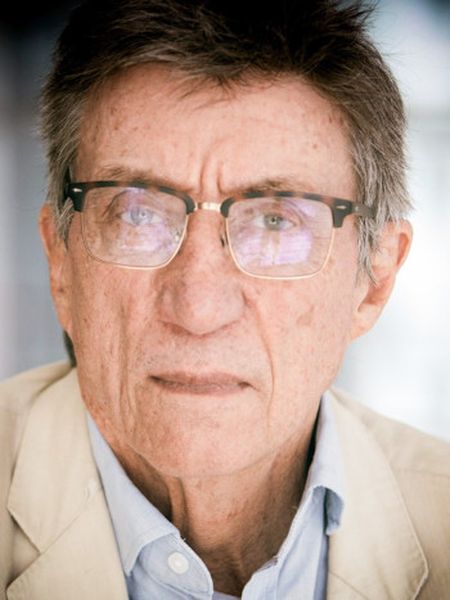
Loren Landau, a research professor at Wits University’s African Centre for Migration and Society, told Daily Maverick, “I think since 1994 there’s always been these tensions in South African politics between the kind of Mbeki’s pan-Africanist global orientation and what Zuma represented … a much more ethnic or nationally based inwardly looking South African transformation.
/file/attachments/orphans/Loren_Landau_web_new_893237.jpg "Wits immigration expert Loren Landau.
<br>(Photo: University of Oxford / Wikipedia)")
(Photo: University of Oxford / Wikipedia)
“And, over the years, that kind of inwardly looking or South Africa-first kind of idea … has really gained prominence. So I think these are just the latest incidents in which South Africa is continuing to turn its back on … whether it’s SADC or AU things … to try to really promote South African interests above continental interests.
“I think … it is already hurting South Africa — it’s hurt the brand South Africa, it’s hurt South African tourism, it’s hurting South Africa’s moral authority on the continent and its ability to shape continental politics, and it’s going to hurt South Africa’s investment opportunities.” DM
Additional reporting by Victoria O’Regan.
Comments
Scroll down to load comments...