




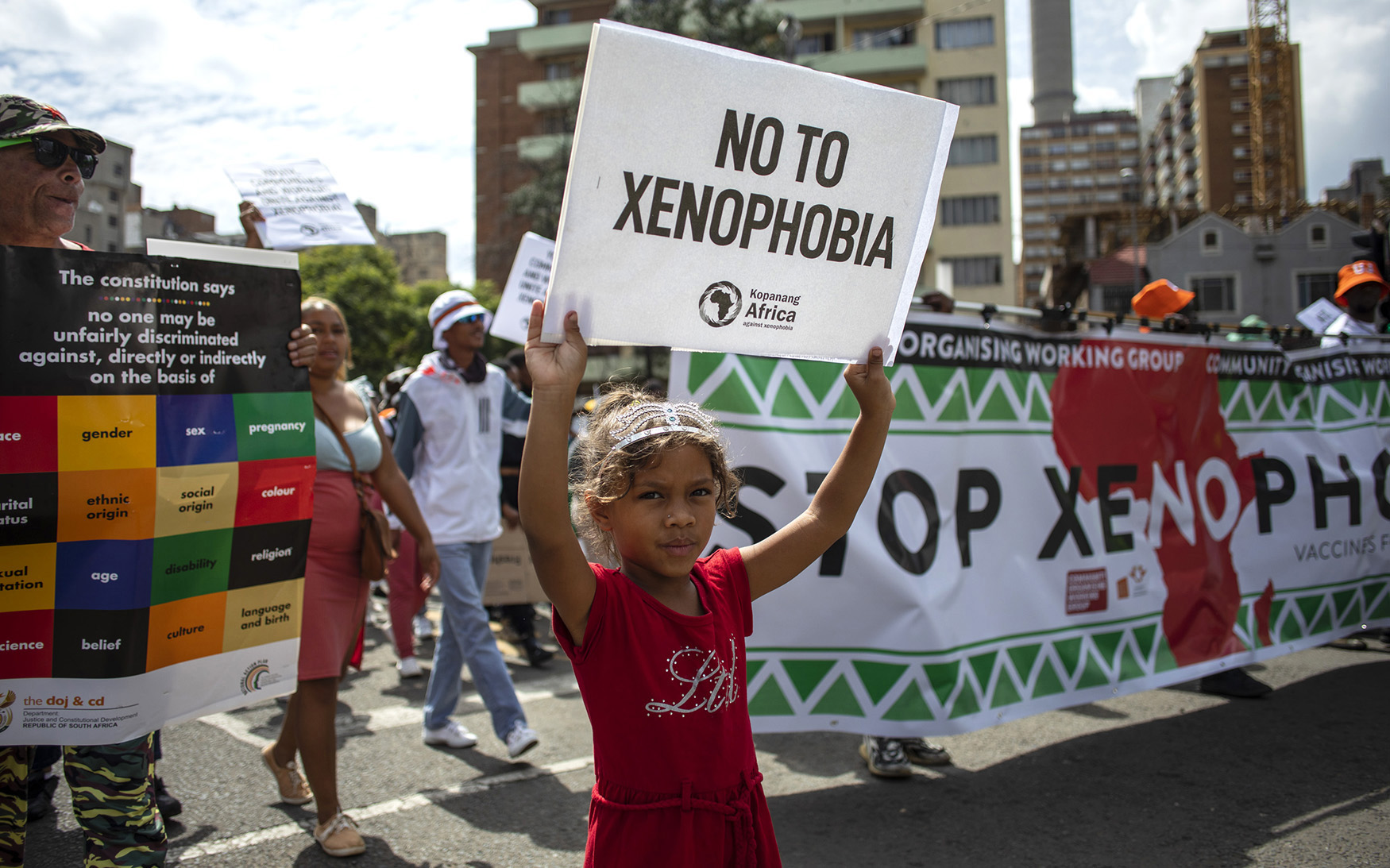
 People take part a rally organised by Kopanang Africa against Xenophobia, calling for an end to ‘xenophobic sentiments and groups’, in Johannesburg on 26 March 2022. (Photo: EPA-EFE / Kim Ludbrook)
In recent years South Africa has faced recurring waves of xenophobic violence, highlighting the urgent need for effective legal and policy measures to combat hate crimes and protect vulnerable communities.
Despite the government’s condemnation of xenophobic violence, the absence of robust legal frameworks, such as the criminalisation of hate speech, has hindered efforts to address the root causes of xenophobia and hold perpetrators, who often mobilise via social media, accountable. The Prevention and Combating of Hate Crimes and Hate Speech Act 16 of 2023, although enacted, remains inoperative due to pending regulations. As tensions rise in the lead-up to the November 2026 local government elections, it is imperative to expedite the implementation of this legislation to safeguard human rights and promote social cohesion.
On 17 April 2026 a Cameroonian shopkeeper, 20 years in the country, was confronted by a large group who broke down his front door and attacked him with golf clubs, whips and pepper spray. In recent weeks there have been many similar examples which have left victims unaided and too fearful of laying a charge. Events like these remain far too common in South Africa, emerging only in the light of international condemnation. It underscores the ongoing and urgent need for effective legal protections to combat xenophobia and promote social cohesion in South Africa.
The South African government has rightly condemned the most recent wave of xenophobia. However, this was not accompanied by what could have been its strongest message: the criminalisation of hate speech. Such a measure would have sent a clear warning to the perpetrators of the “March and March” and Operation Dudula actions that this racist behaviour will not be tolerated in South Africa.
South Africa’s Prevention and Combating of Hate Crimes and Hate Speech Act 16 of 2023 was signed into effect in May 2024, but it still awaits operationalisation and a commencement date. This will only happen once the draft implementing regulations are finalised. These regulations were published for comment in late 2025, and submissions closed on 28 January 2026. Now, three months later, the urgency seems forgotten. This bill, which was introduced back in 2016, provides an important tool for addressing impunity, which itself is a powerful prevention strategy. Had hate speech been criminalised before these current incidents, it could have addressed the rather lacklustre response from law enforcement to date against the harassment, assault and intimidation suffered by non-nationals.
Under the Act, any person will be guilty of hate speech if they intentionally publish, propagate, advocate or communicate anything to one or more persons that could reasonably be construed to demonstrate a clear intention to harm or incite harm and to promote or propagate hatred. This applies to prejudice based on several characteristics, including ethnic or social origin and nationality, migrant or refugee status. A first conviction would result in a fine, imprisonment not exceeding three years, or a fine and imprisonment. Subsequent convictions could result in imprisonment not exceeding five years.
The Act will also address the lack of data on hate crimes, which is key to our prevention efforts. It will require the police to collect hate crimes data, enabling an understanding of the full extent of the problem and improving the design and implementation of evidence-led interventions. It will also enable the police to mobilise critical resources to build their capacity to prevent, detect and investigate hate crimes.
Recent research by the Human Sciences Research Council shows that South Africans are more hostile towards immigrants than at any other time since the survey began in 2003. This coincides with the increasing normalisation of extra-legal enforcement, where civic groups illegally take it upon themselves to check and verify documents, bringing themselves into direct confrontation with state functions. The delay in operationalising the Act has left a gap in the legal system that must be addressed urgently. As the country approaches the local government elections, the potential for increased tensions makes it even more crucial to implement this legislation without further delay. By doing so, South Africa can demonstrate its commitment to upholding human rights, fostering social cohesion and ensuring that all individuals, regardless of their origin, can live free from fear and discrimination. DM
Sharon S Ekambaram is head of the refugee and migrant rights programme at Lawyers for Human Rights. Sean Tait is director of the African Policing Civilian Oversight Forum.
Comments
Scroll down to load comments...