




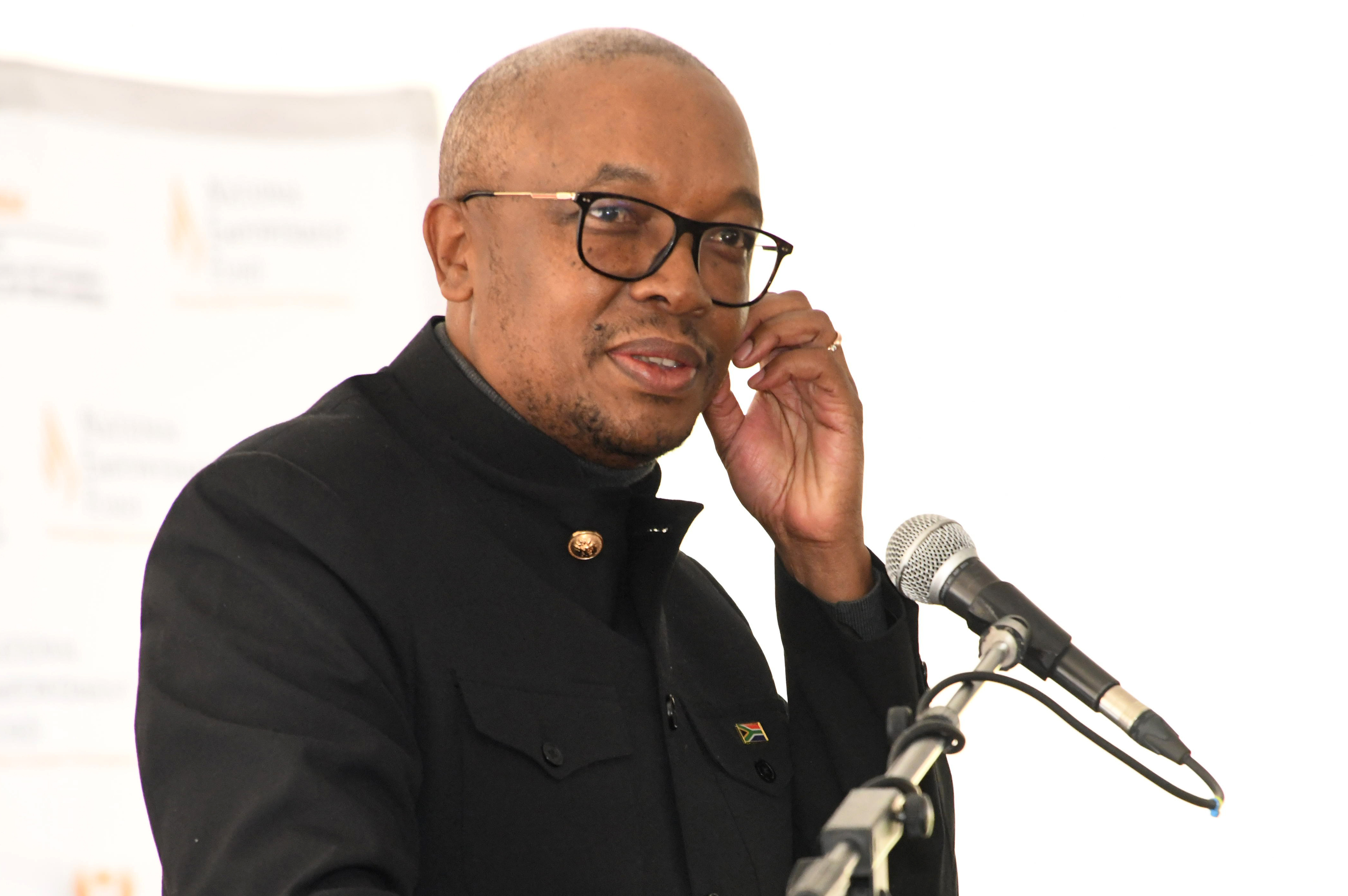
 Minister Parks Tau during a business breakfast engagement session on the Transformation Fund at Freedom Park Heritage Site and Museum in Pretoria. (Photo: Gallo Images / Frennie Shivambu)
That was the central tension at the Department of Trade, Industry and Competition’s (DTIC) post-budget engagement after Minister Parks Tau tabled Budget Vote 39 for the 2026/27 financial year in Parliament.
The engagement, chaired by programme director Hardin Ratshisusu and moderated by Deputy Minister Zuko Godlimpi, brought together organised labour, business and Parliament to reflect on the department’s industrial strategy, transformation agenda and delivery risks. The programme panellists were Stavros Nicolaou, group senior executive strategic trade at Aspen Pharma Group, Mzwandile Masina, chair of the Portfolio Committee on Trade, Industry and Competition, Matthew Parks, the parliamentary coordinator for Cosatu, and Christine Qunta, chair of the Legal Sector Charter Council.
Tau told Parliament that the DTIC and its entities had been allocated about R130.6-billion over the medium term to advance industrialisation, economic transformation and investment. He said Cabinet had adopted the Industrial Development Strategy, anchored in decarbonisation, diversification and digitalisation, because South Africa “cannot compete in the world of the future using the tools of the past”.
But the post-budget discussion quickly moved from industrial policy to implementation challenges: procurement rules, tariffs, state coordination, industrial financing, transformation litigation and whether the government’s own entities are buying in line with its policy goals.
Parks said the labour federation welcomed the policy direction, but wanted to see delivery.
“I think in terms of policy commitment, there’s good commitments, very progressive ideas,” Parks said. He rejected the idea that the ministry was “anti-business”, saying it was “pro business and pro workers, because we’re all in the same boat together”.
/file/attachments/orphans/ParksTau_278435.jpg "Minister Parks Tau at the post-budget engagement (Photo: DTI)")
But Parks warned that the DTIC’s budget is too small for the scale of the task. “We’re talking about industrialisation, 43% unemployed, 1% economic growth for the past 15 years, but in the world we allocate the 10, 11 billion year after year. It’s not enough. We should be actually adding a zero to it,” he said.
He said the challenge could not sit with the DTIC alone. Municipalities and provincial departments also had to buy local vehicles, furniture, textiles and other goods if industrial policy was to work.
/file/attachments/2992/dticbudgetvote_500276.png)
Qunta, a lawyer and businessperson involved in the legal sector transformation debate, was blunter. She argued that South Africa could not grow while most of the population remained locked out of meaningful economic participation.
“How can this economy grow, how can you create jobs when the economy locks out 92% of the population?” she asked. “When you oppose transformation, you oppose equality for black people in the economy, in professions everywhere.”
Qunta said black economic empowerment and employment equity should be understood not as optional add-ons, but as constitutional and economic tools to widen participation. She said some state-owned enterprises were unable to provide proper statistics on procurement from black lawyers and advocates because their systems did not capture the data, even though the BBBEE Act requires annual reporting.
/file/attachments/orphans/ChristineQunta_195764.jpg "Christine Qunta, chair of the Legal Sector Charter Council. (Photo: DTI)")
That weakness echoed one of Godlimpi’s concerns: that the DTIC can set policy, but cannot succeed if other parts of the state fail to move.
The deputy minister pressed the panel on whether transformation had been reduced to narrow ownership arguments, while the broader question of structural change had been lost. He argued that public procurement should be viewed as an instrument of industrial development, not merely a compliance exercise.
Nicolaou, who has long been involved in the pharmaceutical sector, said transformation made business sense because widening the middle class expands the market.
“The more previously disadvantaged people you bring into the middle class, the bigger your market is,” he said. “Whether you’re an importer, an investor, someone that’s domestically invested, if you had a middle class of five million people and you grow it to 25 million people, then you’re in panacea, quite honestly, as a business person.”
Nicolaou said industrialisation was key to transformation because few sectors have the same employment multiplier as manufacturing. But with limited fiscal room, he said the state had to use the instruments it still had, especially public procurement.
“The most important tool in my mind is public procurement,” he said, adding that repeated legal challenges to preferential procurement rules were delaying one of the state’s most important industrialisation levers.
He used antiretrovirals as an example. South Africa consumes about six million packs a month, but imports more than 70%, despite local capacity to produce about four million packs monthly, he said. Strategic procurement could fill local capacity and create off-take agreements that help new entrants raise finance.
“This two-, three-year tender cycle is the most destructive thing I’ve seen for industrialisation,” Nicolaou said.
/file/attachments/orphans/StavrosNicolaou_437762.jpg "Stavros Nicolaou, group senior executive strategic trade at Aspen Pharma Group. (Photo: DTI)")
The discussion also exposed the pressure from smaller businesses. Pravashen Naidoo, founder and CEO of EWaste Africa, said his company recycled four million light bulbs last year and was trying to set up a facility to process electric vehicle batteries, but funding delays had left the project stuck. He said 65 jobs had been created organically and another 140 could follow if funding was unlocked.
Leonie van Pletzen, chief executive of the Credit Association of South Africa, said non-bank credit providers could unlock R300-billion into the economy with limited regulatory reform, arguing that people declined by formal lenders often end up in the illegal credit market.
Godlimpi responded that the DTIC should engage the association on what regulatory changes would be needed, especially given work with the Export Credit Insurance Corporation to mobilise trade finance for SMEs.
Masina said the seventh administration had moved the department in a clearer direction, but warned that silos in government remained a major brake on delivery.
“The first thing we need to end generally in government is operating in silos,” Masina said. He argued that the DTIC has a far wider role than its budget suggests because it must coordinate across network industries, provinces, municipalities and regulators.
He cited interventions involving oil and gas, airlines, mobile data, the auto sector and distressed industries such as steel and sugar as examples of areas where the department and portfolio committee had pushed for a more active industrial role.
Godlimpi closed the discussion by noting that there appeared to be convergence in the room on industrialisation. The problem, he said, is that the loudest voices outside the room often do not reflect that consensus.
That is now the DTIC’s real test. Tau’s budget vote sketched an economy built through green industrialisation, localisation, export growth, investment mobilisation and technical capacity. Deputy Minister Alexandra Abrahams put it more plainly in her speech: “South Africa cannot regulate its way to prosperity. We must build our way there. We must trade our way there. And we must industrialise our way there.” DM
Comments
Scroll down to load comments...