




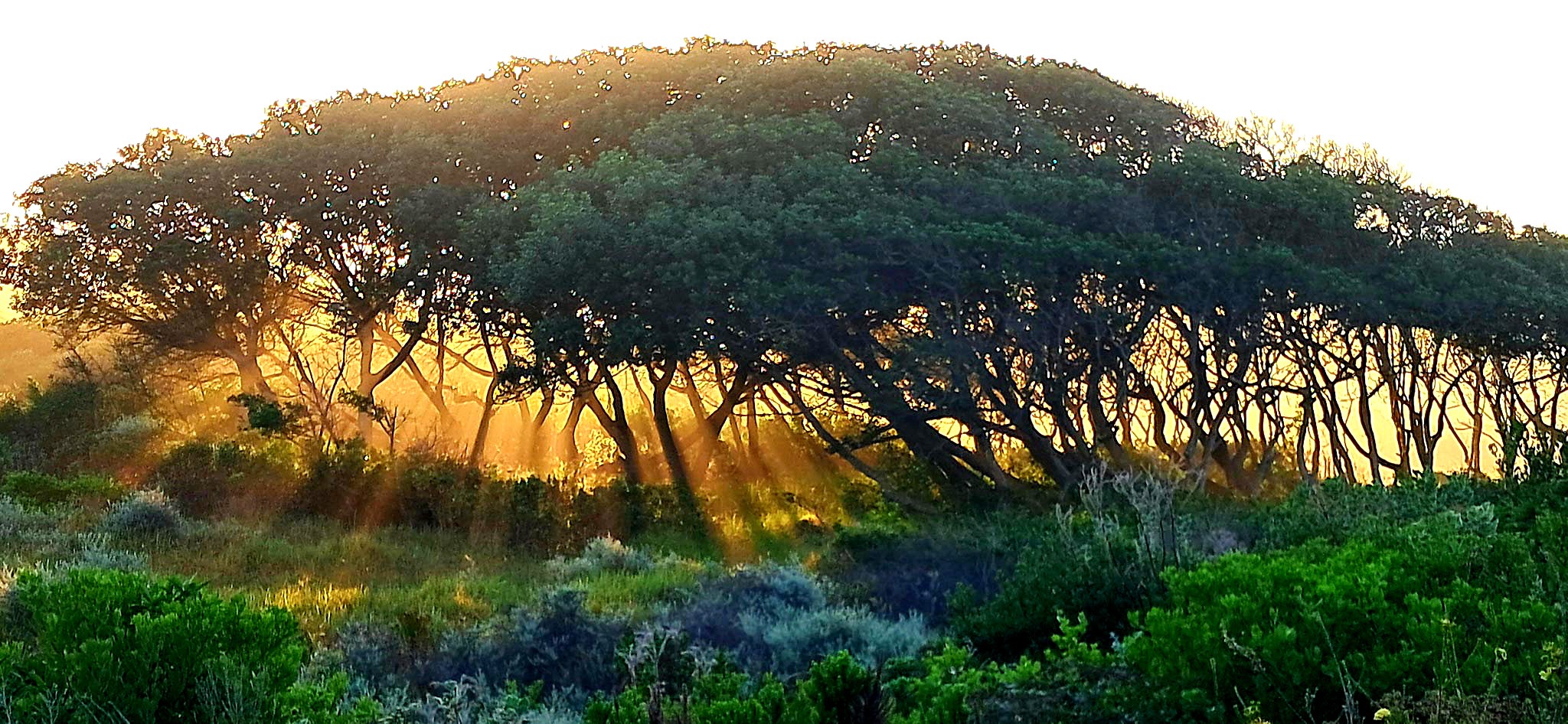
 For Thomas Berry, mountains, rivers, forests, insects, birds, soils and stars are the primary text. (Photo: Don Pinnock)
/file/attachments/2989/NOtesfromasmallfinal_693776.jpg)
In an age saturated with information, we tend to think of “texts” as things produced by human beings: books, reports, theories, screens filled with data. Yet the cultural historian and ecological thinker Thomas Berry suggested something far more radical.
Long before the first human inscription on clay or parchment, he wrote, there existed another text: the Earth itself. Mountains, rivers, forests, insects, birds, soils and stars. Together these form what Berry called the “primary text”.
Human writing, by comparison, is secondary commentary. If we’re looking for a creation story to give our life meaning, he says, look there.
To read the Earth in this way is not merely a poetic metaphor, it has a history stretching far back in time. It once structured human all cultures across the world.
Seasons, migrations, flowering cycles, the behaviour of animals and the patterns of water and weather were not simply observed; they were interpreted. The land communicated conditions, warnings and possibilities. Knowledge was embedded in attention.
/file/attachments/orphans/ThomasBerryDonPinnock_738219.jpg "Cultural historian and ecological thinker Thomas Berry. (Photo: Thomas Berry Foundation)")
Berry believed that modern industrial society created a profound break in this relationship. We surrounded ourselves with human-made texts – screens, manuals, laws, theories – and have gradually lost our literacy in the older one.
The result is not only environmental damage. It’s also a deeper disorientation: a loss of belonging and direction.
“We can no longer hear the voice of the rivers, the mountains, or the sea,” he wrote in The Great Work. “The trees and meadows are no longer intimate modes of spirit presence. The world about us has become an ‘it’ rather than a ‘thou’.”
Who was Thomas Berry?
Berry was an unusual figure. Born in North Carolina in 1914, he trained as a Catholic priest but became widely known as a cultural historian of religions and one of the early voices in what would later be called ecological thought.
His work bridged theology, cosmology, anthropology and environmental philosophy. Rather than writing as a scientist or theologian in the narrow sense, Berry tried to situate humanity within the larger unfolding story of the universe.
One of his central ideas was that societies require what he called a “guiding story”. For millennia, religions and cosmologies offered narratives that explained where humans came from and how they should live within the wider community of life.
In the modern era, however, Berry believed those stories have lost much of their power. Scientific knowledge dramatically expanded our understanding of the cosmos, but this knowledge has not yet been woven into a shared cultural story.
“The more clearly we understand the sciences and their perceptions of the universe,” he wrote, “the more clearly we understand the intimate presence of each component of the universe with every other component.”
/file/attachments/orphans/ThomasBerryDonPinnock-9_624790.jpg "‘We can no longer hear the voice of the rivers, the<br>mountains, or the sea.’ (Photo: Don Pinnock) <br>")
mountains, or the sea.’ (Photo: Don Pinnock)
Berry suggested that a new guiding narrative should emerge from what he called the “Universe Story”. Drawing on modern cosmology and evolutionary science, it describes our place in the universe as part of a creative unfolding that has taken place over billions of years. Earth, within this perspective, is not simply a stage for human activity, but part of a living fabric in which we participate.
This shift in perspective carries profound implications. Berry argued that the Earth must be understood as a subject rather than an object. Forests, rivers, animals and ecosystems are not inert resources awaiting human use; they’re participants in a vast community of life whose processes sustain the conditions for existence. They, like we do, have rights.
The forgotten literacy
In many parts of the world, indigenous traditions still carry this ecological literacy. Knowledge is not only stored in written records but embedded in observation, memory and story.
Modern societies, however, have largely lost this connection. Our knowledge about nature now tends to be mediated through institutions: weather forecasts, ecological reports, satellite imagery and predictive models.
These systems provide powerful insights, yet they also distance us from the direct experience of the living world.
/file/attachments/orphans/ThomasBerryDonPinnock-7_271731.jpg "‘Our place in the universe is part of a creative unfolding that has taken place over billions of years.’ (Photo: Don Pinnock)</p>
<p>")
Berry believed this distance has psychological consequences. When the Earth is perceived only as inert matter rather than as a living presence, human beings begin to experience themselves as separate from the world around them. The sense of belonging to a wider community of life fades. Depression is one of the consequences.
In this light, the environmental crisis is not only technological or economic. It is also a crisis of perception.
The green language
Berry often spoke of rediscovering a kind of “green language”. This isn’t a literal vocabulary but a form of attentiveness that allows the patterns of the living world to become intelligible again.
/file/attachments/orphans/ThomasBerryDonPinnock-4_818710.jpg "Berry believed our distance from nature has psychological consequences. (Photo: Don Pinnock)
<br>
<br>")
Learning this language requires observation: noticing seasonal rhythms, ecological interactions and subtle environmental changes. It also involves imagination, intuition – capacities through which people historically experienced their surroundings.
Berry valued modern science for revealing the complexity and evolutionary history of the universe. But he believed that scientific knowledge alone is not enough to restore a sense of relationship with the Earth.
The green language emerges with a felt recognition of belonging. When this happens, the natural world begins to feel less like a collection of objects and more like a field of relationships.
The task of remembering
Education, he believed, should begin with the story of the universe itself, helping people understand their lives as part of an evolutionary continuum stretching from the formation of stars to the emergence of ecosystems.
The Earth continues to write its text every day – in the growth rings of trees, in the migration routes of birds and in the slow shaping of rivers and coastlines. The question Berry posed is whether we will learn to read it again.
Dr Thomas Berry died in 2009. DM
If you’d like to read further, his book The Great Work is the place to start. Here’s a free 7-module Yale University course on Berry.


Comments
Scroll down to load comments...