



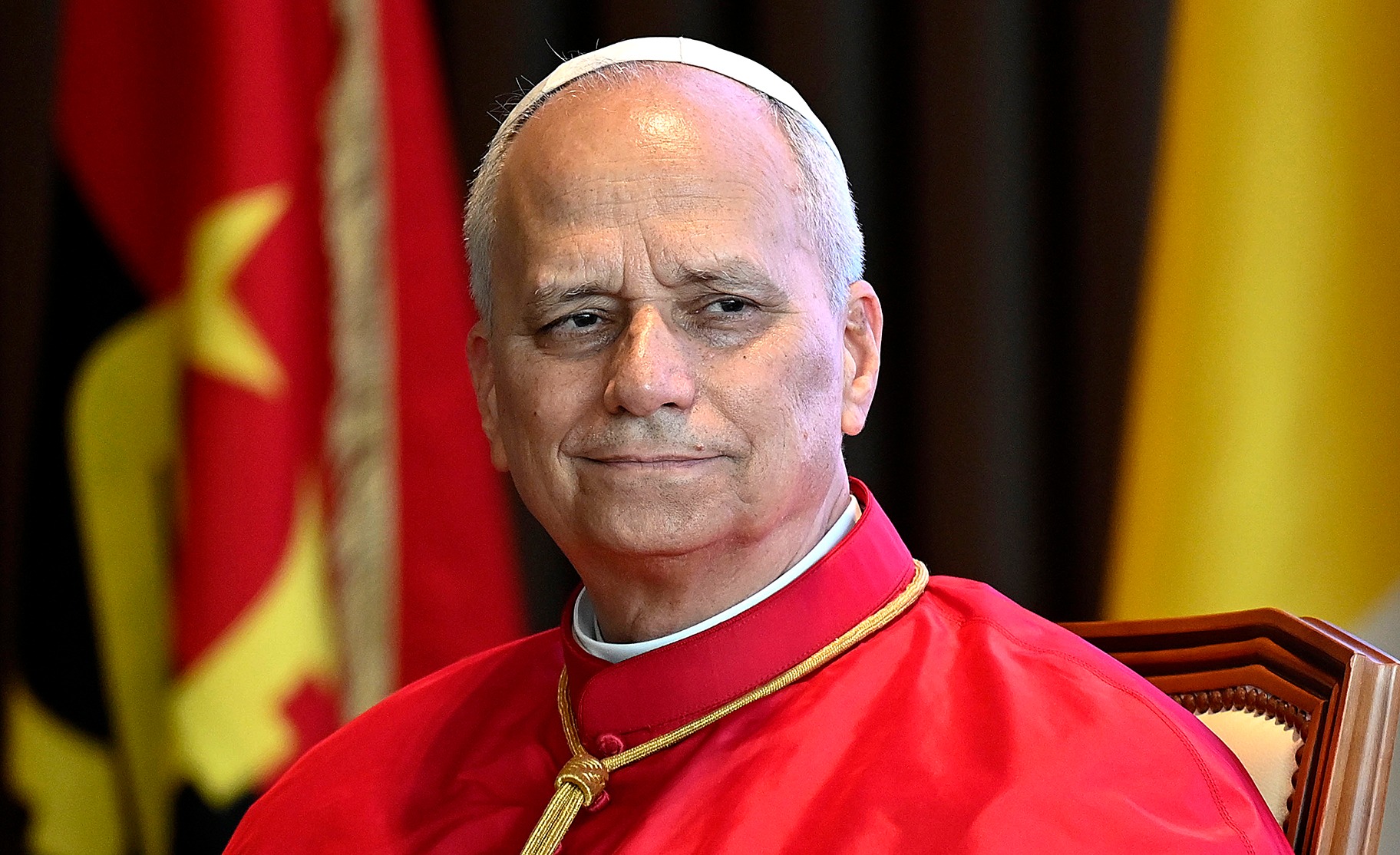
 Pope Leo XIV meets Angola’s authorities, representatives of civil society and members of the diplomatic corps at the Presidential Palace in Luanda on 18 April 2026. (Photo: Matteo Pernaselci - Vatican Media via Vatican Pool / Getty Images)
 /file/dailymaverick/wp-content/uploads/2025/10/label-Op-Ed.jpg)
In an insightful and challenging encyclical letter, Pope Leo XIV has called on humanity to consider the potential effects of artificial intelligence (AI) and condemned a “culture of power”, challenging the military industry and those waging war.
This is the first encyclical of the America-born Pontiff since his election on 8 May 2025, and it could prove to be one of the most important Catholic social teaching documents in the past 100 years. The document, titled Magnifica Humanitas (Magnificent Humanity), was signed on the 135th anniversary of Pope Leo XIII’s watershed encyclical Rerum Novarum (Of New Things) in 1891. In that encyclical, Leo XIII addressed the changing epoch amid the Industrial Revolution. Leo XIV has chosen to address another epochal shift: the digital revolution.
Using artificial intelligence as a starting point, Leo addresses a wide range of contemporary crises, including war, the abuse of power, modern slavery, wealth inequality, the erosion of democracy and the devaluation of human capacities. He asks everyone to reflect on how the world is being transformed and what this means for the dignity of the human person.
The pope says that “technology should not be considered, in itself, as a force antagonistic to humanity”. He goes on to say that it “has significantly improved the living conditions of humanity”. However, “each phase of progress has also revealed the ambiguity of tools that can cause harm when not oriented towards the good”.
He frames his encyclical with a stark biblical metaphor: humanity can either build a new Tower of Babel, capitulating to a technological paradigm that excludes God and subordinates people to systems, or build a world in which human dignity, justice and community are truly possible.
Leo states that “the church does not claim to assume the functions belonging to the State”. However, “when the dignity of our brothers and sisters is violated, when politics fails to address the tragedies of humanity, when the economy turns against the person or science oversteps the limits of its competence, the Church – together with other Christian denominations and believers of other religions – must make her voice heard, not in order to dominate, but to promote communion”.
The pope says that every generation faces the challenge and task of shaping its own era. He says that we can guide history towards a place where the dignity of all is safeguarded and justice is promoted, or we can create an inhumane and unjust world.
Leo warns of “Babel syndrome”, namely the idolatry of profit that sacrifices the weak, uniformity that neutralises differences and the pretence that a single language – a digital one – can translate everything, including the mystery of the person, into data and performance.
The pope says AI must be freed from an “armed” logic of competition driven by the pursuit of geopolitical and commercial dominance. “To disarm does not mean rejecting technology, but preventing it from dominating humanity,” he writes.
In South Africa, where the promise of liberation has so often been deferred by ever-growing structural inequality, Leo’s words seem even more poignant. It is no secret that South Africa has one of the highest Gini coefficients in the world. Unemployment sores, the wounds of apartheid – spatial, educational, economic – have not been addressed as effectively as they could have been, and corruption has become a way of life, further disadvantaging millions of people. The encyclical’s central warning is not abstract: AI must be made to ease inequality rather than entrench it. Without deliberate governance and moral guardrails, the opposite is all but guaranteed.
The encyclical confronts us with the reality of who currently holds power over these technologies. The main drivers of AI development, Leo says, are private, often transnational corporations endowed with resources that surpass those of many governments. “Technology is never neutral, because it takes on the characteristics of those who devise, finance, regulate and use it,” he writes. AI developers “bear a particular ethical and spiritual responsibility, for every design choice reflects a vision of humanity”.
A digital revolution shaped almost entirely elsewhere, by foreign powers and capital interests, will not necessarily, for example, be designed with the interests and welfare of people in the rural Eastern Cape or KwaZulu-Natal in mind.
Leo is clearly addressing not only policymakers but also asserting that this is a moral question for all people of goodwill to reflect on. In Magnifica Humanitas, he calls for regulatory frameworks capable of upholding justice and mitigating the distorting effects of technological power.
He devotes substantial attention to the question of labour, which he calls “the dignity of work in a time of digital transition”. He does not reject technology or consider himself a technophobe; he acknowledges AI as a potentially valuable tool. However, he insists that the economy must be reoriented around the dignity of persons, not the efficiency of machines. He says that “among the goods that are universally intended for everyone, we must also include new forms of property, such as patents, algorithms, digital platforms, technological infrastructure and data”.
This, too, is important in South Africa. Formal employment rates have fallen, and our economic structure has been inadequate to sustain the growing population for decades. The informal economy sustains millions, and the potential onslaught of automation threatens the very jobs that have historically provided entry points into the formal economy. Automation also raises the question of new forms of ownership, as the pope suggests.
Leo also calls for moving beyond GDP as the sole measure of development, focusing instead on shared prosperity, reducing inequalities, protecting the environment and creating conditions that enable families and young people to sustain hope.
The encyclical also addresses how information is used and abused. Disinformation circulates freely across social media platforms. Public trust in institutions has eroded. Political narratives are increasingly shaped by those who control the algorithms, not by those who have thought most carefully about the common good. The pope addresses this directly, treating truth as a common good that AI can either protect or destroy. He calls for what it describes as an ecology of communication – a concept that speaks, perhaps, to South African debates about media freedom, the regulation of social media and the role of public broadcasting.
The encyclical highlights the need for education in the digital paradigm. The pope says that a generation of young people is entering a world increasingly mediated by AI, with digital access but often lacking the critical formation to navigate it.
Leo addresses what he calls a “violent culture of power”. In an era of technological change, humanity is being pushed towards polarisation, and ethical erosion is occurring. He acknowledges the right to self-defence but challenges the church’s teaching on just war, a teaching that recently made headlines and was vigorously debated following the US and Israel’s attack on Iran.
“Today, more than ever, without prejudice to the right to self-defence in the strictest sense, it is important to reaffirm that the ‘just war’ theory, which has all too often been used to justify any kind of war, is now outdated,” Leo says. Pope Francis, his predecessor, had already rejected the use of just war theory to justify “preventive” acts of war. But Leo’s rejection goes further, as he says that technological developments have decisively altered the moral conditions on which just war theory was based. Though Leo doesn’t articulate his own parameters for an updated understanding of just war, he says that “humanity possesses far more effective and capable tools for promoting human life and resolving conflicts, such as dialogue, diplomacy and forgiveness”.
Leo condemns “the evolution of nuclear arsenals” and says: “The situation is further destabilised by the presence of new armed operatives, such as jihadist groups, private militias and criminal networks that mark the end of the State’s monopoly on the use of force.”
In what he calls “the military-industrial complex”, Leo denounces “the enormous economic interests behind war” and describes how “the armaments industry, and countries that supply weapons, profit from a market that thrives precisely on conflicts”.
Perhaps Magnifica Humanitas resonates most especially for South Africa in its closing vision: what the pope calls “the civilisation of love”. Against the logic of technological dominance, he insists on solidarity, fraternity and mutual care as the true measure of a society’s health.
This is not a foreign concept in South Africa. The tradition of ubuntu (umuntu ngumuntu ngabantu – a person is a person through other persons) has long articulated this insight. Human flourishing is not individual. It is relational. It is communal. Leo, in the encyclical, arrives at the same conclusion by a different path.
It is clear that Leo invites ethicists, civil society leaders and theologians to bring this African wisdom tradition into conversation with the global debate on AI governance and the many crises facing humanity. The world needs voices that insist on the relational nature of humanity and on the dangers of technologies that atomise and commodify. South Africa has something to contribute to this conversation. Magnifica Humanitas is a call to action for all who are concerned about the wellbeing of society and, ultimately, humanity.
A takeaway from this encyclical for South Africa might be that our country is at a crossroads. The Fourth Industrial Revolution is not waiting for us to resolve our existing inequalities before arriving. It is already here, and it will either compound those inequalities or challenge them, depending on the choices we make now. The pope’s encyclical does not offer policy blueprints. What it offers is something more durable: a set of moral principles grounded in the conviction that every human being is important, and that these principles must govern whatever choices we make.
For Leo, the choice is clear: we can choose between a civilisation of power and a civilisation of love. DM
Fr Russell Pollitt SJ is the parish priest of Holy Trinity Catholic Church in Braamfontein, Johannesburg.