




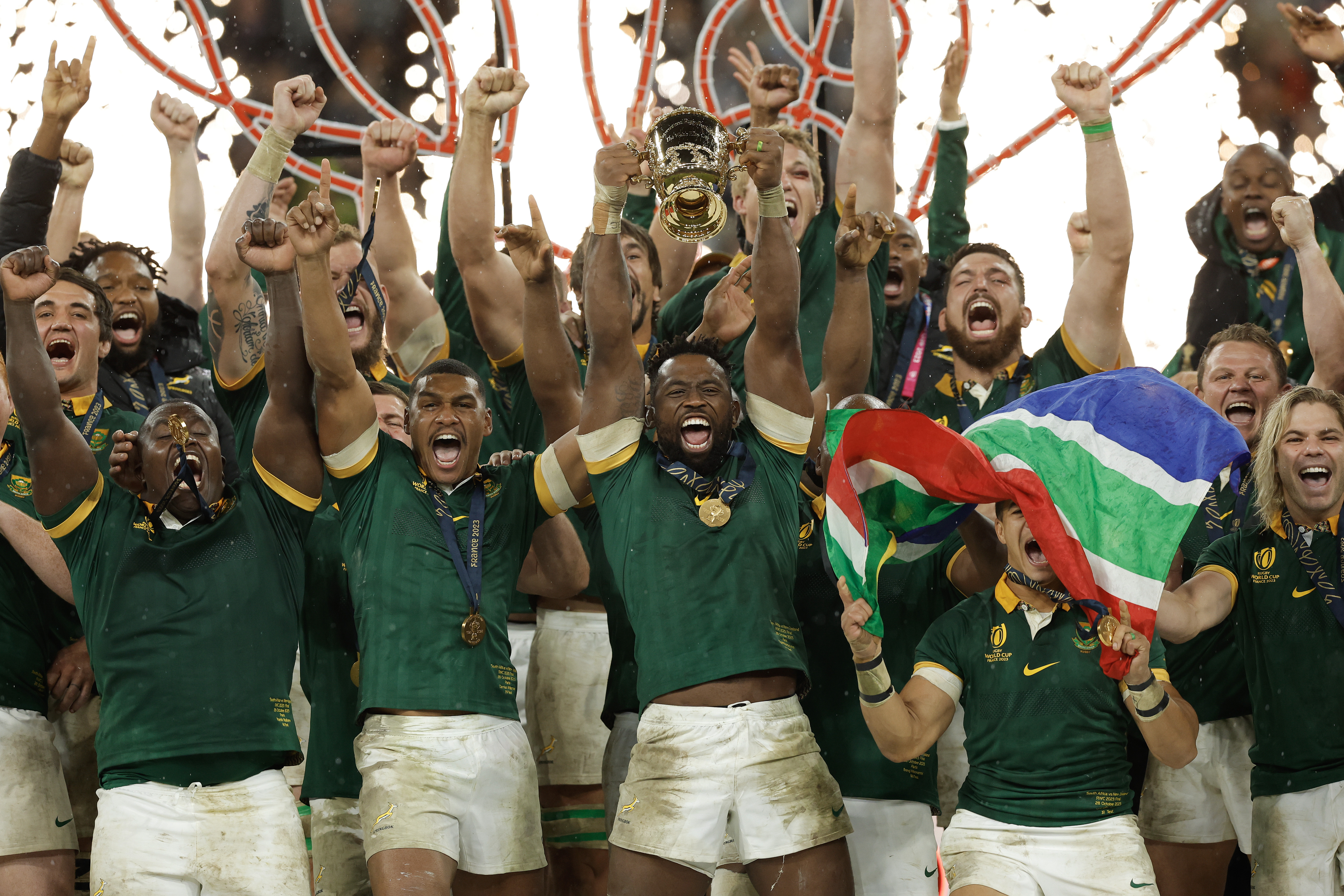
 Springbok captain Siya Kolisi lifts the Webb Ellis Cup after the Boks beat the All Blacks 12-11 in the final of Rugby World Cup 2023 in Paris. (Photo: Tom Jenkins / Getty Images)
 In the warm glow of Springbok rugby success over the past eight years, it’s easy to forget the images of fans burning the green and gold jersey and essentially turning their backs on the national team.
After the 57-0 drubbing at the hands of the All Blacks in 2017, Springbok rugby hit rock bottom. Social media was rife with Bok jerseys and player effigies being defaced in a range of inventive ways.
Some fans were angry, but many had quietly given up, which was far worse.
/file/dailymaverick/wp-content/uploads/2022/09/OZ-SA-Photo_18.jpg "A Springbok fan reacts during The Rugby Championship match between the Australia Wallabies and South Africa Springboks at Allianz Stadium on September 03, 2022 in Sydney, Australia. (Photo: Hanna Lassen / Getty Images)")
What happens to the flagship team does not happen in a vacuum, and South African rugby fans turned their backs.
Now, nearly a decade after that dark night in Albany, which was the culmination of a slow decline in Bok rugby, the picture is vastly different.
The Springboks are back-to-back Rugby World Cup champions – 2019 in Japan, 2023 in France – and the only nation to lift four World Cup titles.
They have held the world number one ranking for three consecutive years. They have won back-to-back Rugby Championship titles. And in September 2025, they inflicted the largest defeat in All Blacks history, a 43-10 demolition in Wellington that sent shockwaves through global rugby.
/file/attachments/orphans/22351664611_930310.jpg "Bok fullback Damian Willemse scores a try during The Rugby Championship match against the All Blacks in Wellington in 2025. (Photo: Hagen Hopkins / Getty Images)")
Coach Rassie Erasmus, whose contract has now been extended through to the 2031 World Cup, has built not just a winning team, but a winning culture.
It is proving to have profound implications well beyond the field.
New data released by marketing research company BrandMapp shows a remarkable turnaround in fortunes that backs up the obvious notion that the Boks are the most beloved South African sporting team.
Huge support, new faces
Perhaps the most underappreciated dimension of this transformation is what it has done to the Springbok supporter base.
/file/attachments/orphans/GettyImages-1763378001_979415.jpg "Siya Kolisi of South Africa celebrates with the The Webb Ellis Cup following his side's victory in the Rugby World Cup France 2023 Gold Final match between New Zealand and South Africa at Stade de France on October 28, 2023 in Paris, France. (Photo: Dan Mullan/Getty Images)")
For most of South African rugby’s history, the fan profile was relatively predictable: predominantly male, predominantly white, predominantly Afrikaans or English-speaking.
Rugby was a tribal sport in a tribal society, and those tribes were clearly delineated.
That picture has changed fundamentally.
According to BrandMapp’s latest annual survey of South Africa’s consumer class – the about 14 million adults living in households earning R10,000 or more per month – rugby has become the most watched sport in the country.
BrandMapp’s research looks at what could loosely be defined as middle to upper-middle class households and above. This is the sector that has the most economic clout.
And the numbers are clear, with 44% of consumer-class adults watching rugby, edging ahead of soccer (42%) and well clear of cricket (29%). But the more remarkable finding is in who is watching.
/file/attachments/2992/Slide9_876554.jpeg)
BrandMapp’s director of storytelling, Brandon de Kock, calls it the “Siya Kolisi effect”.
Under Kolisi’s captaincy since 2018, when he became the first black Test captain, and Erasmus’s transformation philosophy, the Springboks became genuinely, visibly representative of the country they represent on the field.
The data backs this up in a striking way: while soccer still shows a large gender gap – 56% of men watch versus just 29% of women – rugby has narrowed that gap considerably.
Today, 38% of consumer-class women watch rugby compared with 49% of men, making it by far the most gender-balanced of South Africa’s Big Three sports.
/file/dailymaverick/wp-content/uploads/2025/02/11806653.jpg "A Bok fan celebrates after the team won the Rugby World Cup 2023 final against New Zealand. (Photo: EPA-EFE/YOAN VALAT)")
Rugby, once the most masculine of South African sporting obsessions, is becoming a shared national pastime. That is not a coincidence. It is the direct commercial consequence of a team that now looks like its country.
“Overall, and with few exceptions like swimming and netball, sports-watching skews towards male,” De Kock said.
“Rugby viewership used to be particularly male-dominated, but over the years it has actually become the most gender agnostic of sports that South Africans love to watch.
“I think that this is a major factor in rugby taking top spot on the podium.”
/file/attachments/2992/Slide6_493786.jpeg)
Financial weight
This broadening of the fan base has real financial weight, with 37% of the consumer class expressing interest in attending live matches.
It’s important to note that this is for Bok Test matches, and not necessarily for competitions such as the United Rugby Championship.
This is the income segment that can afford ticket prices, although even homes with monthly incomes of tens of thousands are battling to afford Test ticket prices, which can run to more than R3,000 per match.
Despite this, the commercial case for marquee rugby events in South Africa has never been stronger.
/file/dailymaverick/wp-content/uploads/2023/11/ED_477380.jpg "Crowds throng the Springbok bus in Darling Street in CapeTown's CBD during the team's Rugby World Cup Trophy Tour on 3 November 2023. (Photo: Gallo Images/Brenton Geach)")
Rugby spectatorship is social by nature, and 27% of consumer class adults watch matches communally in sports bars and public venues, creating economic ripple effects that extend well beyond the stadium. When the home team is winning, those effects multiply.
“Playing sport for South Africa is about more than tries, goals or runs; it’s about bringing joy and hope to the nation and proving what Rassie and the Springboks have demonstrated since winning the Rugby World Cup in 2019,” SA Rugby Union president Mark Alexander told Daily Maverick.
“This data hopefully shows that that message has resonated with South Africans. The sport of rugby and our national teams have created a safe space both literally and emotionally where all peoples of this country can celebrate their South African-ness in unity, from whatever their background.
“The fact that more women are finding their way to rugby is particularly exciting for us, as that is the next great frontier for rugby to cross, and we are unbelievably excited about what the future holds for women’s rugby in this country. It is only going to get stronger.”
/file/dailymaverick/wp-content/uploads/2025/02/TL_2217193.jpg "Mark Alexander, the president of Saru. (Photo: Ashley Vlotman / Gallo Images)")
Financial strain
Despite the impressive data, the cost of running professional rugby continues to furrow brows.
In its 2025 financial report, Saru stated that its group revenues increased by 29% from R1.5-billion in 2024 to R2-billion in 2025. But costs also increased, with R500-million spent directly on the Springboks (R281-million) and the High-Performance Department (R221-million), into which all other national teams fall.
Despite the jump in revenues, SA Rugby still ended the year reporting a pre-taxation loss for the group of R40-million, which underlined the continuous challenge of making professional rugby profitable. It’s a challenge faced by unions globally.
/file/dailymaverick/wp-content/uploads/anso-Noah-Boks-CT-inset-10.jpeg "The Springbok bus passed under a bridge on the N2 highway lined with fans. Fans not only gathered on the bridges but lined the N2 highway on both sides. (Photo by Anso Thom)")
But 2025 was the first year of Saru’s profit sharing in the URC after a painful period of paying R392-million annually in URC and European Professional Club Rugby (EPCR) fees.
Rugby, despite its healthy outlook, is competing in an increasingly crowded field and new mediums.
“In our modern world, we also have emerging hybrid sports spectators,” De Kock said.
“So, there are lots of enjoyable ways to be a sports fan, and you can tap into sport in multiple ways. In our post-Covid castles, there’s a good chance that watching at home on your private big screen is a very enjoyable experience, so whether they make it to the pub or not, there’s a good chance most sports lovers will be glued to the telly.
“We know that 89% of the consumer class watch TV; 65% on a daily basis – and we know that 42% regularly watch rugby on TV.”
From a generational view, Gen Z is least likely to watch sport on TV, but that is because they are watching less TV in general than the older generations.
But if they are watching sport on TV, it is still most likely to be rugby. “However, when we put this in the context of the other data, it suggests that Gen Z are perhaps more likely to be watching a match down at their local pub than paying for a DStv subscription.”
/file/attachments/2992/Slide7_670808.jpeg)
The 2026 outlook is where this all crystallises.
“The Greatest Rugby Rivalry” is the All Blacks’ first full tour of South Africa in 30 years, and it promises to deliver the financial windfall that will provide a healthy profit and much-needed cash reserves for Saru.
Four Tests against the All Blacks, played at Ellis Park, DHL Stadium, FNB Stadium, and a landmark fourth Test in Baltimore, represent not just a sporting occasion, but a massive revenue-generating event.
/file/dailymaverick/wp-content/uploads/2025/09/2233958788.jpg "Cheslin Kolbe of South Africa and All Black Damian McKenzie compete for a high ball at Eden Park on 6 September 2025 in Auckland, New Zealand. (Photo: Hannah Peters / Getty Images)")
The final match of the tour is specifically designed to grow rugby in the US ahead of the 2031 World Cup, extending the Springbok brand into entirely new markets at precisely the moment its domestic audience is at its broadest and most engaged.
For Saru, the lesson of this Springbok era is a simple but powerful one: excellence on the field is not separate from sustainability off it.
A team that wins and reflects the demographics and the aspirations of the entire country is also a team that fills stadiums, sells jerseys, attracts sponsors and secures broadcast deals.
At least six million consumer-class South Africans, who are more diverse, more engaged and more commercially active than at any point in rugby’s history, are watching, and the money should follow. DM