




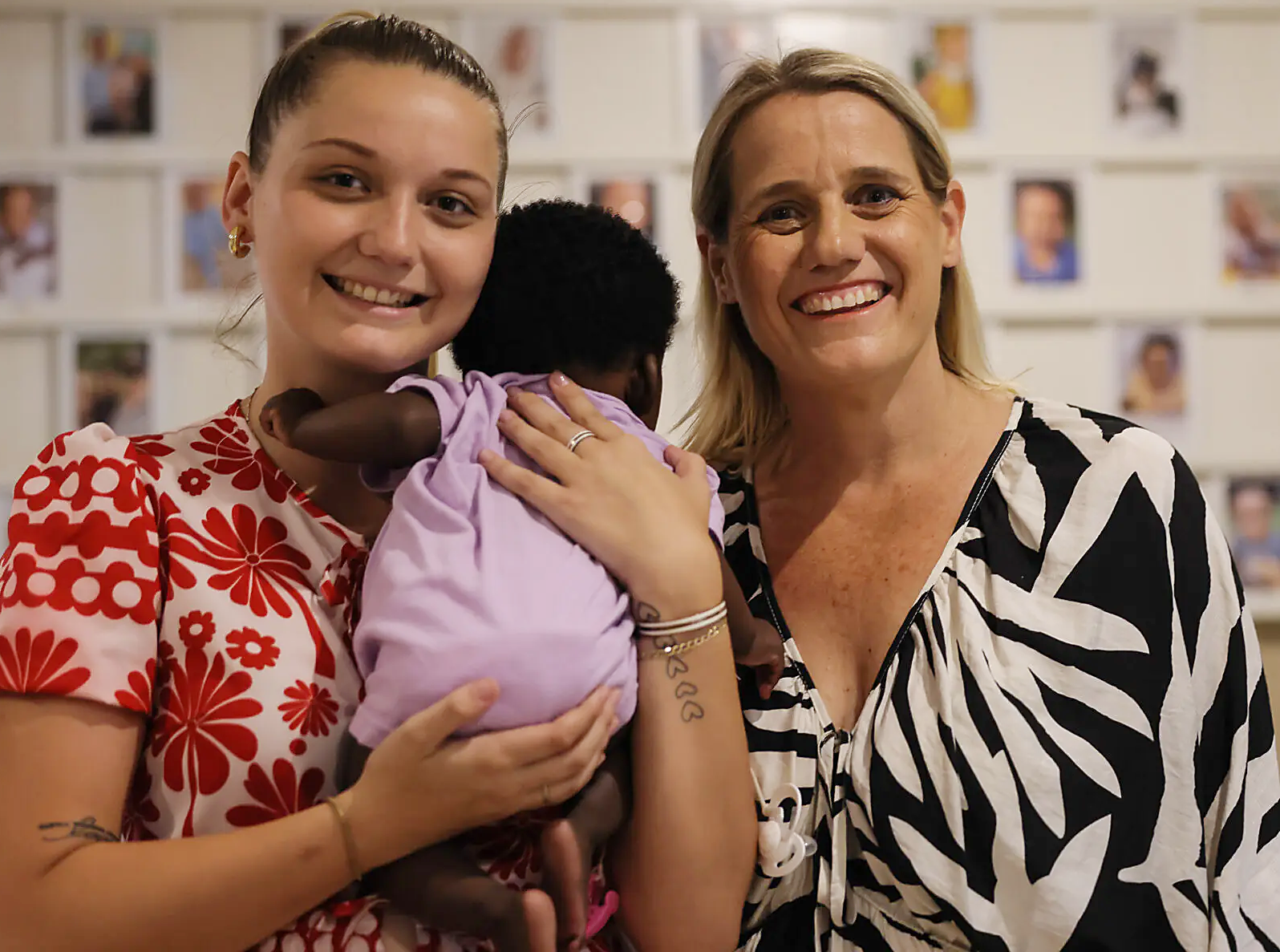
 Founder of Baby Home Durban North Joanne Teunissen (right) and her daughter Tatum have their hands full with children needing a place to call home. (Photo: Halden Krog/Spotlight)
 Behind every abandoned baby is a mother in crisis – overwhelmed and desperate, a situation often exacerbated by poverty.
South Africa recorded 595 cases of child abandonment in 2024, recently fired Minister of Social Development Sisisi Tolashe announced at the launch of Child Protection Month in May 2025. However, the actual annual figures for the past several years is believed to be much higher since many babies who are abandoned are not reported and thus not recorded in the National Child Protection Register, the department admitted in response to questions before the National Assembly in 2025.
Child abandonment is a criminal offence under South Africa’s Children’s Act. There are, however, formal processes around “relinquishing” babies to temporary safe homes. In a sloping suburb amid Natal Mahogany trees, Baby Home Durban North is such a temporary refuge for infants and toddlers.
Either adopted or reunited
“The idea is that while the babies stay here, they grow up in a family-type environment,” says Jo Teunissen, director of the home in Durban. “That is, until they are either reunited with their biological family or until they are adopted. We really treat them like family; so they come grocery shopping with me, they’ll come and watch sport in the house with us. We sometimes do crazy things like all go out to the Spur together.”
Teunissen and her husband Bjorn, who are teachers, founded Baby Home Durban North in 2015 after they adopted an 18-month-old boy named Emmanuel. The baby home was established in rooms next to their family house in Glen Anil.
Together with Child Welfare Durban and District (a nonprofit), Baby Home Durban North provides refuge to children referred from government hospitals such as Addington, Prince Mshiyeni Memorial, Victoria Mxenge and King Dinuzulu. They have capacity for six children and four permanent child caregivers.
‘I always tell people to donate with dignity’
At the time of our interview, there are five babies inside the sun-washed room, where the Disney movie Frozen is playing on a screen in a corner.
A three-year-old boy is seated in a table-chair as childcare provider Precious Biyase tilts spoonfuls of dinner – minced meat and rice – into his mouth. Teunissen croons to the boy: “Where do you sleep, show us your bed?” The toddler beams, flashing baby teeth, pointing a finger to a white crib behind him. Inside the crib, there are six stuffed Mickey Mouse toys, side-by-side. “He loves Mickey Mouse, it’s his favourite, isn’t it?” Teunissen says to him.
/file/attachments/orphans/Image4baby-home_826797.png "A carer at Baby Home Durban North feeds one the babies currently living with them. (Photo: Halden Krog / Spotlight)")
Even though they rely solely on philanthropy and donations, Teunissen emphasises that their children play with whole toys and do not wear torn clothes. “I always tell people to donate with dignity. Just because a child comes from rough circumstances does not mean they need to live like that now. Our children never wear torn clothes,” she says.
Next to the boy, child carer Lindiwe Khumalo is feeding another three-year-old boy. A nine-month-old girl and a seven-month-old boy are peeking from their cribs. A four-month-old is sleeping on her stomach with a clenched fist, unperturbed by the ruckus. All five have been at the baby home since soon after birth.
Turnover and length of stay
The sixth crib is empty. “So our one boy left yesterday, he was 18 months old. It was a family reunification process. But tomorrow we’ll probably have a new baby, that’s the turnover,” Teunissen says.
Legal processes determine how long each child remains at the home. “There’s actually not a set time that they’re with us. It all depends on how long it takes for the social worker with each individual case,” she says.
“Mostly we get babies from hospitals – which is the best way because we know about their mum and their birth history. So every government hospital has social workers working within the hospital. And when a mum goes to hospital, she might say, ‘I’m unable to look after my baby’ or, you know, ‘I need help, I can’t do this’.”
She continues: “And then normally what happens is when the mum gets discharged, the baby stays behind in the nursery. And then they phone the welfare who contact one of us at the homes. And then we go and fetch the baby.”
Teunissen explains that when a mother voluntarily gives up a baby for adoption, she must first appear in court and sign formal consent documents. From the date the documents are signed the mother has 60 days to change her mind. After that, social workers complete medical assessments and background reports before the child can be matched with adoptive parents through the Register on Adoptable Children and Prospective Adoptive Parents.
Abandoned babies often remain at the house even longer. A notice “goes into the paper asking for information, if anyone knows anything about that baby. That has to run for 90 days and the social worker has to follow up on every lead. A granny or anyone can come forward and say that they’re family. But it’s not just taken at face value, there’s DNA testing and screening, things like police clearances, sexual offender checks and home evaluations.”
Explaining the adoption process, Teunissen says prospective parents are asked whether they are open to adopting children with special needs, and whether they are prepared to adopt a child born from rape.
/file/attachments/orphans/Image3baby-home_295085.png "A baby sleeps soundly in her cot at Baby Home Durban North. (Photo: Halden Krog / Spotlight)")
At Baby Home Durban North, Teunissen says they are open to babies of all backgrounds and those with special needs. “Which obviously gives a lot [of] extra work because you’ve got to be very thorough and be very positive. We’ve had children with cerebral palsy, we’ve had autistic children, we’ve had kids living with HIV,” says Teunissen, adding that while shared with prospective parents, children’s origin stories are kept strictly private.
Police officers on their doorstep, with a baby
While their official capacity is six children, “emergency babies” are not turned away. It is not unusual for police officers to ring the baby home’s doorbell, bearing in their arms babies or toddlers with nowhere else to go.
“Sometimes the police don’t even phone before they arrive,” says Teunissen. “Sometimes they just ring the bell and they’re here, right outside our gate. It’s normally over the weekend or public holidays when the welfare offices are closed. It could have been a case of domestic violence where they had to remove the child. Or maybe the mum was found shoplifting and she had a baby with her. And so they have to take the child somewhere safe while they follow due process with the mum.”
Teunissen recalls an Easter weekend during the Covid lockdown where they made room for three additional emergency babies. “Depending on the ages, sometimes they sleep in my house. We use camp cots and bassinets for them. As soon as welfare is open again, they find the babies more permanent placement.”
Phone and WhatsApp support for mums
Baby Home Durban North falls under the umbrella not-for-profit Peace Agency, along with Baby Line, which supports pregnant women and struggling mothers through telephonic and WhatsApp counselling. Baby Line is coordinated by Teunissen’s daughter Tatum (20), a social work student enrolled with the University of South Africa.
During our interview, the two women each display their inner arms, where they have the same tattoo: “Small things, great love,” an abbreviated version of a quote by Mother Teresa. Against a wall inside the baby home is a plaque with the entire quote: “Not all of us can do great things. But we can do small things with great love.”
“So Baby Line is a support and counselling service for pregnant women and mums,” says Tatum.
“Often we are the only people they have as a support system. They go into hospital without a partner, all alone. And, I mean, sometimes they’re in labour for four days, all alone. So I’m just a message away for them.”
Tatum says they visit the mums at maternity wards in the area, delivering care packs with basic baby and maternal care items.
/file/attachments/orphans/Image2baby-home_598081.png "The Baby Home Durban North cares for babies who have been abandoned or placed for adoption. (Photo: Halden Krog / Spotlight)")
A small package brings help and hope
Reflecting on the impact, she says: “When they message, I ask all my usual questions: ‘Where do you stay, how old are you,’ and so on – and then I’ll ask: ‘Why do you want to give your child up for adoption?’ And the number one response is: ‘Financially I can’t afford my child.’ Or: ‘I can’t afford nappies.’ Or something like that. And my immediate response is: ‘Would you consider keeping your child if I can help you with nappies and baby supplies?’ And probably eight times out of 10 it’s an absolutely yes. So it’s something so small as small as a pack of nappies, two outfits and wet wipes or Vaseline, that is the deciding factor between keeping their child or putting them up for adoption.”
Teenage pregnancy
Tatum says the oldest mother she has counselled was 28 and the youngest 15. On teenage pregnancies, she says: “So, a lot of the time it’s high school boyfriends who they’re obviously head-over-heels in love with. But then they fall pregnant and often the fathers go absent. The pregnant girls get scared, a lot of the time their nerves kick in. They’re scared of what other people might think, or that their family might kick them out, so they don’t open up. As soon as they do, the family often is incredibly supportive.”
While teenage pregnancy rates appear to be decreasing in South Africa (an issue Spotlight will explore in an upcoming article), the numbers remain alarming.
In October 2025, KwaZulu-Natal premier Thamsanqa Ntuli launched the KwaZulu-Natal Multisectoral Strategy to Curb Child and Teenage Pregnancies (2025-2029) to address what he described as a “direct threat” to the province’s future. He cited recent figures of 26,515 girls aged 10 to 19 having fallen pregnant in an eight-month window. This included 1,254 girls aged 14 and younger. DM
Child Protection Month 2026 was launched on 3 May in eDumbe in the Zululand District Municipality of KwaZulu-Natal.
This article was first published by Spotlight – health journalism in the public interest. Sign up to the Spotlight newsletter.
/file/dailymaverick/wp-content/uploads/2024/08/image1-1.jpg)