





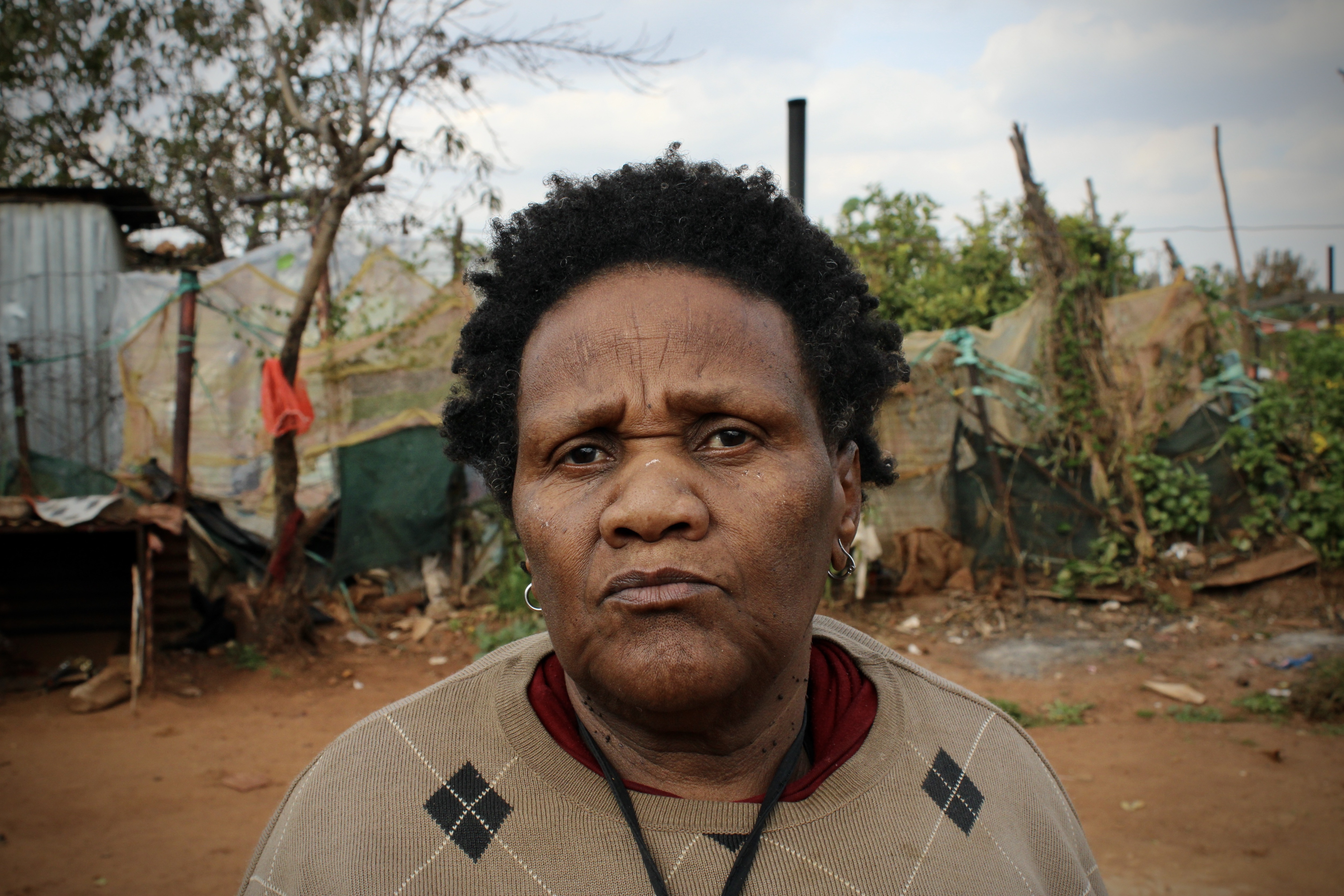
 Nonkululeko Gwaza (65) has lived in Snake Park, Soweto, for 26 years with no electricity or running water. (Photo: Lillian Roberts)
 Outside a small Northern Cape town near Upington, a mother of three — who asked to remain anonymous — is doing her best to raise her three children and her sister’s two kids. The household gets by on social grants and the unpredictable income from occasional farm work.
Feeding a family of six on so little is a constant struggle. “You buy what can stretch,” she said. “Pap, bread, sugar, tea. Things like fruit and meat, you buy if you can.”
About two years ago, she noticed changes in her youngest child. “He wasn’t eating properly,” she said. “Even if I made food, sometimes he just wouldn’t eat. Then he got sick often, and was getting smaller and smaller.”
Getting to the clinic meant a taxi fare she struggled to afford. A few months later, her son died, from what a doctor told her was a lack of vitamins and acute malnutrition.
“People ask if you’re okay after some time. But what do you say? You still wake up and think about your child.”
Now, she still has four children to look after and fears that she will lose one of them too, just because it is so difficult to put enough food on the table each day.
The National Food and Nutrition Security Survey (NFNSS) 2024 found that 63.5% of South Africans are food insecure. Many of South Africa’s population of 63.1 million face increasing challenges related to who eats and who does not.
The country’s unemployment crisis is a driver of its food insecurity, with 8.14 million South Africans officially unemployed. This climbs to 12.94 million under the expanded definition, which includes people who have stopped looking for work altogether, according to Statistics South Africa’s Quarterly Labour Force Survey for the first quarter of 2026.
The Northern Cape has the highest proportion of households registered as indigent with local municipalities. High input prices affect 96% of households, the highest nationally, and arid conditions limit grain and fruit production, with 19% of land-holding households using land for food production.
Child Support Grant
“Everything is expensive,” said Nonkululeko Gwaza (65). She has lived in Snake Park, Soweto, for 26 years, with no electricity or running water. There is only a pit toilet outside. There are two adults and three children in the two shacks. Gwaza receives the Child Support Grant, but the eldest turns 18 in July and she will lose that financial support.
/file/attachments/2992/5C0C8089-6650-4B44-AF05-CC595DA495B5_1_201_a_792511.jpeg "Nonkululeko Gwaza, from Snake Park, Soweto. (Photo: Lillian Roberts)")
The family’s main expenses are gas, paraffin, candles and food. They cannot afford vegetables or meat, and no one in the house is employed. The household’s supply of mielie meal always runs out before the end of the month.
Gwaza’s fervent wish is that “the government can help us by removing us from this space and at least allocate us where there are services like electricity and water”.
/file/attachments/orphans/2474BE7B-ED15-4232-A3E5-B6B7F33DFDEF_1_201_a_757263.jpeg "Nonkululeko Gwaza's home in Snake Park, Soweto. (Photo: Lillian Roberts)")
Of South Africans aged 15 to 24, at least 60.9% are unemployed, a generation entering adulthood with no pathway to income and, in many cases, no safety net beyond the Child Support Grant, which is R580 per month. The food poverty line in 2026 is R855 per person per month, meaning a single Child Support Grant does not cover even one person’s minimum food needs, let alone a household’s.
Female-headed households are identified as more food insecure and economically vulnerable than male-headed households across every province and settlement type. Women are less employed than men to begin with; pregnancy increases vulnerability to job loss; and the post-natal period offers little formal protection for those outside the formal employment sector.
Waste-pickers
“It’s only the grant from the government,” Victoria Linqe (71) said of the help she receives. She has lived in Snake Park for 25 years. She looks after six young grandchildren. Her children do not have formal jobs, but are waste-pickers.
/file/attachments/2992/5CF018A6-8533-4B2E-A036-202B986491E1_1_201_a_322079.jpeg "Victoria Linqe supports six young grandchildren. (Photo: Lillian Roberts)")
Two grandchildren do not have identity documents, as their mother died before acquiring them. Linqe has been trying to fix the problem — in vain. She receives the Foster Child Grant and the Old Age Grant.
“It’s not enough to buy food. There’s nothing, even now,” Linqe said of the end-of-the-month food stores. “No sugar, no fat, just mielie meal.”
She can afford to buy meat and vegetables once a month. Lacking electricity for refrigeration, Linqe must store her meat at another house, where it frequently goes missing. When her food runs out completely, she is forced to borrow money from loan sharks.
Poverty here didn’t use to be this crushing. There was a time when charities and aid groups routinely delivered food parcels to help families get by. Today, those safety nets are gone, leaving the community with nothing.
Linqe uses firewood and paraffin for cooking and heating, though both have become increasingly expensive. To get by, she grows pumpkins, cabbage, onions, spinach and green peppers, but she deeply wishes for the seeds and fertiliser needed to expand her garden.
“The government can move us to a house with electricity and water, permanently,” she says.
/file/attachments/orphans/0092E2E5-36B9-4946-B3F9-B482749356B0_1_201_a1_933865.jpeg "Victoria Linqe's garden in Snake Park, Soweto. (Photo: Lillian Roberts)")
The indignity of indigence
Indigence is defined as “lacking the necessities of life”. Municipalities usually classify it as a household where the combined family income is less than R3,200 per month, though some use a lower threshold of R1,600.
As of 2017, 3.51 million households in South Africa, roughly one in five, were classified as indigent, yet 56.9% of households surveyed in the NFNSS reported being on a municipal indigent register, pointing to a significant gap between who is formally recognised and who is actually struggling.
Walter Ntamela (64) has lived in Snake Park for 35 years and has been unemployed for 20 years, relying on the Old Age Grant. He buys mielie meal, rice, and samp with the grant money. Sometimes, he runs out of food during the month.
/file/attachments/2992/997C9CFF-2DAC-4817-BD8A-E695867FA9A3_1_201_a_493383.jpeg "Walter Ntamela relies on the Old Age Grant for his income. (Photo: Lillian Roberts)")
“I can’t afford to buy vegetables,” said Ntamela. When his family visits, he buys them eggs and other necessities, and then has to turn to avaricious moneylenders.
Crime is a constant threat. Ntamela was recently robbed of his phone, following a previous robbery at his home, where thieves took his first phone, his charger and even essentials like soap.
If he could ask the government for anything, it would be a higher Old Age Grant. But his expectations remain low.
“They won’t. The only thing they can give me is food parcels.”
After a cat died, Ntamela found its kitten and fed it milk, nursing it until it was old enough to drink milk on its own. It is his only companion.
/file/attachments/2992/16773C53-9858-42C8-94BB-F15179BF2F3F_1_201_a_576456.jpeg "Snake Park in Soweto lies below the mines of the Central Rand and its tailings — the waste created from the mining process. The residents are exposed to heavy metals, dust and air pollution, water and soil contamination. (Photo: Lillian Roberts)")
The burden on the elderly
The proportion of South Africa’s elderly population, those aged 60 and older, is growing. Many depend on the Old Age Grant to support entire extended households. Life expectancy was estimated at 64 years for males and 69.6 years for females in 2025.
/file/attachments/2992/683A76FE-E990-45D5-84B2-F61FD5509BF8_1_201_a_479967.jpeg "Doreen Likhanya often worries about her family's food running out before the end of the month. (Photo: Lillian Roberts)")
Doreen Likhanya (69) has lived in Snake Park for 26 years, without electricity or running water in the house. Twelve adults live in the shacks on the property, with six grandchildren. Only one of her children gets “piece jobs”; otherwise, the family relies on one Old Age Grant, one Child Support Grant and one Social Relief of Distress Grant.
Likhanya is widowed, and none of the fathers of the grandchildren is present. Sometimes she can afford cabbage, spinach, potatoes and packets of soup, but she often worries about food running out before the end of the month.
The children who attend primary school do not get food every day.
“The major problem that we can ask of the government is to give us decent housing, with electricity and water. We have to fetch firewood at the [mine] tailings and use paraffin,” she said.
Five litres of paraffin — her household’s weekly need for cooking and heating — now costs R163. It used to be R100 for the same amount. She also has funeral cover costs of R700 for two plans.
Hunger in children and young people
According to Stats SA, 31.75% of Limpopo’s and 30.23% of the Eastern Cape’s population are younger than 15, and the two provinces have some of South Africa’s highest rates of poverty and unemployment.
Sibulele Sigcau* (23) lives in the informal settlement of Nolukhanyo in Bathurst, Eastern Cape. Since the death of her sister, she and her mother care for her two children and her sister’s child. She relies on grants, supplemented by occasional seasonal work on neighbouring farms.
She uses the grant money for school uniforms and other essentials, but it doesn’t last until the end of the month. Paying R250 for a crèche and nappies chews up a lot of the money.
“I worry about food a lot,” she said. “I budget for the month, but the food doesn’t go past 2½ weeks.”
Sigcau cannot afford vegetables or meat and only buys staples like flour and mielie meal.
“In short, high food prices are hitting us hard. If food was cheaper, I’d be able to at least buy other things, like nappies.”
/file/attachments/2992/F634CB2C-C6BA-4391-A390-658E49205729_1_201_a_292024.jpeg "The 2024 Unicef child food poverty report found that 23% of South African children experience severe food poverty, eating less than two of the recommended five food groups per day. (Photo: Lillian Roberts)")
Holistic support
Project Hope works in early childhood development centres in the Valley of 1000 Hills, KwaZulu-Natal, holistically supporting children under the age of six and families, explains the organisation’s director and founder, Sara Brown.
They get meals and snacks at centres, and those at risk get additional nutritional support, growth monitoring and referrals to health services. High-risk cases get food parcels and are linked to support services.
“We often hear caregivers say that they send their children to school because at least they will eat there. This is a painful reality — it reflects how food security can, in some cases, become the primary perceived value of early childhood education, rather than learning itself. It reinforces for us how central nutrition is to a child’s ability to simply show up, participate and thrive.”
Though Project Hope gets support from Rise Against Hunger and ePap, it is not always enough for the scale of need. The organisation’s ePap supplies will run out in July. They also rely on the community for Jars of Hope, which are pre-packed dry food: one cup of rice, one cup of lentils, one cup of soup mix, one stock cube and one packet of soup powder.
“What we see on the ground is persistent and often invisible child hunger,” said Brown.
Caregivers are doing their best in extremely constrained circumstances, with limited income, rising food prices and inconsistent access to social support systems. Diets are frequently lacking in diversity and nutritional value, not because of neglect, but because of structural poverty, Brown explained.
“We also recognise that true impact requires sustained, collective action across sectors, because no single organisation can meet the scale of need alone,” said Brown.
Organisations like Project Hope, Gift of the Givers, and FoodForwardSA directly help people with nutritional support — you can make a difference by donating through the links. Food & Trees for Africa works on community market gardens for income-producing vegetable gardens, and you can click on this link to donate. DM
*Not her real name
Comments
Scroll down to load comments...