



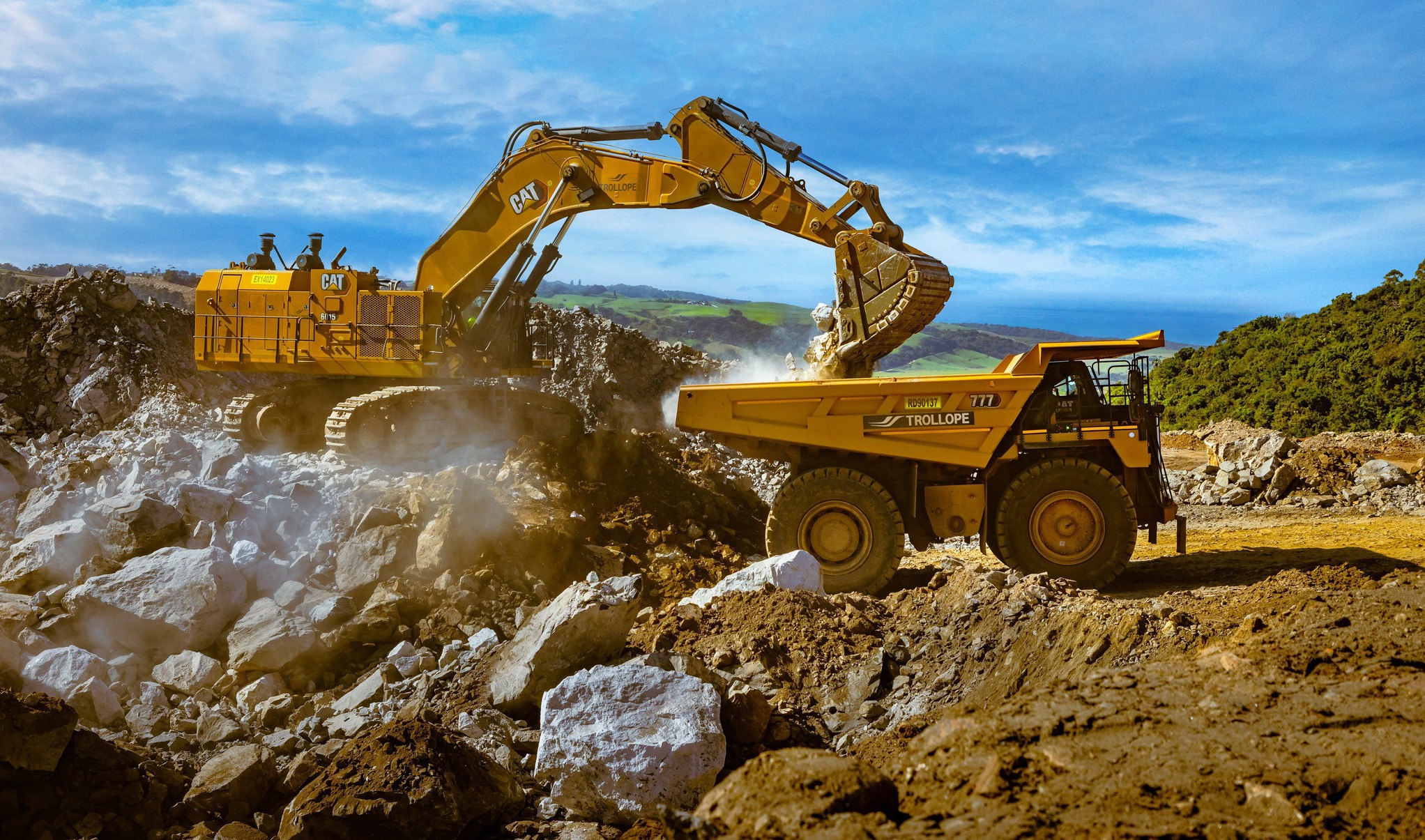
 Operators use heavyweight industrial machinery to load lithium ore at the Highbury Mine near Umzumbe on the KZN South Coast. (Photo: Barloworld Equipment Southern Africa Facebook)
Roughly 150 homesteads in the village of Magog have been earmarked for relocation by the SA Lithium group due to their proximity to its new Highbury lithium mine near Port Shepstone.
According to a basic environmental impact assessment (EIA) report compiled by Joan Consultants on behalf of SA Lithium, the mine plans to increase the size of its mining pit by at least five times, as well as expanding its waste rock dumping area at least fourfold.
This would necessitate the physical removal of “about 142 to 153 households situated within the mine’s buffer zone”.
The consultants say this equates to about 800 people, based on their estimate that Magog household sizes vary between single-person homes and those with as many as 18 family members.
When the mine was established about two-and-half years ago, several residents on the immediate fenceline were regularly temporarily “evacuated” to shelter in a local crèche during dynamite blasting operations, rather than being relocated.
It remains unclear why residents were not relocated – or mining plans not amended – before the onset of mining operations, as hundreds of residents in Magog and the nearby Fairview Mission areas have since been exposed repeatedly to high levels of noise, along with dense clouds of dust from exploding rocks and daily convoys of heavy trucks hauling lithium mining ore through residential areas for export via the port of Durban.
/file/attachments/orphans/tonylithium2ThenewSALithiummineatUmzumbeissurroundedbyruralhomesteadsandsubsistencefarmsImageSupplied_834115.jpg "The SA Lithium mine at Umzumbe is surrounded by rural homesteads, cane fields and subsistence farms. (Photo: Supplied)")
According to the Mine Community Resettlement Guidelines gazetted by Mineral Resources and Energy Minister Gwede Mantashe in March 2022: “No mining activity shall commence until a resettlement agreement is agreed on the appropriate amount of compensation as a result of resettlement of landowners, lawful occupiers, holders of informal or communal land rights, mine communities and host communities.”
Now, SA Lithium has applied to “revise” its existing environmental authorisation and waste dumping permits on the basis that it has since discovered new seams of pegmatite (a lithium-bearing ore) at Highbury. It argues that existing lithium ore at the current mine pit will be exhausted within five years and that allowing expansion will enable it to extend the life of the mine to about 20 years.
Curiously, during the previous EIA proposal in 2023, SA Lithium predicted that the new mine would last for 20 years.
In its latest application, SA Lithium argues that while the existing mine layout plan was authorised for a mining life of 20 years or longer, the new expansion is required “to ensure safe mining practices and to optimise resource extraction within the approved Mining Right area in a safe and controlled manner”.
It further states that the proposed expansion remains entirely within the previously approved Mining Right area, although it was required to “update” certain aspects of the authorisation.
Challenge
However, the amendment plan has been challenged by Durban-based All Rise Attorneys, acting on behalf of the Ugu Mining Integrity Land Action association and 10 supporting local organisations.
“The identities of these supporting organisations have been deliberately withheld due to concerns about potential pressure and intimidation arising from ongoing conflict in the area since SA Lithium commenced its operations,” states All Rise lawyer Janice Tooley.
She argues that SA Lithium has adopted a “hybridised process of its own invention to achieve a number of outcomes contrary to the processes prescribed in the prevailing legislation”. She has also called on SA Lithium to withdraw its current applications and “restart the process in accordance with the correct legal procedures”.
As these legal and procedural disputes continue, the mine expansion is set to engulf most of the Magog settlement, along with several local cane fields, subsistence farms and several ancestral graves.
Significantly, Daily Maverick received reports about a major resettlement plan nearly a year ago, and we asked SA Lithium director Ian Harebottle, in June 2025, to comment on reports that nearly 100 households close to Highbury had been told that they would be required to move out of their homes due to regular dynamite blasting and other mine operations. We also asked him to provide exact figures on the number of affected homes and how they would be compensated for the loss of homes, land, graves and other economic assets.
/file/attachments/orphans/tonylithium6SALithiumdirectorIanHarebottlesourceLinkedInprofile_128578.jpg "SA Lithium director Ian Harebottle. (Photo: LinkedIn)")
At the time, Harebottle did not provide any home relocation figures, stating that: “Under no circumstances have any households been ... notified this week that they will shortly be required to move out of their homes …” and no community land or resources has been or will be “lost”.
“Regular formal interactions with all affected communities in the area of the project are ongoing and in full compliance with all legal requirements and all National Guidelines. Claims to the contrary are outlandish and defamatory,” he said.
Now, almost a year later, it has emerged that as far back as March 2024, SA Lithium planning consultant Thys Blom was busy designing layout plans for at least 88 new relocation plots for Magog residents in the neighbouring Silwane area, owned by the Ingonyama Land Trust.
/file/attachments/orphans/tonylithium3RelocationplotproposalforSALithiumSourceJoanConsultingreport_628424.jpg "A layout map of some of the proposed resettlement plots in Silwane village, compiled by planning consultant Thys Blom. (Source: Joan Consulting report)")
One of the new documents that has come to light is a 19-page Mine Resettlement Plan compiled by Joan Consulting, which also provides an “indicative resettlement schedule”. This document suggests that the first cash compensation settlements to displaced residents were expected to be paid in February 2026, and the first relocations to new houses in Silwane and other areas would begin in August 2026.
The document is undated, but the chronology of the report suggests it was compiled at some point after August 2024.
We asked Harebottle last week to confirm whether the figure of 150 homestead relocations has since been revised and whether the indicative timeline for relocations has been revised.
/file/attachments/orphans/tonylithium5highburyrelocationtimeframesourcejoanconsulting_403488.jpg "An ‘indicative’ timeline schedule for the relocation of more than 800 residents of the Magog area on the KZN South Coast. (Source: Joan Consulting report)")
In his response, Harebottle did not answer these questions directly, stating instead that: “All proposed relocations are being conducted in consultation with affected persons who are actively and regularly involved in the ongoing process.”
The document states that stakeholder engagement forms a “cornerstone” of the SA Lithium Highbury resettlement plan and “ensures that all individuals and groups affected by the project are informed, consulted and meaningfully involved in decisions that impact their lives”.
According to the plans designed by Blom, displaced residents of Magog have the option of relocating to a section of Farm Alexandra Native Location No. 5, made up of 88 plots ranging in size from 313m² to 815m².
“The affected households that are not willing to relocate to this allocated land are allowed to identify a land or house that is within their compensation bracket for the mine to buy or build for them.”
The report also cites a Highbury Mine relocation impact assessment, apparently adhering to World Bank and International Finance Corporation standards for “involuntary resettlement” that are designed to ensure that “affected households are not worse off – and ideally better off – after relocation”.
As a result, the SA Lithium relocation plan aimed to provide support to all affected residents that would include a livelihood restoration programme incorporating agricultural training and starter input packages; microenterprise development support; skills development and employment opportunities within the mine and special assistance for vulnerable groups (eg, women-headed households, youth, and the disabled).
Though SA Lithium has been mining and blasting close to dozens of homes for more than two years, its new resettlement plan acknowledges that “proximity to mining operations exposes communities to blasting vibrations, dust emissions, and noise pollution”.
“Health risks include respiratory ailments, stress, and structural damage to homes. Preliminary community health surveys found that 34% of households reported respiratory or dust-related illnesses alleged to be caused by the mining activities.”
/file/attachments/orphans/tonylithium4highburygravephotoIntegratedSpecialistServicesreport_194883.jpg "The project also entails the exhumation of several graves to make way for the mining pits and rock dumps. (Photo: Integrated Specialist Services report)")
Several ancestral graves also fell within the expanded mine footprint. Their relocation would pose “a sensitive cultural challenge” that would require consultation, rituals and compensation.
It states that community “engagement activities” were initiated in August 2022 during the environmental authorisation process and “expanded” in August 2024 to support the resettlement phase. The primary objectives of the stakeholder engagement process were to “build trust and social license to operate through transparent communication” and “ensure informed participation by affected persons and communities”.
However, the establishment of the existing mine before the resolution of the resettlement proposal involving more than 800 people raises several questions around the degree to which haste to mine has taken precedence over sentiments such as trust, social licence and “informed participation”.
/file/attachments/orphans/tonylithium7highburyblockadesupplied_290592.jpg "A lithium truck comes to a standstill at a roadblock set up by angry community members. (Photo: Supplied)")
While several local residents contacted by Daily Maverick have declined to be quoted on the record, significant community anger and dissatisfaction were documented recently in a report by the National Council of Provinces (NCOP) committee on public petitions.
In its December 2025 report, the NCOP committee said it received a petition from former Magog resident Michael Sithole and other affected community members, alleging “systematic disregard” of the mining regulatory framework by SA Lithium.
Sithole told the committee that the mining company had failed to consult the Magog community before undertaking the mining activities in the area. It had also allegedly infringed on cultural and other human rights as a result of “inappropriate grave relocation practices” or by destroying land and biodiversity.
“Since mining started operating on their doorsteps, the walls of their homes are being cracked and the floors are collapsing as houses are being damaged by unabated blasting”, it was alleged.
See Scramble for white gold:
Part One: New mine triggers ‘white gold’ prospecting stampede on the KZN South Coast
Part Two: ‘Progress’ lands on the doorstep of rural communities as residents blast lithium mine
Part Three: Lithium mine objectors run into R345,000 appeal fee ‘roadblock’
Some community members were also reported to have been diagnosed with certain illnesses, probably caused by mining activities, while community complaints to the director-general of the Department of Mineral Resources and Energy were to “no avail”.
In response to our questions about SA Lithium’s EIA expansion application, Harebottle said:
“SA Lithium has invested several billion rands into the Highbury mining project, an investment which has created in excess of one thousand direct and indirect jobs, and contributes well in excess of one hundred million rand, on a monthly basis, directly into the local economy.
“SA Lithium is one of the largest and most meaningful investors in the South Coast of KZN. We pride ourselves on the positive impact that we have had within the local economy, our strong compliance record and the solid relations that we have established with the local communities...
“The processes that have been followed by SA Lithium in its application are legitimate and in accordance with all relevant legal procedures. We are supported by a team of specialist advisers that have assisted and guided us throughout this process... SA Lithium remains firmly committed to environmental stewardship and to the growth and development of the communities in which we operate. We welcome engagement from interested and affected parties and look forward to continued constructive dialogue.” DM


Comments
Scroll down to load comments...