



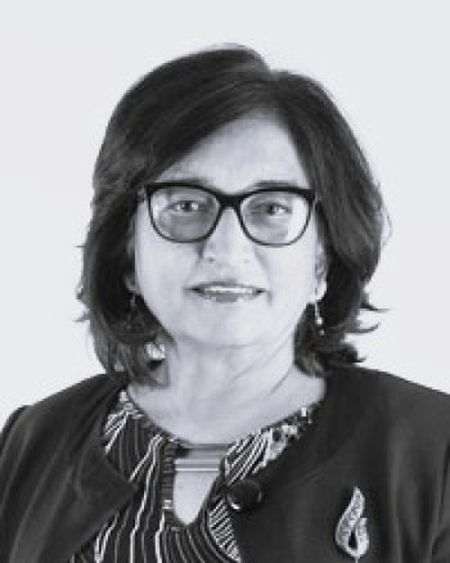
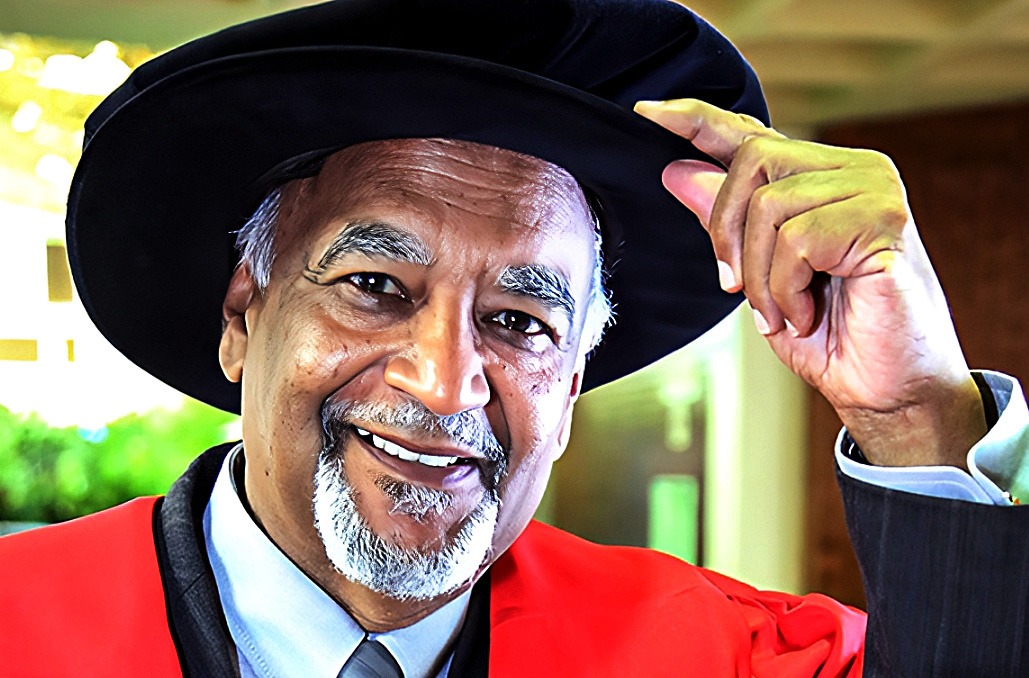
 Judge Barathanathan ‘Thumba’ Pillay. (Photo: University of KwaZulu-Natal)
Thanks to the 1860 Heritage Centre for hosting a memorable celebration of a stalwart of the struggle for democracy. And for inviting me to speak. As a 60-something asked to speak at the birthday of a 90-year-old, I know that I’m an afterthought. That’s okay. All the eligible, eloquent and eminent speakers are already up there in heaven, looking down upon us, wondering whether their sacrifices were worthwhile.
Reminiscing
The chat group Thumba Pillay @90 a Life of struggle and service overflows with accolades of all that Judge Pillay is – husband, father, lawyer, activist, comrade, landscaper, builder, chef, and much more. It captures many memories of his participation in the struggle for democracy.
I could reminisce about our time together, our holidays in the Drakensberg and Knysna, our monthly dinners and the Saturdays Judge Pillay spent building for Yunus and me a water feature that remains an enduring testament to his generosity and DIY talents. But reminiscing would be self-indulgent if not followed through with activism. Rather, I want to highlight Judge Pillay’s contribution to humanity through the law.
The first case that Judge Pillay and I, as attorneys, worked on together was the so-called Doctors’ Treason Trial (State v Dudu Butherlezi and 11 Others.) The doctors were Dr Vijay Ramluckan, the late surgeon-general and Dr Sibongiseni Dhlomo, currently an MP. My partner, Yunus Mahomed, was in hiding from the security police during the state of emergency and kept a low profile. I had recently qualified and Judge Pillay was brought in briefly to add gravitas to the defence team.
Judge Pillay had earned his stripes as a heavyweight human rights lawyer after being the attorney for many activists. Billy Nair, Natvarlal Babenia and Curnick Ndlovu were among his clients who were imprisoned on Robben Island with Nelson Mandela.
Judge Pillay served on the KwaZulu-Natal High Court Bench for 10 years. He was highly respected, a role model of patience and empathy. On retirement, he was aptly awarded a pair of white gloves from the prosecution services.
Historically, the white gloves have symbolised pure hands, free of vice and crime. It also symbolises meticulous care, attention and flawless handling of cases. It is a prestige traditionally bestowed in recognition of professionalism and fraternity. I know of no other judge who received such an honour. In many ways, Judge Pillay set a high bar.
Judge Pillay’s seminal judgment was to grant prisoners at Westville Prison access to medication for HIV/Aids. He saved many lives. In 2026, we also celebrate the 20th anniversary of that judgment.
Struggle for antiretroviral treatment
In 2000, the International Aids Conference, held in Durban, elevated the struggle of people living with HIV/Aids to receive antiretroviral (ARV) medication. Until then, the government at the time steadfastly resisted recognising the disease as a treatable virus.
/file/attachments/orphans/55d373c5e1b88271c13de86e8827d34bf87bcb581_540803.jpg "This tribute celebrates the 90th birthday of Judge Barathanathan ‘Thumba’ Pillay, recognising his life of service as a stalwart of the struggle for democracy and a judge dedicated to human rights.
<br>(Photo: UCT)")
(Photo: UCT)
In 2003, the Constitutional Court accepted that the spread of HIV/Aids could be prevented if breastfeeding mothers had access to ARV treatment. I digress to mention that another stalwart of our struggle, Professor Hoosen “Jerry” Coovadia, was the lead researcher in discovering that the spread of HIV/Aids can be prevented by administering ARV’s to breastfeeding mothers. Professor Coovadia was also our close friend who nominated Judge Pillay for the honorary doctorate he received from the University of Durban Westville.
HIV/Aids prisoners case
Yet, by 2006 more than 100 Westville prisoners required ARV treatment. It was a matter of life and death. Inmates launched a hunger strike, demanding that the government provide ARV treatment for infected prisoners.
On 12 April 2006, the Aids Law Project (ALP) lodged an urgent application against the government for the removal of all obstacles to ARV treatment for 15 HIV-positive prisoners at Westville Prison.
Astoundingly, the government opposed the application. Not only that, it applied for the recusal of Judge Pillay because his daughter was the ALP’s correspondent attorney. Judge Pillay dismissed the recusal application.
Judge Pillay ordered the government to implement its own operational plan, to provide ARVs to all those who needed them and to file an affidavit in court attesting to its plans to give effect to his order.
The government applied for leave to appeal against his judgment. The ALP asked for the order to be implemented, pending the appeal, since a delay would cause the prisoners irreparable harm. Judge Pillay reasoned in his judgment:
“One cannot, on the one hand hail the values of our Constitution which holds the right to life as sacrosanct, and on the other allow people to die in a situation when something can and should be done, certainly more diligently, to counter a pandemic which has been described as an ‘incomprehensible calamity’ and the ‘most important challenge facing South Africa since the birth of our new democracy’... on the Respondents’ own version, nine prisoners per month died of HIV/Aids-related illnesses since the beginning of 2005.”
/file/dailymaverick/wp-content/uploads/2024/09/Book-Ancer-GordhanTW.jpg "Key activists during the anti-apartheid struggle, gathered in Durban. Back row, from left: Mohamed Simjee, Swaminathan Gounden, Jerry Coovadia, Thumba Pillay, Virgil Bonhomme, Ela Gandhi, Zac Yacoob, Abdul Haq Randeree, Paul David, Roy Padayachee, Yunus Mohamed. Front, from left: George Sewpersadh, MJ Naidoo, Archie Gumede, Mewa Ramgobin and Pravin Gordhan. (Photo: Supplied)")
Judge Pillay granted the application for implementation of his order pending the appeal. He also ordered the government to report back to the court on steps taken to do so by 14 August. He hoped that “good sense will prevail and a settlement reached through negotiation in the interest of those affected prisoners whose vulnerability cannot be denied. Any protracted litigation can only be counterproductive and harmful to those in whose interest this application was launched.”
Good sense did not prevail. On 14 August, the government contemptuously failed to report back to the court. Instead, on 15 August, it lodged an application for leave to appeal against the interim order. Eventually, Judge Chris Nicolson dismissed the appeal.
What hasn’t changed?
Currently, court cases and commissions of inquiry flood our television screens, radios and social media. We wonder: where does truth lie? Retreating into process and technicalities to avoid addressing substantive issues and getting to the truth continues to be a tactic. Applications for the recusal of presiding officers and evidence leaders continue to be used to avoid exposing the substantive complaint.
The government scraped the barrel for a defence when it applied for Judge Pillay’s recusal; no other challenge – neither process nor substance – could be dredged to justify withholding medication from dying prisoners.
Not even a jurisdictional challenge – separation of powers, another typical technical defence – could be raised. Meticulously, Judge Pillay had “stayed in his judicial lane” when he ordered the government to implement its own plans. He held the line by lawyering for the love of humanity, not for decay.
What has changed?
Lawyering to defend the indefensible accelerates democratic decay. Abusing the institutions of democracy, such as the courts, is but one symptom of decay.
Public response to the decay is another. The Human Sciences Research Council found that 69% of South Africans were satisfied with democracy in 2004. In 2025, that percentage plummeted to 17%. Vesting in people’s hope for a happy life and inspiring patriotism would be a way to reverse the decay.
In conclusion, Judge Pillay served on the Electoral Court before he retired. He will be exercising his hard-won right to vote in the local government elections on 4 November 2026. And so should every eligible adult South African. DM
Dhaya Pillay is a judge of the High Court of South Africa (retired), and a commissioner of the Electoral Commission of South Africa.
Comments
Scroll down to load comments...