




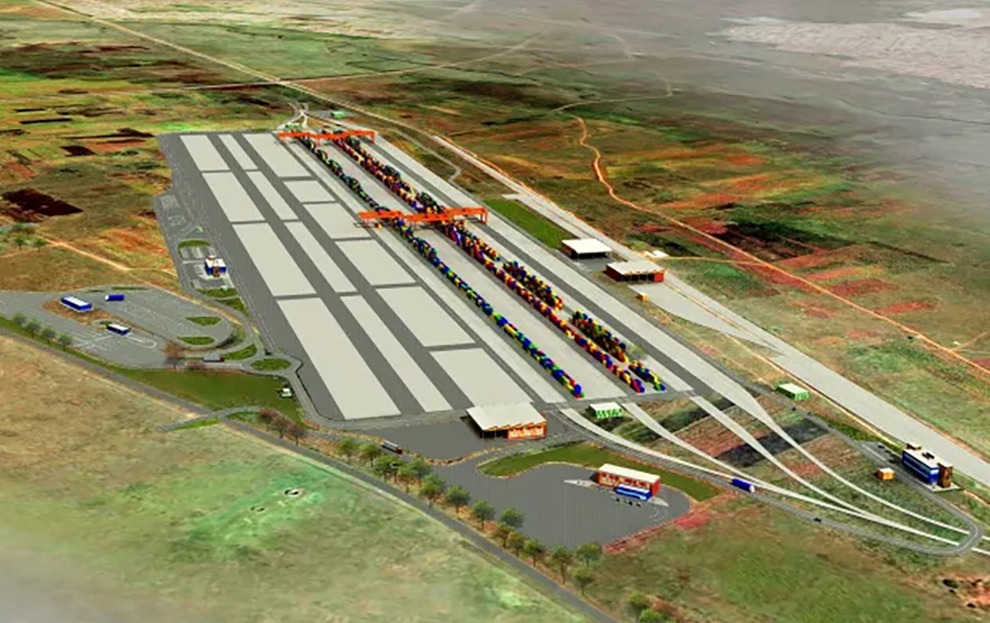
 An artist’s impression of the proposed Tambo Springs Intermodal Facility. (Image: X)
The Tambo Springs inland port project — designed to streamline cargo movement between Durban and Johannesburg — has encountered a major legal setback. A Gauteng High Court ruling that cancelled the environmental approval for the controversial K148 road will stand, as no appeal had been filed by the deadline.
The litigation battle, which one of the parties estimates may already have cost between R30-million and R40-million, leaves a key logistics corridor tied to the project facing renewed uncertainty.
The proposed road forms a critical link in the broader logistics and inland port vision repeatedly promoted as a catalyst for economic growth, freight efficiency and industrial expansion in Gauteng.
Friday, 24 May marked the deadline for the losing parties to seek leave to appeal the ruling. No application had been filed by the close of business, meaning the April judgment stands, and the environmental authorisation for the K148 project is now effectively set aside.
The ruling is a significant blow to one of Gauteng’s most ambitious freight and logistics infrastructure visions, repeatedly promoted by Premier Panyaza Lesufi and other provincial leaders as part of broader plans to strengthen Gauteng’s role as a logistics hub.
/file/attachments/orphans/ED_607049_804730.jpg "Gauteng Premier Panyaza Lesufi. (Photo: OJ Koloti / Gallo Images)")
In a scathing judgment handed down in April, the Gauteng High Court found that defects in the environmental approval process had “vitiated the entire process”, overturning both the original environmental authorisation and a later amendment process intended to rectify the defects.
At the centre of the dispute was the proposed K148 road — intended to service the inland logistics corridor near the Tambo Springs development.
The court found serious flaws in the environmental impact assessment (EIA), including failures relating to affected landowners, public participation processes and broader environmental governance.
Floodplain and wetland system
At the centre of the legal battle was a major environmental contradiction.
Environmental reports showed that the proposed route interacts directly with a sensitive floodplain and wetland system — even as approval conditions initially prohibited development in the area.
That contradiction became central to the court battle.
The original environmental authorisation included a 30m buffer around the floodplain. But that restriction was later removed in an amended decision, effectively allowing the road to proceed through environmentally sensitive areas.
The court ultimately rejected that approach, finding that the defects in the approval and amendment process undermined the legality of the environmental authorisation itself.
Developer’s challenge — and a R16m legal fight
The case was brought by businessman Francois Nortjé, whose company NT55 Investments is developing a separate inland logistics hub, the Port of Gauteng, on neighbouring land.
Although Nortjé’s NT55 Investments project is separate from the provincial road development, both are linked to competing and overlapping logistics ambitions around the broader Tambo Springs freight corridor.
Nortjé said he was forced to go to court after repeated attempts to raise concerns about the approval process failed.
“The provincial government was attempting to short-circuit the law and fudge the environmental impact of its proposed route,” he said.
/file/attachments/orphans/557577491_1229388879204361_7284669755030083245_n_258454.jpg "Francois Nortjé, who leads the company NT55 Investments. (Photo: Port of Gauteng)")
Nortjé said he had spent an estimated R16-million pursuing the litigation.
“It shows how abusive the Gauteng government is; this matter should never have gone to court … it’s a disgrace,” said Nortjé after the ruling.
He has long argued that the proposed road cuts through one of the most sensitive wetland systems in Gauteng and that environmental safeguards were progressively weakened during the approval process.
With the appeal deadline having passed, Nortjé said it appeared that the EIA had now effectively been set aside. He estimated that legal costs for all parties involved in the lengthy litigation were between R30-million and R40-million.
/file/attachments/orphans/558481083_1229388782537704_4783497451950316885_n_658499.jpg "NT55 Investments’ Port of Gauteng project. (Photo: Port of Gauteng)")
Gauteng government responds
The Gauteng Department of Agriculture and Rural Development (GDARD) acknowledged, in a response to Daily Maverick, that the route traverses a floodplain but argued roads are not prohibited in such areas under the National Environmental Management Act and pointed to other roads that cross floodplains and watercourses.
The department further argued that socioeconomic considerations formed part of the decision-making process when granting the environmental authorisation.
The department said that aspects of the dispute were “commercial in nature and not purely on environmental conservation”.
It strongly defended both the original approval and the later amendment process, despite the court ruling against it.
The department said it did “not share” the court’s conclusion that defects in the Environmental Impact Assessment process had “vitiated the entire process”.
It argued that although some affected properties were allegedly omitted from parts of the EIA documentation, the department believed the approval process remained legally adequate because the road alignment, specialist studies and environmental assessments had all been considered.
“The department did not only rely on the property description provided,” it stated.
The department further insisted that all relevant specialist reports had been considered and that risks associated with the Transnet petroleum pipeline had been assessed and found to be “very low” because of the depth of the underground pipeline and an existing wayleave agreement.
On the public participation process, GDARD maintained that the application met “the basic requirements” of the EIA regulations and argued that even properties allegedly omitted from formal listings were still represented through stakeholder consultation processes.
On the floodplain controversy, GDARD argued, “The EIA process and the outcome thereof did not contain any information that suggests that the road cannot be constructed within the floodplain.”
The department defended the controversial amendment process that was later overturned by the court, saying the approval was “not only correct but was lawful”.
Perhaps most significantly, GDARD stated that it did not believe the court findings related entirely to the legality of the approval process itself, arguing that litigants had also failed to comply with certain appeal procedures.
“The issues raised in the judgment are not uncommon in the EIA process, especially in instances where the dispute is commercial in nature and not purely on environmental conservation,” the department stated.
GDARD confirmed it had conducted an internal review into the matter in 2019 and remained satisfied that the environmental authorisation process complied with EIA regulations. The department also indicated that no officials would face accountability measures arising from the judgment.
Softer public tone in official statement
Those detailed responses differed sharply from a broader public media statement issued by the department on 7 May.
In that statement, the department said it “respects the ruling of the Court” and viewed the judgment as an opportunity to strengthen governance systems and public confidence in environmental oversight.
The statement described environmental authorisations as critical tools balancing “infrastructure development, economic growth and environmental protection in the public interest”.
“The Department views the judgment as an opportunity to further strengthen internal governance systems, enhance regulatory safeguards and reinforce public confidence in the environmental management regime of the province,” it said.
Gauteng’s MEC for environment, Ewan Botha, said communities must have confidence that environmental decisions are taken “carefully, transparently and in the broader public interest”.
“This matter has reaffirmed the importance of maintaining strong and robust environmental governance processes at all times,” said Botha.
For now, however, with no appeal lodged before the deadline, the high court ruling stands — leaving one of Gauteng’s flagship freight and logistics infrastructure projects legally stalled, environmentally contested and facing profound regulatory uncertainty. DM
Comments
Scroll down to load comments...