




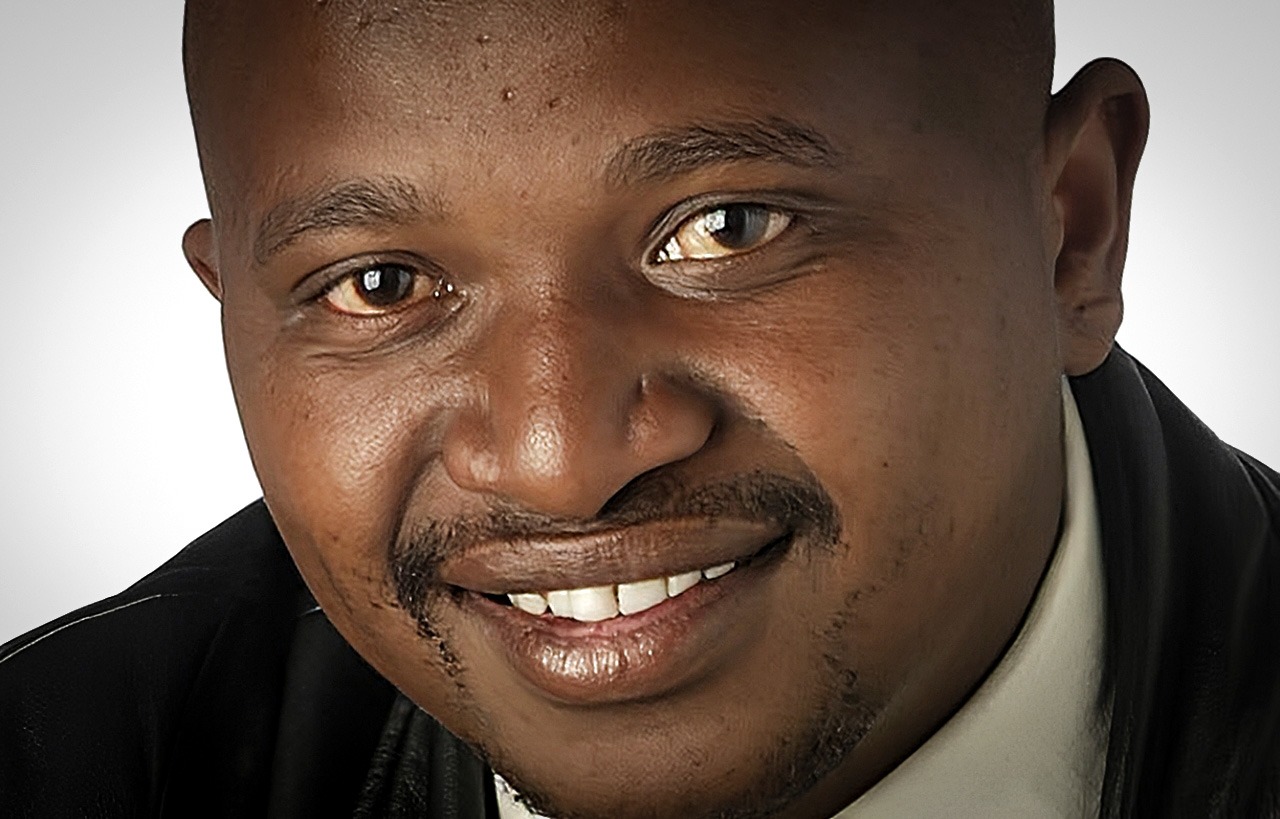
 Journalist Baldwin Ndaba was a respected journalist known for his deep political insights and mentorship. (Photo: Supplied)
 I learnt of Baldwin Ndaba’s death shortly before midnight on Friday.
Only days earlier, after not hearing from him for a very, very long time, I had picked up the phone and called him. We spoke for more than an hour before the line cut off.
Afterwards, we exchanged brief WhatsApp messages and promised to continue the conversation. There was still so much to discuss, so much to plan, serious business this time.
It was not to be.
According to his family, Baldwin went to bed on Thursday night and simply never woke up. There had been no known illness. His younger brother, Robert, had been with him the previous day and said he had appeared perfectly fine. His wife was away in Kimberley at the time. Baldwin was at home with his eldest daughter and grandchildren.
I had known Baldwin since the early 1990s, when he arrived at Rhodes University, apparently after spending the previous year at the University of the Western Cape – still universally known in our circles simply as “Bush” – where he had been studying law. We stayed in the same hall at Rhodes, Founders Hall, and in the same residence, Cory House.
He was scrawny in those days, thinner even than I was.
To understand Baldwin properly, one must understand the Rhodes University of the early 1990s. Black students were still a tiny minority on that campus, even after apartheid laws restricting university admissions had fallen away. Politics saturated everything.
Among black students, there were divisions. The overwhelming majority were Charterists. A much smaller contingent identified as Africanists and supported the PAC. Baldwin belonged firmly to the latter camp, and he held on to those convictions until the end.
At Founders Hall, tea urns would be wheeled out on to the verandah every day at 11am and again at 3pm, except on Sundays, as I remember it. Students from different residences drifted there to drink tea and argue about everything: politics, women, music, books and the future of South Africa. Those conversations could stretch for hours and often did.
A natural fit
Quite quickly, a postgraduate education student from Kimberley, bra Tex Moraladi, became our warden. Soon enough, a distinct Kimberley contingent formed around him. They would often drift away from the larger crowd and slip naturally into Afrikaans, the lingua franca of Kimberley.
Baldwin fitted naturally into that world.
Years later, when I joined The Star, I used to tease him by calling him “Sol Plaatje”.
He spoke Afrikaans, Xhosa and Setswana with equal ease and naturalness. English almost seemed secondary. I used to tease him that his Xhosa sounded slightly Afrikaans.
Around 2015, when I was beginning to get seriously into Setswana myself, we had many moments in the newsroom around language. One day, after listening to me stumbling through yet another Setswana exchange, Baldwin turned to newsroom assistant sis’ Thandi Mabuza and joked: “Monngwe o ithuta Setswana ka nna (Someone wants to learn Setswana, using me).”
The newsroom burst into laughter.
That was Baldwin: always listening, always quietly amused.
Some years later, after I had left Rhodes for Johannesburg to work at Business Day, we bumped into each other again at the Johannesburg Magistrates’ Court while covering a story. He told me Independent Media had transferred him from the Diamond Fields Advertiser – the DFA, as everybody called it, one of South Africa’s oldest newspapers – to The Star.
A journalist’s journalist
By then, he was already becoming what journalists call a journalist’s journalist.
His command of Afrikaans gave The Star an edge few rival newsrooms could match whenever court proceedings slipped into Afrikaans, as they often still did in those years.
He always seemed to know what was happening – in the newsroom, in politics and even in the higher echelons of power. The remarkable thing was that you never really saw him aggressively cultivating sources. Yet somehow, he always had the information.
Former Saturday Star editor Kashiefa Ajam captured that quality perfectly when she wrote on Facebook at the weekend that Baldwin “knew all the gossip. Whenever he walked into the newsroom wearing that toothy smile and asked, ‘Have you heard?’, you knew something significant – and usually juicy – was coming.”
But gossip understates it. Baldwin understood the movement beneath institutions.
He had a feel for politics, for factional tensions, for who was rising and who was falling. Younger reporters gravitated towards him because he enjoyed mentoring them and teaching them the craft.
Formidable career
Publicly, Baldwin built a formidable career covering politics, corruption, state institutions and democratic accountability over nearly three decades. He received a Special Mention in the Nat Nakasa Award for Media Integrity in 2000 and became a Standard Bank Sikuvile Awards finalist in investigative journalism in 2013.
One of the investigations I particularly remember involved former Gauteng local government and housing MEC Humphrey Mmemezi. Baldwin’s reports in The Star about Mmemezi’s use of a government credit card caused enormous political embarrassment and ultimately contributed to the pressure that led to his resignation.
I still remember Baldwin showing me an exasperated note from Mmemezi’s spokesman, Motsamai Motlhaolwa, who is himself a friend and a former contemporary from Rhodes. We had all occupied the political trenches at roughly the same time. The note suggested Motlhaolwa was taking serious heat from his boss over Baldwin’s exposés and was somehow expected to perform miracles to stop the stories.
Baldwin merely chuckled.
That understated amusement was very much his style.
The public Baldwin was the political journalist whose reporting examined corruption, procurement scandals, provincial governments, Nkandla, State Capture and municipal dysfunction. But there was also the Baldwin of everyday newsroom life.
He enjoyed his drink, as many Rhodes graduates of that generation did, and before I stopped drinking in 2011, we indulged enthusiastically enough ourselves.
A love for ‘skopo’
As photographer Steve Lawrence recalled at the weekend, Baldwin loved skopo (sheep’s head), chicken head and chicken feet, also known as “runaways” or maotwana. Steve remembered with horror how Baldwin demolished chicken heads with relish while everyone else reached desperately for serviettes. I remember Baldwin and Phomello Molwedi, another colleague, once inviting deputy news editor Yvonne Grimbeek to a Sunday skopo feast at the large conference table where we held editorial conferences.
And then there was the walking.
As far as I know, Baldwin never obtained a driver’s licence. Our late colleague Solly Maphumulo, one of Baldwin’s regular partners in crime in newsroom mischief, once told me he suffered from some kind of phobia. When I asked Baldwin about it directly, he simply ignored me.
Walking the streets
But he walked constantly around the Johannesburg city centre. He walked to the court. If there was a transport strike or boycott, he did not mind walking from Sauer (Pixley ka Isaka Seme) Street to Empire Road, where he lived, after work and back again the next day. Even on ordinary assignments in town, one often encountered Baldwin moving briskly along the streets on foot.
In retrospect, it feels strangely fitting. Journalism for him was never distant or abstract. He moved through the city attentively, absorbing its rhythms, anxieties and rumours as part of ordinary daily life.
The National Press Club described him this week as “a consummate and unassuming journalist” who understood that democracy required “a vigilant fourth estate”. That is true enough.
But for those of us who knew him personally, Baldwin will also be remembered for the smaller things: the tea debates at Founders Hall, the banter in the newsroom, the political arguments, the mischievous smile, the long walks through Johannesburg and the quiet way he carried information.
The memorial service in Kimberley will be held on Thursday. The funeral will be held on Saturday, also in Kimberley. DM
Bonile Ngqiyaza is a journalist, editor and author with more than 32 years’ experience in the media industry. He is the author of Small Fires in the Dust, a collection of short stories published late last year by Xarra Books.