




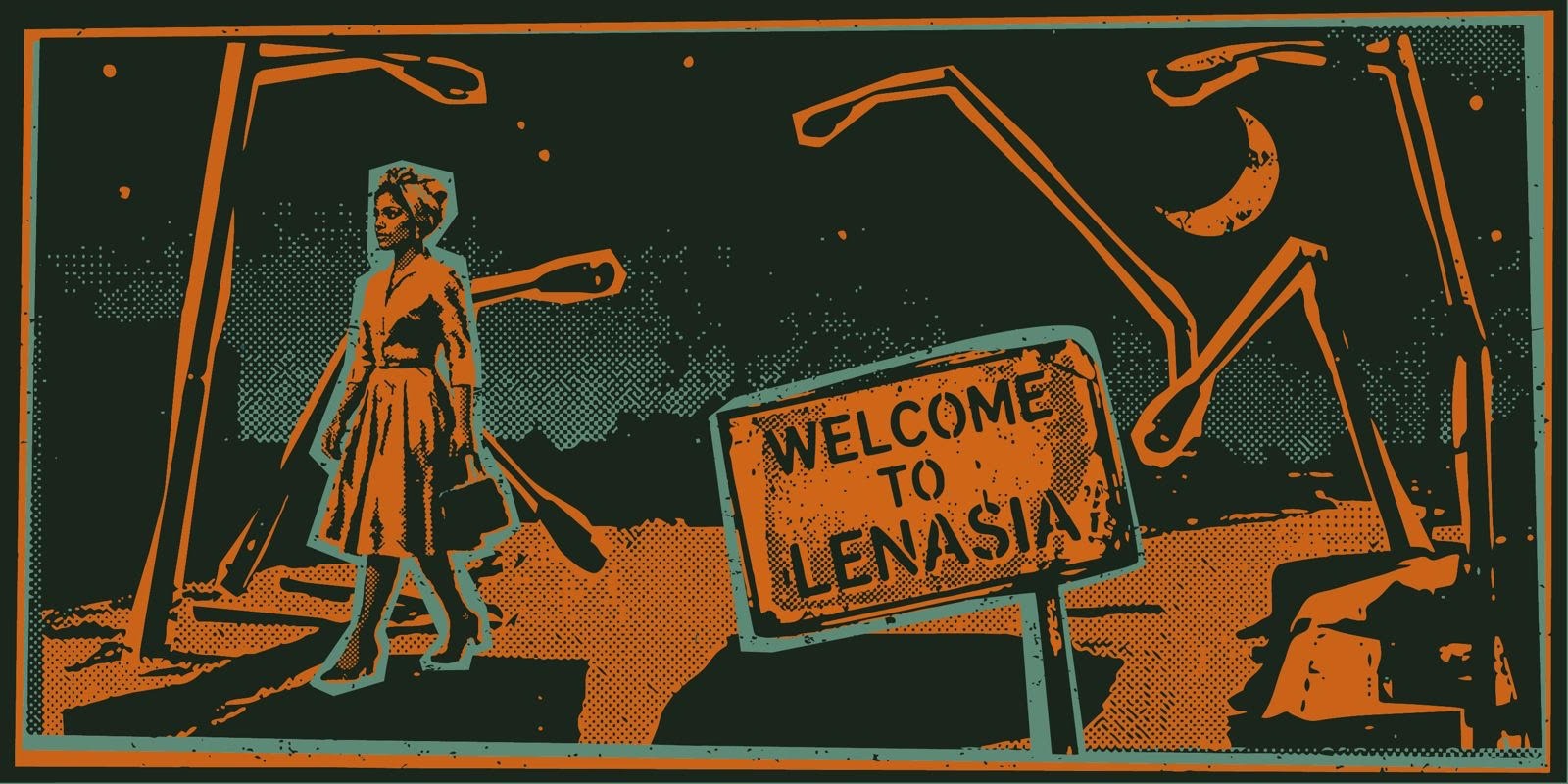
 Broken streetlights in Lenasia South contribute directly to crime, say residents of the Johannesburg suburb. (Illustration: Kevin Momberg)
 Driving down Nirvana Drive, the main street in Lenasia South, Johannesburg, we are greeted by the sight of rusted street poles bent at the top as if pointing motorists away from the area. On closer inspection, the poles have open boxes which once housed copper wiring but are now empty. In some patches, a row of vandalised lights are clustered together.
Lenasia is one of the many areas in Johannesburg that have suffered from service delivery failures driven by ageing infrastructure, severe budget deficits and maladministration — issues that have taken centre stage ahead of the local government elections scheduled for 4 November.
A Daily Maverick investigation previously found that repair times skyrocketed from 2023 to 2024, with streetlights being targeted for cable theft and vandalism. As a result, residents are finding their worlds shrinking.
Earlier this year, Daily Maverick asked readers to report broken streetlights across the city. More than 130 readers logged issues, with some streetlights experiencing regular outages for up to six years. The results were published in January. They were a snapshot of the time and may have since changed:
After tracking broken streetlights across the city, we used readers’ submissions to examine the impact of the lack of lighting on residents’ lives. In a roundtable discussion, five women described how their worlds were shrinking due to concerns over crime and safety.
In this instalment of the Joburg streetlight series, we visited Lenasia South, which readers repeatedly raised as a concern, to see the impact broken streetlights have in just one community.
/file/attachments/orphans/6I1A1054_796924.jpg "Motorists travelling at night on Nirvana Drive in Lenasia South have to navigate in darkness as broken streetlights leave the street unsafe and poorly lit. (Photo: Felix Dlangamandla)")
Lenasia residents say the lack of public lighting contributes directly to crime. The poor responsiveness has led many to lose faith in local governance.
“The lights don’t work all along this road, and it’s pitch dark at night,” said Zarina Motala, a former councillor in the area and steering committee member for the Johannesburg Crisis Alliance (JCA).
Motala has been a resident in Lenasia for the past 50 years and has watched service delivery deteriorate. She’s seen signs of decline since 2016, notably the area’s library being vandalised and potholes going unrepaired. The most visible sign is the lack of public lighting — in some places, there are no streetlights.
/file/attachments/orphans/WFD_0898_632863.jpg "Zarina Motala, a resident of Lenasia South, says the lack of lighting is contributing to safety concerns and ongoing problems in the area. (Photo: Felix Dlangamandla)")
“You also look at our taxi rank ... [where] there’s no lights. The females come and go, and they take taxis late at night,” said Motala.
Contested repair times
City Power told Daily Maverick that the high rate of theft and vandalism was the main obstacle to providing consistent public lighting in the area. Criminals target valuable components in streetlights, including aerial bundle conductor cables, LED fittings, control boxes and copper wiring,” said City Power spokesperson Isaac Mangena.
“These incidents often result in missing lightbulbs, damaged poles and non-functional infrastructure, requiring not only repairs but also the submission of insurance claims before major restoration work can proceed.
“Such criminal activities place significant strain on resources and delay the restoration process compared to routine maintenance issues. The frequency of these incidents makes it increasingly difficult to source and replace materials at the pace required to expedite supply restoration.”
/file/attachments/orphans/6I1A0921_640456.jpg "The cables of this streetlight on Nirvana Drive in Lenasia South have been stripped. (Photo: Felix Dlangamandla)")
Despite this, City Power continues to report low turnaround times for repairs. Our previous reportage on the issue found that repair times in Lenasia had skyrocketed from 5.6 days in the 2022/2023 financial year to 19.64 days in the 2023/2024 financial year.
Since then, City Power’s Q2 report for 2025/2026, which looked at 1 October 2025 to 31 December 2025, showed that the repair time had reduced to 2.1 days on average.
Motala says these figures don’t tally with her experience.
“It’s not on a three-day turnaround; unfortunately, definitely not. I have logged calls where people have logged numerous calls, and some of them just get closed, but, unfortunately, they were not obeyed,” she said.
Pointing to a nearby streetlight, she noted it took eight days and a barrage of complaints to get it fixed. Elsewhere in the neighbourhood, some streetlights have been dead for four years.
Compounding the issue is the lack of service delivery to the Waterworks Informal Settlement, which sprang up on disused railway tracks set on land owned by Prasa. Residents have reported inconsistent supplies of water and electricity, with impassable roads that make it difficult for water tankers to access the area. Residents rely on illegal electricity connections, often connecting from the streetlight poles on Nirvana Drive.
‘Element of criminality’
For Lenasia’s residents and business owners, the lack of street lighting carries a direct, criminal toll. Jamiel Mohamed, manager of local food retailer Megachicks, said that businesses in Eland Street had been systematically targeted. According to Mohamed, the security vacuum is driven by two main factors: a nearby transformer that is repeatedly sabotaged by vandals, and a severe local drug crisis where nyaope users strip copper infrastructure for quick cash.
As a result, the street is often completely dark at night, leaving the businesses vulnerable. Mohamed’s business was targeted by criminals who used the cover of darkness to steal more than R22,000 worth of copper wiring.
“The reality is, the moment there’s darkness, there’s definitely an element of criminality that can take place,” Mohamed explained. He said the business had installed floodlights to increase visibility and safety, but this solution only lasted two or three weeks.
/file/attachments/orphans/6I1A0975_494628.jpg "Broken streetlights make the taxi rank in Lenasia unsafe, say residents. (Photo: Felix Dlangamandla)")
“You won’t believe it. After two weeks, the owner comes here. He tells us, ‘Oh, your people took your lights out. They stole the lights away from there.’ So we obviously have hired security. They come, escort us out of the building, make sure my staff are gone. My staff enters [the shop] with them here. So we have armed responses all the time.”
Zero improvement
The offices of Al Jamah-ah Ward 9 councillor, Yakoob “Jakes” Karolia, are in Lenasia’s CBD, parts of which have been unlit for the past eight years. He has reported faulty streetlights that have gone months without repair, or have been repaired and then vandalised within days.
“Believe me, people are continuously calling me and continuously WhatsApping me to say, ‘You know, my streetlight still hasn’t been sorted out.’ [In January 2025] I called up a meeting with public lighting. They all came, and the regional manager told me, ‘Councillor, I will definitely make your CBD like New York.’
“To date, zero [improvement]. Never mind my CBD, my residential area, people go to mosques, in the early parts of the morning, and they’re getting mugged.”
While City Power has proposed transitioning to solar-powered streetlights, the high cost makes it a distant prospect. In the interim, Karolia has suggested that businesses pool resources to install boom gates and step up private security. It is a defensive strategy Megachicks has already embraced, with its head office hiring armed security across all branches to safeguard staff. Lenasia’s ordinary residents, however, enjoy no such luxury.
‘It’s not safe’
Just off Nirvana Drive lies a quiet residential road, separated from the Waterworks informal settlement by a fence and a gate that locks at night. Yet, with no public lighting to speak of, the street is swallowed by darkness after dark. Among those living in the shadows is Lukhanyo Mkhize, a young mother of two who moved here after buying her first home. What should have been a milestone has turned into a nightmare: she says the persistent blackout has made her house an easy target, leading to three break-ins in just two years.
/file/attachments/orphans/WFD_0915_786273.jpg "Lenasia South resident Lukhanyo Mkhize has been burgled three times in two years. (Photo: Felix Dlangamandla)")
“[I feel] very unsafe. It’s not safe because people jump from that side and come this side, and you can’t even see them. Literally, when you’re parking the car, they can just walk behind you.
“They’re looking at you the whole time. You don’t see them because we [have] light from this side, from the house lights. So it’s dark on that side, and they see you, and they watch you,” she said.
She showed us exposed wiring near the roof where cameras and lights were once mounted to increase security. Within weeks, they were stolen. All of her neighbours have similar stories. Because of the safety issues, she does not allow her young children to play outside, even during the day. Jogging is also out of the question.
When asked why they bought the house, she responded, “We did not know. If we knew, we wouldn’t have bought this house. We didn’t know.”
A Joburg problem
All of the residents we spoke to pointed to the same issue: a lack of responsiveness, including from councillors. As a result, residents have had to pay for private security and resorted to fencing off parts of their community and conducting regular patrols.
Councillor Chris Avant Smith, from the DA, said, “Unfortunately, public lighting is a problem across the city, not just in Lenasia. This problem is a systemic one that has been brought about by years of mismanagement by the the entities in the City, a lack of supply chain management, which results in the ordering of necessary spares, including globes, cabling and the masts themselves.
“The intermittent power supply has also caused damage to the poles and workings of the lights, often resulting in electrical fires. Cable theft and vandalism have also contributed to this problem. This obviously has a detrimental effect on the residents and is a major cause of the rise of criminal hotspots.
“It is also dangerous for drivers and pedestrians alike. Recently, the City’s financial woes have exacerbated this problem as suppliers and contractors struggle to be paid.”

City Power said it had intensified efforts to protect its public infrastructure and replace streetlights with solar lighting that does not contain high-value components attractive to thieves.
“Despite the ongoing challenges posed by theft and vandalism, our current initiatives to curb its effects on our infrastructure include strengthened collaboration with law enforcement agencies to support operational planning and stabilise identified hotspot areas. In addition, City Power continues to forge strong partnerships with customers, communities, and other stakeholders to protect public infrastructure against theft and vandalism,” said Mangena.
Crime hotspots
City of Johannesburg spokesperson Nthatisi Modingoane said it was “widely recognised” that a lack of public lighting can contribute to crime.
“The Johannesburg Metropolitan Police Department (JMPD), through its Crime Prevention Units and Integrated Intelligence Operations Centre, continuously monitors crime hotspots and accident-prone areas.
“Internal assessments consistently support the ‘Fighting Crime Through Environmental Design’ theory, which suggests that poor lighting creates ‘dark spots’ that can provide cover for criminal activities, including smash-and-grab incidents, hijackings, and contact crimes such as muggings and gender-based violence,” he said.
He added that crime statistics from the South African Police Service indicate that there is a “higher prevalence” of opportunistic crime in areas where public lighting has been compromised because of vandalism or poor maintenance.
“In addition, poor visibility is recognised as a significant contributing factor to pedestrian-related accidents and collisions, particularly at intersections. JMPD accident data is regularly analysed to identify high-risk corridors where targeted lighting interventions may help reduce incidents and fatalities,” said Modingoane.
Compounding Johannesburg’s widespread streetlight crisis is a looming showdown with Eskom. The power utility has threatened a blanket disconnection of the city’s streetlights over an outstanding R4.1-million debt, threatening to plunge already vulnerable neighbourhoods into permanent darkness. DM
Daily Maverick also requested comment from the ANC parliamentary constituency office in Lenasia and other stakeholders, including Premier Panyaza Lesufi’s office, the JMPD and SAPS. We will update the story if we receive a response.