




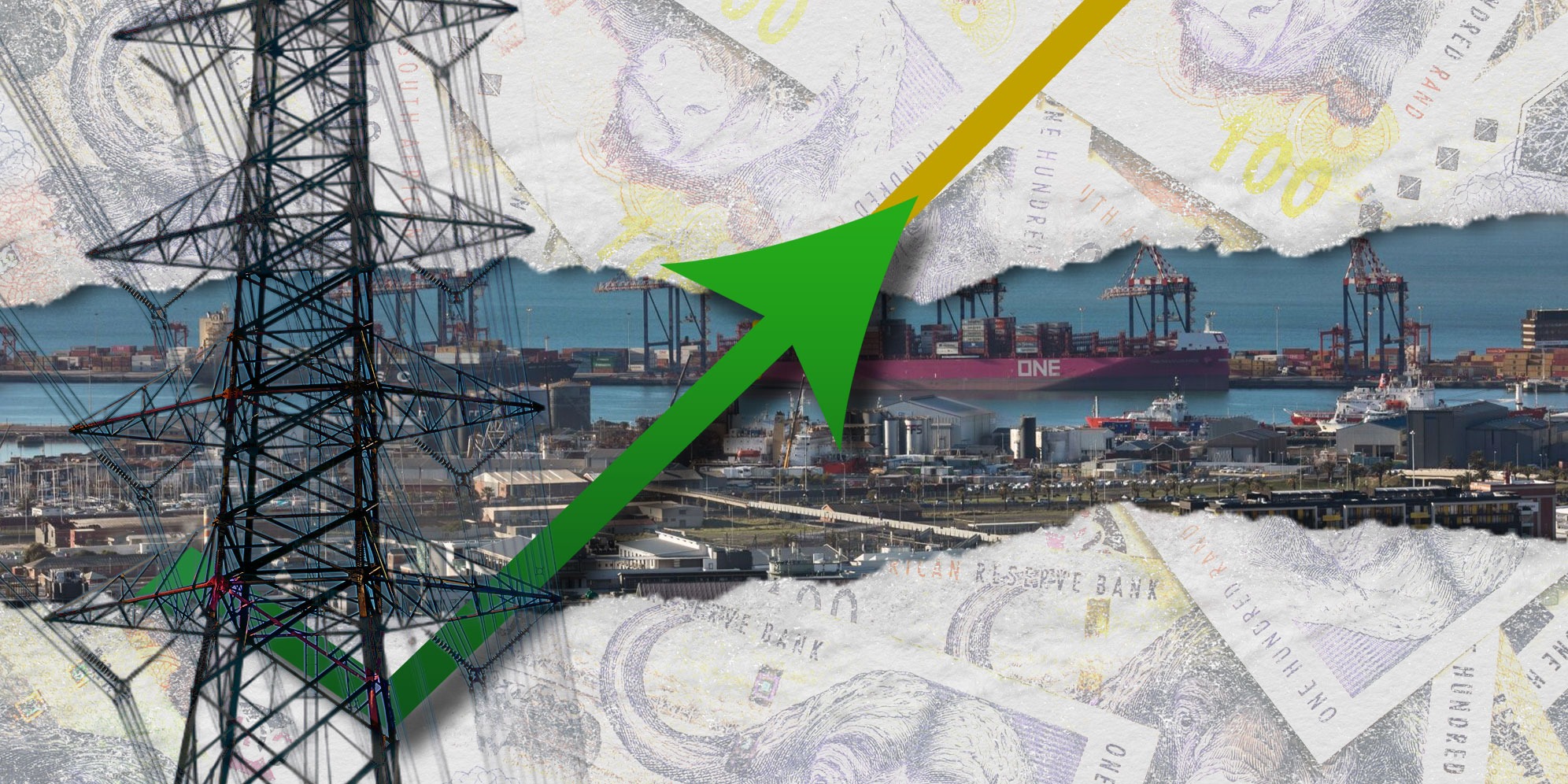
 Illustrative Image: Cape Town Port. (Photo: Getty Images / Bloomberg / Dwayne Senior) | Electrical pylon(Photo: Magnific) | Money. (Image: Istock) | (By Daniella Lee Ming Yesca)
 South Africa has been handed a rare piece of good news from Moody’s Ratings, which has revised the country’s sovereign credit rating outlook to positive from stable, while affirming the rating itself at Ba2.
In plain English: Moody’s has not upgraded South Africa’s credit rating. The country remains in sub-investment grade territory, the ratings basement more commonly known as “junk”. But the agency is now signalling that an upgrade is possible if the current improvement in public finances and reform delivery holds.
The move is significant because credit ratings influence how investors price the risk of lending to a country. A stronger rating outlook can help lower borrowing costs over time, especially if investors believe the government is becoming more credible in its efforts to contain debt.
Moody’s said the positive outlook reflected South Africa’s “gradually strengthening fiscal performance” and its sustained commitment to structural reforms, with the prospect that those reforms might start producing more visible results. The agency expects the country’s primary budget surplus to rise, debt-service costs to improve gradually and the government debt burden to stabilise in the near term.
The primary balance is an important marker because it shows whether government revenue is enough to cover spending before interest payments on debt. Moody’s estimates that South Africa recorded a primary surplus of about 1% of GDP in the 2025 fiscal year, stronger than the agency had expected. It expects this surplus to rise to about 2% by 2028.
That improvement, together with lower debt-service costs, could allow the debt-to-GDP ratio to decline gradually to about 85% by 2028, from an estimated 87% in 2025. This is still a very heavy debt load, but it is going in the right direction, which is a change. For years, South Africa’s debt numbers have moved in the wrong direction, while rising interest payments have crowded out money for basic services, infrastructure and growth-supporting spending.
/file/dailymaverick/wp-content/uploads/2025/03/Damien-Pieterse_4202.jpg "Director General in Finance department Duncan Pieterse briefing the Joint meeting with the Standing Committee on Appropriations, Select Committee on Finance and Standing Committee on Finance, Select Committee on Appropriations,on the 2025 budget speech . (Photo : Phando Jikelo/ Parliament of SA)")
National Treasury welcomed the decision, saying it made South Africa the only G20 country currently on a positive outlook from Moody’s. Treasury also noted that the decision came during a period of negative ratings pressure globally, with more than 23 sovereign ratings affected since the start of the current Middle East conflict.
Treasury director-general Duncan Pieterse said Moody’s decision was “further confirmation of South Africa’s improving fiscal credibility due to a turnaround in the sustainability of public finances”.
“We continue to focus on our two fiscal objectives of ensuring that revenue continues to be ever higher than non-interest spending and maintaining a debt-to-GDP ratio that comes down from the current year onwards. We plan to embed the fiscal turnaround with the introduction of a fiscal anchor for South Africa,” Pieterse said.
The positive outlook is Moody’s first for South Africa since 2007. Treasury noted that the previous positive outlook was followed by an upgrade of the rating itself in 2009. This does not mean history will repeat itself, but it gives investors a reason to watch the next few Budget cycles more closely.
Moody’s expects stronger investment, helped by ongoing reforms, to lift real GDP growth to about 2% by 2028. That would be an improvement from the average growth rate of about 0.8% between 2023 and 2025.
The agency pointed to reform progress in energy, logistics and water as areas that could draw in private investment and ease the infrastructure choke points that have held back mining, manufacturing and exports. It also cited the recent removal of South Africa from the Financial Action Task Force grey list as a boost to investor confidence.
But this is not a victory lap quite yet. Moody’s kept the Ba2 rating unchanged because South Africa’s economic and fiscal fundamentals remain weak. The country still has low growth potential, a weak labour market, high inequality and fragile network infrastructure, even though there has been some improvement in electricity supply.
The agency also flagged the Middle East conflict as a near-term risk, especially through higher oil prices, inflation and pressure on household incomes. It has revised down its 2026 and 2027 growth forecasts by about 20 to 50 basis points because of these risks.
Moody’s baseline view is that the Government of National Unity will last through its term, supported by incentives among the main parties to maintain stability and continue reforms ahead of the 2029 national election. But it warned that reform momentum could still be tested by the political cycle.
/file/dailymaverick/wp-content/uploads/2021/08/BM-Fitch-Mfuneko-BM-Fitch-ratings-option-5.jpg "Pedestrians walk past the financial agency Fitch Ratings Ltd. (Photo: Scott Eells/Bloomberg via Getty Images)")
Momentum Investments chief economist Sanisha Packirisamy said Moody’s decision showed growing confidence in South Africa, but also underlined that the improvements are still in their early stages. She noted that Fitch now looks like the more cautious outlier among the big ratings agencies, with Moody’s moving to a positive outlook and S&P Global Ratings having upgraded South Africa in late 2025. Fitch, by contrast, has kept a more conservative stance because of concerns about debt, weak logistics, low investment and subdued growth.
“The divergence largely comes down to Fitch’s greater scepticism around SA’s debt trajectory and medium-term growth potential. Fitch has repeatedly warned that debt stabilisation assumptions may be too optimistic and that structural constraints, such as weak logistics, low investment and subdued growth, continue to weigh heavily on the sovereign’s profile,” Packirisamy explained.
Moody’s believes that over the longer term, sustained progress in implementing energy, logistics and water reforms can crowd in substantial new private investment to help address infrastructure gaps and boost export capacity,
For South Africa, the signal from Moody’s is clear enough: the country has bought itself some goodwill, but not yet a higher rating.
However, to convert this positive outlook into an actual upgrade, the government will need to keep spending in check, maintain primary surpluses, reduce the debt burden and show that reforms in electricity, rail, ports and water are not only passing through Parliament, but changing what businesses and households experience on the ground.
The ratings cloud has not lifted. But for once, a shaft of light has broken through. DM