




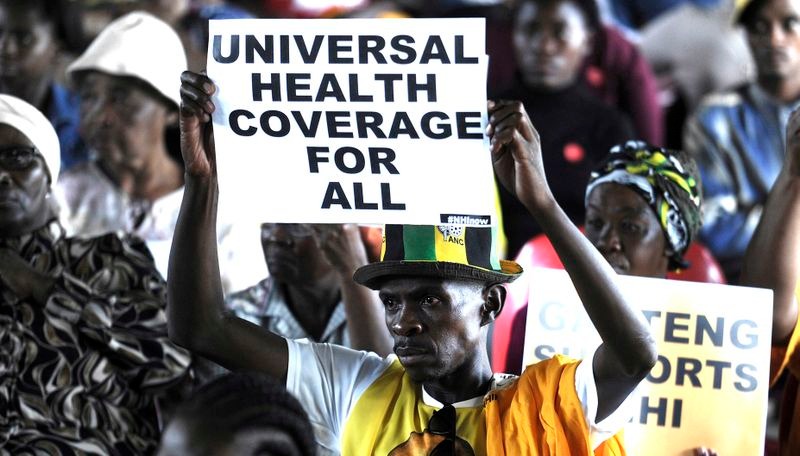
 Despite the setback in the Constitutional Court, the government is determined to achieve universal health cover for all South Africans.
(Photo: Getty Images)
Despite the setback in the Constitutional Court, the government is determined to achieve universal health cover for all South Africans.
(Photo: Getty Images)Just 18 days into her tenure in the Constitutional Court, Justice Kate Savage penned a unanimous judgment that shattered the spine of the proposed National Health Insurance (NHI) Bill.
The ConCourt judgment confirmed the high court’s order declaring sections 36 to 40 of the National Health Act 61 of 2003 inconsistent with the Constitution and, therefore, invalid. These sections outlined the provisions for the “certificate of need”, which would have made it a criminal offence to establish a health facility or provide prescribed health services without a certificate issued by the Department of Health’s director-general.
Specifically, the provisions were found to unjustifiably limit section 22 of the Constitution, which protects the right of citizens to freely choose their trade, occupation or profession. By empowering the director-general to dictate the location, nature and speciality of healthcare providers, the certificate of need would have forced practitioners to either practise contrary to their choosing or risk criminal sanction.
Severing this scheme removes the government’s intended regulatory mechanism to force the geographic redistribution of private health services, which was envisioned to support the NHI framework.
This put a seal on the case brought by trade union Solidarity, private healthcare practitioners and the hospital association. There is now a matter before the ConCourt in which the medical aids – or rather, as they want to be known in their nonprofit form, the Board of Healthcare Funders (BHF) – have taken the Speaker of Parliament and 23 others to court. This is the bit that is stalling any implementation that smells like nationalised public healthcare.
It’s not looking good for the NHI as rubber-stamped by the Government of National Unity (GNU), but there is another way of looking at its possible salvation.
In a candid interview with Daily Maverick, Asgar Rangoonwala, managing director for emerging markets in Europe, the Middle East and Africa at Johnson & Johnson, acknowledged the inherent tension in state-funded models.
“The challenge with National Health Insurance is you give access to quality healthcare to every citizen, which is on the one hand a great concept. On the other hand, of course, it’s a big challenge for economic stability.”
Rangoonwala largely agrees with the sentiment of the local private healthcare industry, which feels it was frozen out of the NHI planning, but he also understands the government’s challenges – a natural position for an executive of a global healthcare company that has interests on both sides.
“No private sector can ever manage national health insurance and national health systems by itself,” Rangoonwala said. “The state has to invest right and take tax money and put it in healthcare. [However], if you go too bullish on day one, you may regret it.”
Regret is bitter medicine
The BHF litigation centres on an argument that the NHI Act was passed without resolving critical details necessary for it to be viable in reality. Parliament, in its view, completely deferred the costing of the scheme, the funding model (including proposed new taxes) and the exact basket of services to be covered by future regulations and unelected advisory committees.
Without a defined benefit package or a realistic fiscal road map, the private industry argues that it is impossible to assess how the operating model will function or can attract adequate budgetary support.

Rangoonwala has seen recurring mistakes in the past when governments make the error of only covering basics. “If you start a national health insurance system just to cover the fundamentals like diabetes and cardiovascular and infection management, you jump not high enough because you need to also build a system which covers cancer and [other] diseases.”
Instead, he praises smart pilot approaches such as those used in Egypt and China, where the state can test the implementation of either specific aspects of the solution or roll it out in specific communities to “learn and to course-correct”.
There are parts of the NHI scheme that, if given the right legislative ruling, the GNU can begin rolling out and in this way perhaps meet one of the deadlines that has not yet been missed.
The original framework for a roll-out placed strengthening the health system and purchasing for vulnerable groups in phase 1 (2023-26) and mobilising additional resources and selectively contracting private providers in phase 2 (2026-28).
There is also the controversial provision (section 33) dictating that once the NHI is fully implemented, private medical schemes may only offer complementary cover for services not reimbursable by the supporting fund. This could be trialled in the same way that Egypt rolled out its pilot projects in rural and urban communities.
Rangoonwala is particularly excited by opportunities to remake public healthcare.
“I think it’s a great opportunity to also include elements like AI and digital into the NHI,” he said. He cited the example of European systems that were built “long before any kind of digitalisation took place” and now suffer from a rigid brick-and-mortar focus. “If you build something new, you can do it more modern.”
Johnson & Johnson played a pivotal role in the global pandemic, notably as one of the companies that developed an effective Covid vaccine. According to Rangoonwala (as well as public records), the company made no profit from the vaccine. For him, the experience proved that “everything is possible if everybody works together”.
Reflecting on the private sector’s role in building the necessary systems, Rangoonwala stresses the need to put long-term commitment before short-term profit. “You cannot just take the money and and walk away… that’s not what we do.”
The solution, it would seem, is for all parties to consider the total impact of economic savings that a healthy, well-cared for citizenry would bring. Unfortunately, the commercial players do not necessarily see that as a benefit. DM
This story first appeared in our weekly Daily Maverick 168 newspaper, which is available countrywide for R35.
/file/attachments/2992/DM-22052026-001_776072.jpg)
Comments
Scroll down to load comments...