




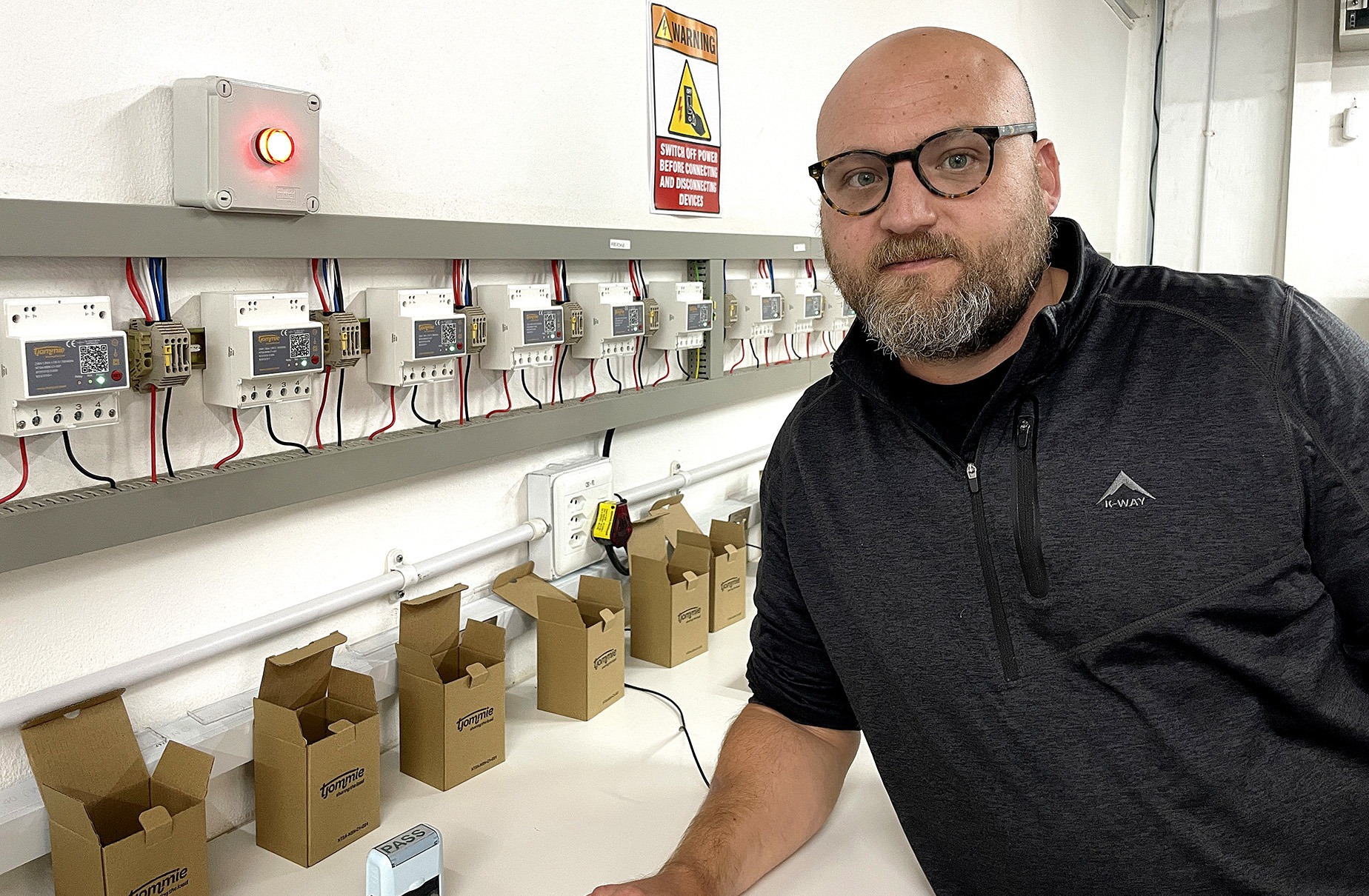
 Nelson Mandela Bay businessman Ignus du Toit with the Tjommie smart geyser management device in Neura’s workshop in Walmer, Gqeberha, on 21 May 2026. (Photo: Kyran Blaauw)
Millions of South African homes have one appliance quietly placing strain on the power grid every day. Now a local company says it has found a smarter way to manage the humble geyser.
Household geysers account for roughly 40% of residential electricity consumption. During peak periods in the morning and evening, they can make up about 20% of the total load being drawn from the network, says Ignus du Toit, CEO of Escoteck and Neura.
It is this problem Neura believes it can help to solve through its flagship smart geyser management device called Tjommie – technology the company is now rolling out in municipalities across South Africa.
The project started in Nelson Mandela Bay, with installations already under way in areas such as Summerstrand, Despatch, Walmer and Central.
Speaking from the company offices and workshop in Walmer, Gqeberha, on Thursday, Du Toit says the company has also secured appointments in Cape Town and Ekurhuleni, while discussions are under way with Tshwane, eThekwini, City Power and Mossel Bay.
An old idea, rebuilt for a new grid crisis
Geyser control itself is nothing new. For decades, Eskom and municipalities have used ripple relay systems to switch off geysers during periods of high electricity demand. The idea is straightforward: reduce strain on the grid during expensive peak hours and move electricity consumption to quieter periods when demand is lower.
“What you try and do with geyser control demand-side management is to reduce the load during peak periods and shift that electricity usage into off-peak periods that are cheaper for the municipality to purchase power from Eskom,” Du Toit explained.
But the old systems were relatively crude. Entire groups of homes were switched together, regardless of how much hot water individual households actually needed.
Neura’s approach, he said, is far more targeted.
“All we have done is – the concept is something that’s been around for a long time – we’ve just developed a modern take on it which is far more cost effective, with far more functionality.”
Why Eskom is backing the programme
The roll-out of load reduction management devices like Tjommie forms part of Eskom’s Distributed Demand Management Programme, which incentivises companies to implement technologies that reduce pressure on the national electricity grid.
Demand-side management has become increasingly important because electricity demand spikes sharply during certain hours of the day, particularly when households wake up in the morning or return home in the evening.
During those periods, Eskom is often forced to rely on some of its most expensive generation sources.
“What happens is during the peak period, then you’re sitting in a situation where they’re now generating electricity from their most expensive fleet,” Du Toit said.
“These are typically open-cycle gas turbines, diesel, heavy-fuel oil-fuelled generation. So Eskom saves a huge amount of money if one can reduce their reliance on that fleet.”
Under the programme, Eskom identifies five peak hours each day. Neura contracts with Eskom to manage demand during two of those hours, while municipalities separately contract the company to manage the remaining three.
How the Tjommie system works
Qualified electricians install the Tjommie directly onto the distribution board where the geyser breaker is located. This usually takes between 20 and 30 minutes.
Once connected, the device communicates through cellular networks and continuously monitors the geyser’s heating and cooling behaviour.
“With this device we’re able to know exactly how many kilowatt hours the geyser actually consumes. We also know the size of the geyser element and, more importantly, we know the heating and cooling cycles,” Du Toit said.
The system tracks how long the geyser takes to heat up, how quickly it cools down and how often it switches on and off. That data is then fed into algorithms which estimate how much hot water is still available inside the geyser at any given time.
/file/attachments/orphans/IMG_6258_475918.jpg "The Tjommie smart geyser management device connects directly to a home distribution board to monitor and control geyser use. (Photo: Kyran Blaauw)")
Neura refers to this estimate as a “hot water index”.
“If your geyser has been off for eight hours, you would maybe have a hot water index value of 50,” Du Toit explained.
“If it has just now switched off and we know it’s hot, it would be at 100. So if it’s at 100 we know that we can switch it off without causing cold water for the next four or five hours.”
The system effectively learns the behaviour of each household individually.
“The Tjommie learns the household’s behaviour. I don’t want to give away too much [intellectual property], but essentially the Tjommie obtains high-resolution data from the geyser; when the geyser switched on, when it switched off, how long it was on for, how frequently it comes on, how much power is being drawn by the geyser and how much energy the geyser is consuming,” Du Toit said.
“Based on that data our algorithms can infer how relatively hot or cold a geyser is, what a typical heating and cooling cycle for that geyser looks like, whether it can at a given point in time be switched off without causing cold water and we can extrapolate the cooling curves to determine how long we can leave the geyser off before it needs to be cycled/switched on again to avoid cold water.”
He said the margin of error is “fairly wide”. According to Du Toit, small differences of a few degrees in hot water temperature are unlikely to be noticed. Even slightly larger variations, he added, are typically absorbed by users adjusting the balance of hot and cold water when showering or running a bath.
Du Toit says Tjommie quickly learns household habits, but over time the algorithms become “smarter and smarter”.
He added: “We have designed the system in such a way that if there are large, sudden changes in behaviour that result in certain parameters being exceeded, the switching first becomes more conservative, assesses whether it is a permanent or temporary change and then adjusts accordingly.”
Du Toit said residents would not be able to override their Tjommie since the device is fully automated.
He added, however, that households could still switch off their geyser breakers manually – which he says is unnecessary – but even this is accounted for in the system’s broader, aggregate management of the municipal distribution network.
“Just a reminder of the First Law of Thermodynamics: energy cannot be created or destroyed, only transformed from one form to another,” he explained.
“When a geyser is switched off for longer periods than it would have been off otherwise, the stored heat gradually escapes into the environment. Any ‘saved’ electricity is therefore offset by the additional energy required to reheat the water once the geyser is switched back on.”
Can geyser timers save you money?
Du Toit says that many homeowners misunderstand how geysers consume electricity.
“A lot of people think that they can save money by having a timer installed. It actually does not work,” Du Toit said.
He explained that geysers naturally spend much of their time switched off once the water reaches the thermostat’s upper temperature limit.
“The reality – and what a lot of people don’t realise – is that your geyser is actually off more than it’s on.”
According to Du Toit, repeatedly switching a geyser on and off each day often achieves little because the water simply cools further, forcing the element to work harder later to restore the same temperature.
“If you’re switching your geyser on and off daily, you are actually wasting your time,” he said.
Residents do not directly save money
Although the programme reduces electricity costs for municipalities and Eskom, households themselves do not immediately receive lower monthly electricity bills.
That is because municipalities buy electricity from Eskom using time-of-use tariffs, where electricity costs more during peak demand periods, while most households are billed on flatter residential tariffs.
“The financial saving actually sits on the municipal side,” Du Toit said.
Municipalities still receive the same revenue from households, but their own electricity purchases become cheaper if peak demand is reduced.
The longer-term benefit for residents, he said, is that municipalities may face less pressure to implement steep annual tariff hikes.
A smart geyser with diagnostic features
The device also gives residents access to an app through a QR code linked to the system. This allows users to monitor the health and efficiency of their geyser, Du Toit said.
Because the system continuously analyses electricity consumption patterns, it can potentially detect problems before homeowners notice them and they become an insurance nightmare.
“We can tell you whether your geyser element is potentially packing up and using more electricity than it should. Second, we can pick up if you potentially have a leak on the geyser,” Du Toit said.
The devices are designed to operate for between 15 and 20 years and generally require little maintenance after installation.
Why they chose the name ‘Tjommie’
Du Toit said the company wanted a name that felt local and approachable.
“Often technology can be a little bit cold. Technology can often seem a little bit scary. We wanted to pick a name that sends a message to say that’s firstly South African. It’s very uniquely South African slang,” he said.
Tjommie’s slogan – “Sharing the load” – was intended to reinforce the same idea. “We’re all in this together,” he said.
Installations are compulsory – but the company wants buy-in
One of the more controversial aspects of the programme is that municipalities are legally permitted to install load-management devices under existing by-laws and national regulations.
“The installation of Tjommie is compulsory,” Du Toit said.
But he insisted the company does not want conflict with residents.
“We do not want to go to people with a stick and force it [the Tjommie] on them. We want people to want this device and want to be positive about it and open up their doors to us,” he said.
Regulation 773 of the Electricity Regulation Act (4/2006) states that “where an electricity water heating facility is required a licensee should install a facility to remotely control the supply of electrify to any electricity geyser that does not incorporate solar water facility”.
Daily Maverick made repeated attempts from Wednesday, 20 May 2026 to obtain clarity from the Nelson Mandela Bay Municipality on which municipal by-laws require residents to install load-reduction management devices but by Sunday, 24 May 2026, no responses were received.
The municipality also did not answer questions about how residents can formally object to the installations and whether any penalties apply to those who refuse to have the devices fitted.
However, according to the Tjommie website, “the Metro will be required to suspend or could disconnect your electricity supply and could also issue you with a fine”.
Security concerns in South African homes
With installers entering private homes, Neura said it has implemented extensive verification procedures.
Installers undergo police clearances, rigorous background checks and intensive technical training. They also wear branded yellow overalls and carry identification cards that residents can verify online or by scanning a QR code with their phones.
“We live in South Africa. Crime is a reality. So identification of installers is absolutely critical,” Du Toit said.
The company makes the effort to also inform local police stations, private security firms and ward councillors before starting work in an area.
Verifications of installers can also be done via the company website.
A private-sector answer to a national problem
For Du Toit, the technology represents more than just a smarter geyser switch.
“I think our philosophy very much is that South Africa’s problems are going to be solved by the private sector, not the public sector,” he said.
“And so for the private sector to step in and actually come in and do this, it is a big part of solving South Africa’s energy woes.” DM
Comments
Scroll down to load comments...