




 Illustrative image: Lines on election day in Saulsville in Attidgeville, Tshwane. (Photo: Alet Pretorius/ Gallo Images) | (By Daniella Lee Ming Yesca)
 /file/dailymaverick/wp-content/uploads/2025/10/label-Op-Ed.jpg)
For the past 15 years, the South African economy has stagnated while the population has been growing. This has resulted in the people becoming poorer with every passing year.
The people, understandably, blame their increasing impoverishment on the policies of the government of the day, the African National Congress (ANC). This is reflected in national voters’ decisions since 2004.
The highest vote for the ANC peaked in 2004 (69.8%) and started declining slowly in subsequent elections. It eventually collapsed between the 2019 elections (57.5%) and the 2024 elections (40.1%) when the ANC lost its majority.
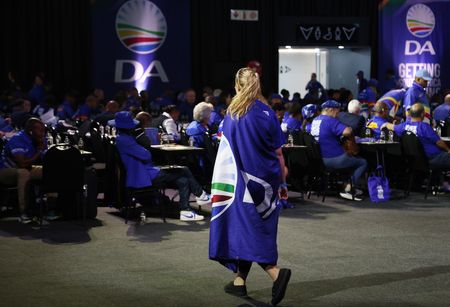
A somewhat different trajectory has been followed by the Democratic Alliance (DA), the second-largest party. Starting from only (1.7%) of the vote in 1994, the DA vote share increased steadily, reaching a peak in 2014 (22.3%). Since then, it has plateaued and has barely changed – in 2019 (20.7%) and in 2024 (21.8%).
The stagnating DA share of the national vote reflects the demographics of its core voters. These are Whites, Coloureds and Indians (WCI). This group is approximately 20% of the population, so it is to be expected that the DA share of the national vote would eventually hit a low glass ceiling.
For the DA to increase its share of the vote, it needs to attract Black African votes in significant numbers, especially former ANC voters. This is not happening. Why?
Black African voters believe that the DA will bring back apartheid – a notion repeated regularly in ANC campaigns. There is also a low policy differentiation between the ANC and the DA, so former ANC voters do not see the need to change parties.
Black African voters who had stopped voting for the ANC blamed it for the following:
- Lack of service delivery;
- Unfairness of its policies, which are seen as favouring inner cliques within the ANC; and
- Corruption.
While the DA is seen by many Black African voters as good at service delivery, it is perceived as lacking legitimacy because it has a White, English-speaking leadership; it is seen as lacking clarity of purpose; and as lacking a plan of action to implement whatever goals it has. Black African voters cannot see what is in it for them if they voted for the DA – besides service delivery.
Why former ANC voters stay at home on election day
The main reason for the dwindling ANC support in elections is that the image and delivery of the post-liberation ANC government did not live up to promises made. Although much has changed and improved since 1994 in terms of living standards, access to jobs and the provision of basic services – for instance water and electricity, housing, health and many other aspects of life in South Africa – a large proportion of the population are still poverty-stricken and about half of South African children go to bed at night hungry.

Many voters say they do not see any reason to participate in an election every five years if nothing changes. To a large degree they have lost trust in both politicians and political parties. Many believe that politicians are only interested in lining their own pockets and that they always try to advance the interests of their friends and family. This opinion is strengthened by the ANC’s policy of “cadre deployment”, where some people are put in lucrative positions, without taking their qualifications or skills into account.
Since the national election in 2009, the turnout in national, provincial and local elections has dropped steadily and in the 2024 national election only 58.6% of those registered to vote turned out. Since the 2016 local government election, many people – especially in metropolitan areas – stayed at home rather than turning out to support the ANC or to vote for another party.
The ANC has increasingly lost its formerly strong metropolitan voter base, with the result that it is now largely a rural party facing an uphill battle in the metropolitan areas.
In rural areas, where political parties provided transport to voting stations, this was not such a huge issue.
The persistent issue of unemployment, especially youth unemployment, is not making this task any easier. In 1994 the unemployment rate was at an already high level of 20%. According to Trading Economics, the unemployment rate in the third quarter of 2025 was standing at 31.9% (according to the official definition), youth unemployment (this figure measures the proportion of job seekers between the ages of 15 and 24) stood at 58.5%. Any political party interested in winning votes in South Africa, especially votes from a rather uninterested youthful population, will need to have workable, clear and achievable strategies for job creation.
Main challenges facing SA today
South Africa today faces a double challenge. The first challenge is that of the stagnating economy – with the associated major issue of unemployment. The second challenge is that of transforming or revolutionising the DA as the second-largest party, so it can attract large numbers of Black African voters and thus become the main party in the country.
To transform the economy, the following things need to happen:
- Providing a reliable supply of cheap electricity;
- Beneficiation of all of South Africa’s minerals domestically;
- Ensuring good quality and affordable public housing for the urban masses;
- Delivering efficient and available transport for passengers and freight;
- Creating an education system that meets the needs of modern industry;
- Advancing technical and artisan training;
- Promoting a culture of entrepreneurship rather than of entitlement;
- Integrating regional economic policies to reduce the need for migration into South Africa;
- Solving the problem of unemployment and poverty;
- Introducing a development strategy for former homelands;
- Building an appropriately priced and fit-for-purpose public service costing 7% of Gross Domestic Product instead of 16% of GDP at present;
- Prioritising investment over consumption; and
- Reforming the electoral system to introduce combined proportional representation and constituencies at national and provincial levels.
In the eyes of the Black African voters the ANC has failed to achieve the above objectives in its management of the economy during its 30 years in power. Black African voters are not clear about the bona fides of the DA, as it currently stands as a White liberal party, and its capabilities to implement most of the above developmental needs of the country. DM
Harris is a consultant and political analyst at research company Ipsos South Africa. Mbeki is chairman of the South African Institute of International Affairs, an independent think-tank.