




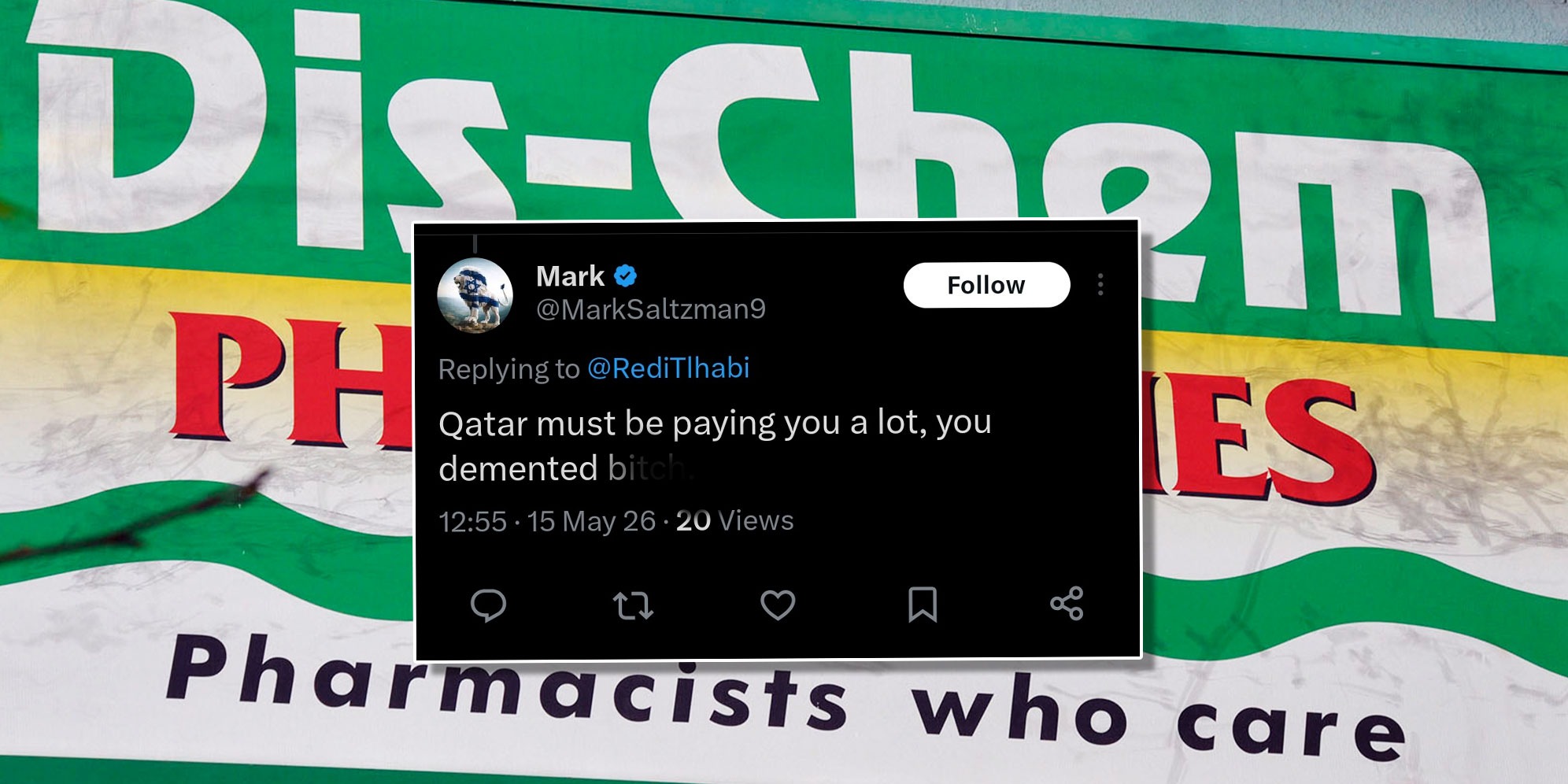
 A Dis-Chem pharmacy sign in Cape Town. (Photo: Gallo Images / Charles Gallo) | Tweet from Mark Saltzman. (Image: X) | (By Daniella Lee Ming Yesca)
 Pharmaceutical giant Dis-Chem has moved to contain a reputational firestorm after the South African Human Rights Commission (SAHRC) launched a formal investigation into social media posts reportedly made by shareholder Mark Saltzman, including one that allegedly contained the k-word.
Saltzman is the son of Dis-Chem founders Ivan and Lynette Saltzman. He is a shareholder in the JSE-listed pharmacy group, but the company has stressed that he holds no board or management position and has no authority to speak on its behalf.
The controversy erupted after an account using Saltzman’s name became involved in heated exchanges on X with journalist and broadcaster Redi Tlhabi over her posts about Israel. During the exchange, Saltzman reportedly made claims about Tlhabi and later retracted allegations that, while working at a previous broadcaster, she had taken money from Saltzman’s mother’s foundation.
The X account was deleted after the exchange, but has since been reactivated.
In a post on X on Sunday, 17 May, Tlhabi said: “For months, @Dischem‘s Mark Saltzman (who has now deleted his account) called me a bitch. I did nothing. I assumed he was another angry troll. I didn’t know who he was until he outed himself and talked about his mommy’s money.”
The SAHRC said it had taken note of the social media content reportedly posted by Saltzman and condemned the use of the k-word as one of the most painful and degrading slurs in South Africa’s history.
Saltzman’s use of the k-word on X occurred on 12 February and is apparently unrelated to his slur on Tlhabi last week, when he referred to her as a “bitch”.
The commission’s intervention followed calls on social media for a boycott of Dis-Chem, placing the retailer in the uncomfortable position of having to answer for the conduct of a shareholder over whom it says it has no direct authority.
In an internal message to staff dated 22 May, Dis-Chem CEO Rui Morais said the company was “taking this matter very seriously” and was “disappointed and upset by the language, comments and sentiments that have been expressed”. He said these did not reflect the company’s culture or values.
“While Mark Saltzman is a Dis-Chem shareholder, he is not a board member nor an employee of Dis-Chem and has no authority to represent the company in any way,” Morais wrote.
“His comments and conduct do not reflect the views, values or position of our board, management team or broader business.”
/file/dailymaverick/wp-content/uploads/2025/10/Dis-Chem-CEO-Rui-Morais.jpg "Dis-Chem CEO Rui Morais. (Photo: Supplied: Dis-Chem)")
Dis-Chem told Daily Maverick via email that it had written directly to Saltzman, calling on him to publicly retract the false statements made, publicly apologise for the language and tone of his posts, and provide a written undertaking to refrain from similar conduct in future.
The company posted on X on Tuesday, 19 May: “We have no record of any payment being made to Ms Tlhabi in her personal capacity by either the company or the Dis-Chem Foundation. Any inference otherwise is false.”
The group has also paused all work with Saltzman Attorneys, issued public statements distancing itself from the comments, briefed its board and engaged independent legal counsel on its options.
Morais said Dis-Chem was cooperating fully with the SAHRC investigation and had reserved all legal rights.
“We have already taken a number of active steps to protect our people, our brand and our reputation,” he said in the internal message. “We are monitoring the situation closely and will take further action as and when it is required.”
The company’s response highlights a difficult governance and reputational question for public companies. What happens when a major shareholder, founder family member or associated person says something publicly that collides with the company’s stated values?
Dis-Chem’s legal position is that shareholders can express personal views independently of the business and that the company does not have authority over shareholders acting in their private capacity. But Morais said the company would “continue to explore every appropriate avenue” to protect its brand, employees, stakeholders and the dignity of others.
A fine line
/file/dailymaverick/wp-content/uploads/2022/10/Ivan-Saltzman2.jpg "Dischem founder Ivan Saltzman")
The line between personal speech and corporate damage can become especially blurred when the person at the centre of a controversy is linked to a founding family. Dis-Chem was founded by Ivan and Lynette Saltzman in 1978 and has grown into one of South Africa’s largest pharmacy retailers, with a national footprint and a prominent consumer brand.
That brand is now being tested in the online furnace where reputational damage moves faster than formal governance processes.
The company’s social media feeds were flooded with criticism after screenshots of the posts circulated online. Some users called for a boycott of the retailer, while others demanded that Dis-Chem explain Saltzman’s relationship to the company and the Dis-Chem Foundation.
In the internal message, Morais told employees that the leadership team was not “standing still” and would keep staff informed as the matter developed. He said the situation could be unsettling for employees because of the association with the company’s name.
The CEO also tried to recentre the company’s internal culture, saying Dis-Chem’s purpose was to reduce the cost of healthcare, improve access and support better health outcomes for South Africans.
‘Care and humanity’
“Every day, thousands of Dis-Chem employees work incredibly hard to serve our customers with professionalism, care and humanity,” wrote Morais. “You are the people who bring our purpose to life across our stores, pharmacies, clinics, distribution centres and support offices. That is the real Dis-Chem.”
The SAHRC investigation adds a more formal layer to what began as a social media dispute. The commission has a constitutional mandate to promote and protect human rights, including equality and dignity, and has previously taken strong positions on the public use of racist language.
The k-word has repeatedly been found by South African courts and equality bodies to be deeply dehumanising, given its history as a tool of apartheid-era racial domination.
For Dis-Chem, the issue is not only whether Saltzman faces consequences through the SAHRC process. It is also whether the company can persuade customers, staff and investors that its response is strong enough.
Companies often speak the language of values, dignity and inclusion. The harder test comes when the crisis arrives with a surname that is part of the corporate story.
Dis-Chem has now chosen distance, legal caution and public condemnation. Whether that is enough to cool boycott calls and satisfy the SAHRC’s concerns will depend on what Saltzman does next, what the investigation finds and whether the retailer takes further steps beyond damage control. DM
Comments
Scroll down to load comments...