




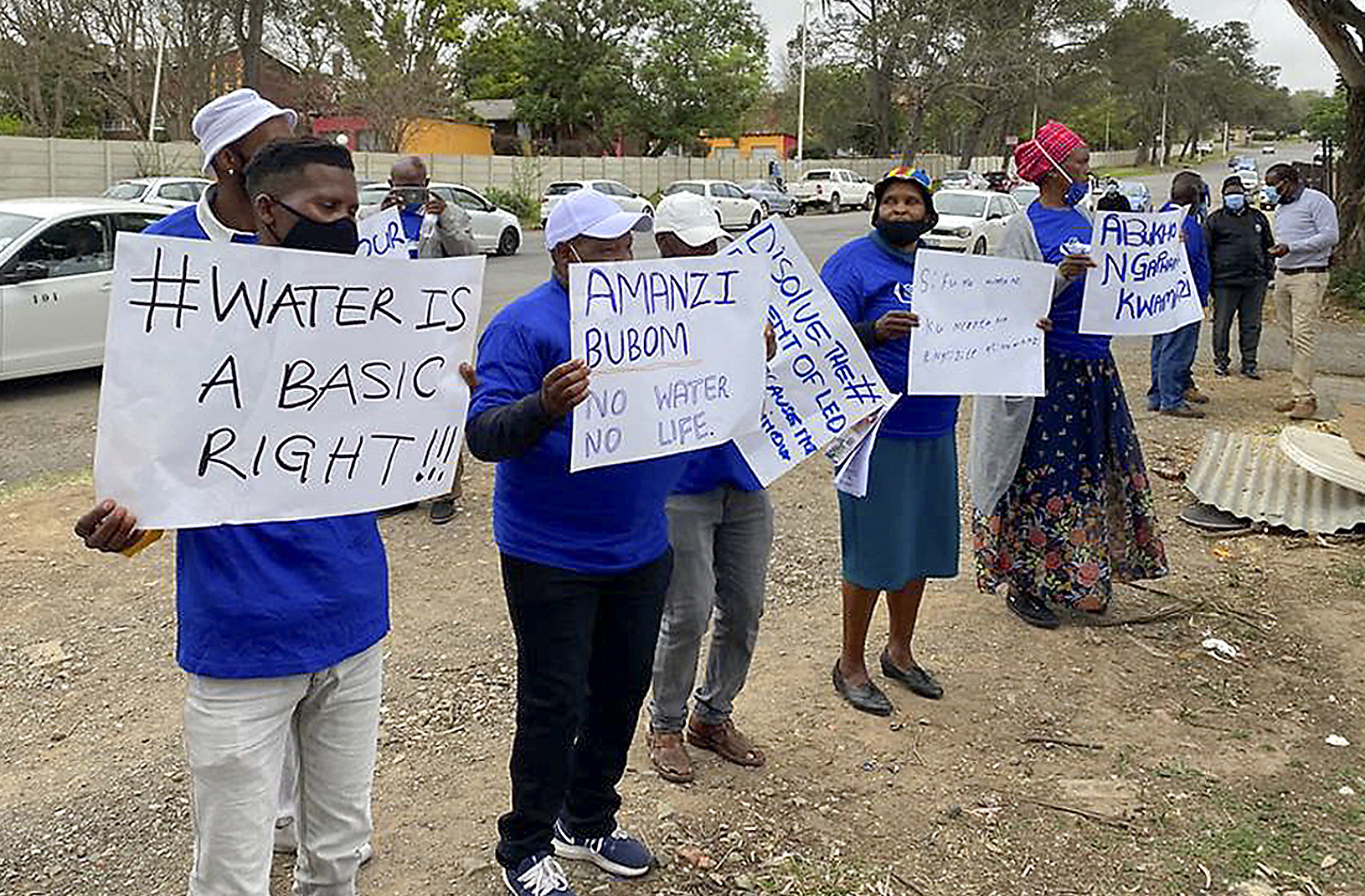
 Villagers from Centane in the Eastern Cape protest over a critical lack of water. (Photo: Supplied)
 Legal attempts by Minister of Water and Sanitation Pemmy Majodina and Eastern Cape Premier Oscar Mabuyane to sanction their decision not to intervene in an eight-year water crisis in Centane were shot down by the Eastern Cape Division of the High Court in Mthatha on Friday.
Deputy Judge President of the Eastern Cape Zamani Nhlangulela found that Majodina, Mabuyane and the Amathole District Municipality were in breach of the Constitution and the Water Services Act over their failure to provide the people of Centane with water.
/file/attachments/orphans/ED_534851_496064.jpg "Minister of Water and Sanitation Pemmy Majodina. (Photo: Gallo Images / Luba Lesolle)")
The application to the court was spearheaded by a group of feisty pensioners who had had enough after waiting for potable water for almost eight years. Lulamile Daveyton Khetshemiya, Mentani Mkalitshi and Harvey Ntshoko were supported by the Masifundise Development Trust. They are residents of Nombanjana and Nxaxo villages.
Since 2017, when the potable water supply to the Centane Villages was cut, residents have been drinking from nearby rivers and water supplies shared with livestock. A debilitating drought and lack of resources in the province have hampered emergency water provision efforts. Promises of emergency procurement by the Minister of Water and Sanitation also never came to fruition.
/file/dailymaverick/wp-content/uploads/MC-WaterActivists-Estelle.jpg "Centane villages were plunged into crisis after their water was cut off in 2017. At the time, this single tap provided water for three villages and 600 households in the Centane Region, Eastern Cape. (Photo: Harvey Ntshoko)")
In April 2020, Ntshoko was among a group of men arrested under Covid-19 regulations when they tried to hold a meeting to discuss their water crisis.
In 2021, Coastal Links and Masifundise filed an urgent application with the Mthatha high court to compel the government to supply these rural communities in the Centane area with basic water services. This was not done.
In October 2024, the court ordered the municipality and the Amatola Water Board to provide water to their community, and the minister and Mabuyane to help ensure that this is done. The order specifically stated that the municipality had to provide 25 litres of water per person per day at a minimum flow rate of not less than 10 litres per minute; within 200m of a household; and with an effectiveness such that no consumer was without a supply for more than seven full days in any year.
When this didn’t happen, the people from the Centane villages returned to court to complain.
Both the minister, who herself served in the Eastern Cape Legislature, and Mabuyane denied that they had a duty to monitor and intervene to stop the water crisis, citing the principle of subsidiarity – a legal principle that dictates that social and political decisions should be handled by the most local, immediate, or decentralised level of authority capable of resolving them.
/file/attachments/orphans/6I1A5457_850873.jpg "Eastern Cape Premier Oscar Mabuyane (Photo: Felix Dlangamandla)")
But Judge Nhlangulela said this was not the case, as the Water Act places obligations on the Minister to monitor and intervene. “The Minister’s promises for the water scheme and to drill boreholes have yet to come to fruition,” Nhlangulela further remarked. He said that if the Majodina, Mabuyane and the other respondents in the case “discharged their legal obligations”, the villages would not have had to endure a water crisis since 2017.
He said the Minister, the Premier and the municipality knew about the water crisis since at least April 2020.
“Since [the municipality] has failed to provide the residents of [the villages] with sufficient portable water, the premier and the minister of water have not intervened. The facts of this case show that neither the premier nor the minister intends to intervene to remedy the violation. The residents of Ward 28 are suffering,” he said.
Nhlangulela ordered Majodina to put together a task team, with the input of the Premier’s Office, the minister of cooperative government and traditional affairs and the Amatola Water Board. This task team has been ordered to report every three months to the court on progress to provide a sustainable water supply to the area.
“The relief sought,” Nhlangulela wrote in his ruling, “ is a constitutional law remedy because constitutional rights have been violated… The fact that the infringement of applicants’ rights is egregious should provide guidance to determine the effectiveness of the relief that will be made. The structural relief to be granted should be an appropriate one for this case.”
‘Obligation to intervene’
He said the minister had obligations to monitor and intervene in water crises, according to the Water Act.
Amanda Sizani, in an affidavit made on behalf of the minister of water and sanitation, stated that neither the minister nor the premier had failed in their duties to intervene in the crisis when the Amatola District Municipality failed to provide water to the villages.
She said the minister could not intervene unless the premier unjustifiably failed to intervene, or had unsuccessfully intervened. In this case, such a failure was not brought to the attention of or made known to the minister. Sizani said that they were never told of the crisis until they received legal papers in September 2021.
She said the minister had ordered that water tankers be provided to the Amatola District
Mabuyane also deposed to an affidavit before the court denying that he had a duty to monitor and intervene in the Centane villages’ water crisis.
Lulamile Khetshemiya, one of the community members from Centane who brought the application, said there was much to be happy about. “We welcome this judgment, but the idea of a task team being created seems like a good idea. We want to see what it plans to do and take it from there,” he said.
Another applicant, Sandawana Ncitakalo, said they would “keep an eye on the task team and see what they come up with”. DM