



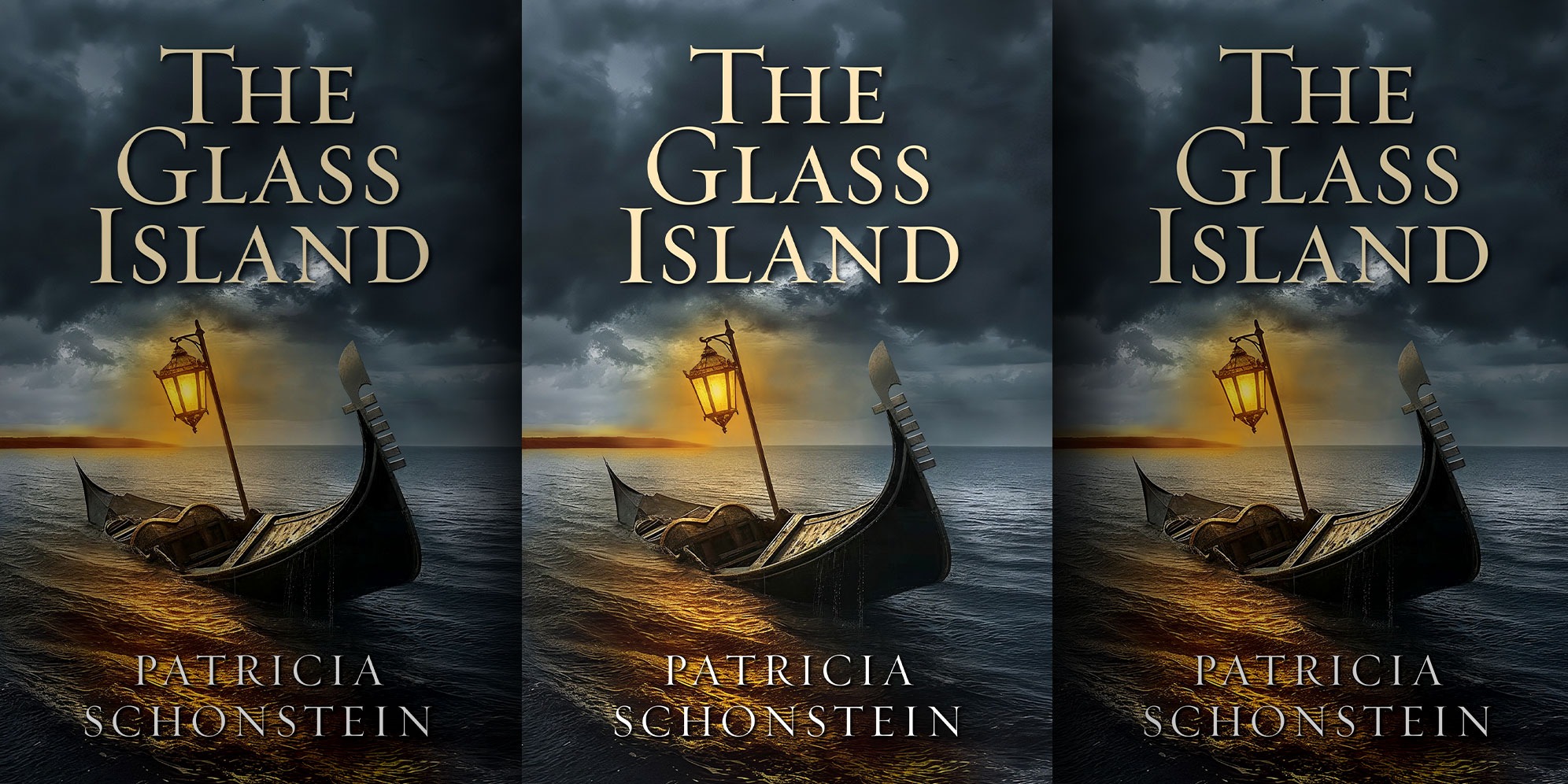
 The Glass Island by Patricia Schonstein. (Image: African Sun Press)
 I meet Patricia Schonstein, the author of The Glass Island, her 8th novel, at her home where she births her books and poems in a room that is filled wall to wall with books. The wind is particularly violent carrying the scent of fire on its raging breath. Her house is cool, quiet, safe and peppered with tchotchkes of a life lived.
Two tea light candles flicker on a low table in the inner house – lit for peace. Wind chimes clack in a stereo of metal and bamboo. A long haired, long-nosed dog lies at the author’s feet occasionally making throaty noises associated with deep ease.
News from the outside world on this day is full of fires, the first appointment of a chief officer of heat, allegations of the 28’s gang infiltration of the SAPS, 30 murders in 72 hours (five women shot dead in four days), the usual corruption and the arrival of Palestinian refugees, which are all held at bay for now in this space.
And yet genocide, war, eco destruction, the fate of the world’s children are very much at home on the pages of the author’s various books. Schonstein is small, compact in stature and self-contained. Even when she gives you her full attention there is always a sense that she is elsewhere with her characters or walking their various scapes.
She is one of the world’s innocents, not to be confused with naivety. There’s a deep compassion about her, a deep core of ethics, a kindness and an ability to have her breath taken away by the wonder of the natural world and the deepest sadness at our impact on it.
Followed by a small, niche readership, Schonstein calls the genre of The Glass Island a “surreal autobiography”, but her editor prefers “speculative fiction”.
It took five years to write and while her influences include the autobiographical work of Deborah Levy, Schonstein’s book The Master’s Ruse is a closer influence.
Schonstein has been creating stories from the time she was a small child, when she first became conscious; she is primarily a teller of stories that become books.
A sense of the improbable
As with most of her books there is, as she says, “the sense of the improbable, the food, interiors” and most important a “continued inability to understand humanity’s default to war”.
Her starting point to each novel arrives in the shape of the character’s voice; without the voice in her head, Schonstein says that she cannot begin the writing process.
“When I begin a new work, I wait for the sound of the narrative voice. If this does not come, I don’t/can’t proceed,” she says.
Sometimes, she explains, the character’s voice dovetails with the mise-en-scène. In the case of her latest novel, The Glass Island, the earliest voices were those of the narrator, Charon the boatman of the river Styx and less distinctly Katarina, Schonstein’s very close friend to whom the book is a farewell.
Schonstein explains that her books want life, and as a writer being called she must oblige. Sometimes the voices from other embryonic books come through and she must politely turn them away, promising that she will return to them.
“I’ll be getting on with everyday [real] life and then the first sound of a narrative voice emerges along with the core of the next book,” she says.
The blurb on the back cover tells us that The Glass Island is set in two imaginary places. A sinking, golden city and an island beyond its lagoon. The island that was once a prison to political prisoners and is now home to Magistra, a fantastical character and her Contemplatives, who have created a peace sanctuary against a fascist world.
The novel begins when five well-known people, including the famous Primo and Carlo Levi, André de Ruyter and the late poet Stephen Watson, who arrive on the island to discuss the moral rot of a dystopian world and whether creativity and Truth can be used against tyranny. Their discussion is overseen by Magistra and a sixth, concealed character.
The storyline is simple. The dying Katarina issues an invitation, or rather a strong instruction, to the narrator to go to Glass Island. The Glass Island is a work of many fragments.
Real characters jostle with historical and fantastical ones, different timelines, the Boer prisoner of war camps, the betrayal of ǀXam by their own, the Shoah, Russia’s invasion of Ukraine, the Gaza genocide and eco disaster converge and separate. Fantasy and fact are neighbours, imaginary places and very specific ones familiar to Capetonians provide points of reference.
A dense, layered mash-up
And when the intensity peaks there are lots of related poems. It’s a dense, layered mash-up and one can feel that to get it all to hang seamlessly together required a great deal of skilful stitching by the author.
It was easy to get sidelined by the fine detail the author provides. The book is bursting with clusters of highly detailed, sensuous descriptions of fabric, food and places.
“In another life,” she says “I might have been a painter. When I write I ‘see’ all these details.”
This characteristic, which is familiar to all her books, could be regarded as a counterpoint to the horrors that her books draw on.
The book’s language is flecked with old fashioned words; biddings of goodnights, blown asunder, sporting, robed that give the story its otherworldly feel and add to the ritualistic rather stylised interactions and gestures of the characters.
Interestingly, the dialogue differentiation between the characters is minimal, as if the characters are really one, sharing one voice and the same standpoint.
Schonstein agrees that there is something of a parable to The Glass Island. It has the feel of a morality tale with the desire for light to triumph over evil.
While Schonstein was once hopeful about humankind’s fate, she is no longer.
Responsibility
“The destruction of Gaza has had a profound effect on me. In my real life I no longer hope. I have come to realise that hope is naïve. Even so, I have a responsibility, as the author of conscience I perceive myself to be, to work towards good and to care for what is defenceless.
“I can’t believe how humanity tramples beauty, creation, animals, ocean, each other when I am so aware of miracle and wonder. I’m like: ‘People! Just fall to your knees and pay homage, instead of destroying everything.”
While Schonstein may have lost hope personally for the world, she nevertheless hopes that through her writings she is able “to make people think, and take care, and, at the end of the day, enjoy a good, provocative read, one which is not hollow, and one which I wrote with generosity”. DM
The Glass Island is available at a retail price of R374.