




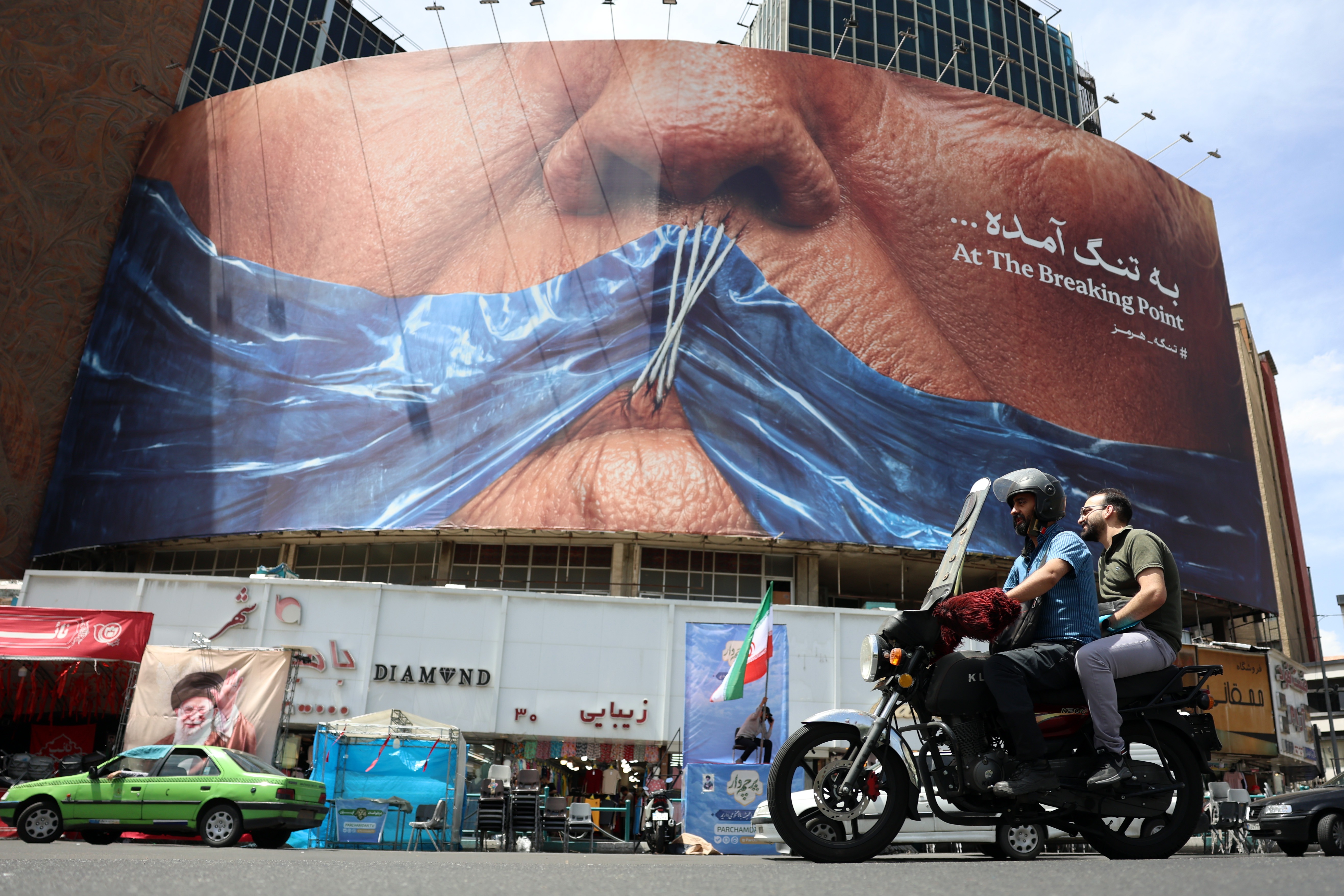
 People on a motorcycle drive near a huge anti-American billboard in Tehran, Iran, on 6 May 2026. The photo depicts US President Donald Trump’s mouth tied with a scarf or banner shaped like the Strait of Hermuz. (Photo: Abedin Taherkenarech / EPA)
 Israel and the US were on the verge of a new joint attack on Iran at the beginning of the week (18 May), but were stopped by the Gulf states, who urged an end to the war, according to US President Donald Trump. Prior to this, Trump had once again been issuing threats, which are often followed by his backing down – until the cycle repeats itself.
Sky News reported on Monday, 18 May, that Trump had called off an attack on Iran scheduled for Tuesday, but warned he could unleash a “full, large-scale” assault at a “moment’s notice” if a deal wasn’t reached.
“For Iran, the Clock is Ticking, and they better get moving, FAST, or there won’t be anything left of them. TIME IS OF THE ESSENCE!” Trump wrote on Truth Social after a telephone conversation with Israeli Prime Minister Benjamin Netanyahu on Sunday, The Jerusalem Post reported.
Israel’s Cabinet held two security meetings in the wake of their call. Public broadcaster Kan cited an unnamed security official as saying that Israel would join any new US strikes and target Iranian energy infrastructure. Netanyahu had been instrumental in encouraging Trump to launch the attacks on Iran on 28 February.
Trump’s latest threats came after Iran vowed to “never bow” to Washington, which had rejected its recent counter-peace offer to end the stalemate between the two countries and the double blockade of the Strait of Hormuz, CNBC reported. As global supplies of energy reach a critical low, Iran is also following through with the establishment of a new toll system for ships using the strait.
What has become obvious to most analysts is that the US’s primacy in the region and its self-appointed role of chief hegemon globally is no longer sustainable – and this development is partially owing to the scrappy, stubborn and belligerent regime in Tehran.
Self-inflicted pain
Trump’s increasingly autocratic and erratic behaviour has weakened the US’s negotiating position and made him unpopular at home, and the Iranians know this only too well. The latest polls say less than 40% of Americans support Trump. His unpopularity is not only because of a war of choice on Iran and the clampdown on Americans’ civil liberties, but also his indifference to the economic shock they are experiencing.
/file/attachments/2992/13972386_527638.jpg "US President Donald Trump speaks to the press before departing the White House in Washington, DC, for China on 12 May 2026. (Photo: Bonnie Cash / Pool / EPA)")
“Trump’s coercive diplomacy, marked by public threats, insults and ultimatums, seems to have hit a wall and may be undermining his own efforts to end a war that has shaken the global economy,” wrote Reuters correspondents Matt Spetalnick and Humeyra Pamuk. “With the two sides deadlocked, Trump has signalled growing frustration over the crisis but shown little inclination to soften his harsh diplomatic approach toward Iran’s leaders.”
Even more significant, analysts say, is Trump’s insisting that the US emerges from the conflict as the outright victor, even if this doesn’t match the reality on the ground, while Iran must accept total defeat, which it is not likely to do.
Foreign policy expert Thomas Wright, in an article published by the Lowy Institute, said the January raid in which Venezuelan leader Nicolás Maduro was captured had given Trump confidence in the use of force to deliver outsized results.
Although Trump and US Secretary of Defence Pete Hegseth have repeatedly claimed that Iran has been weakened militarily to the point of not posing any significant threat, news reports contradict this. A recent article in the New York Times, citing senior US officials, warned that Iran’s active missile sites include 30 located along the Strait of Hormuz that pose a threat to US naval ships in the area.
Furthermore, Iran can still use its missile stockpiles in non-operational sites by launching them with mobile launchers, with the country maintaining roughly 70% of its mobile launcher inventory. The report also cited US military agencies which claimed that 90% of Iranian underground missile facilities are at least partially operational.
The US’s military arsenal has been seriously depleted by the war, and expensive weaponry will take years to restock. Senator Mark Kelly, a retired US Navy veteran, citing a Department of Defence briefing, told CBS’s Face the Nation it could take “years” to replenish stockpiles of Tomahawks, Patriots and other long-range munitions that have been deployed in the attacks on Iran. This could leave the US vulnerable around the world. The White House has also paused the deployment of several thousand US troops to Poland, raising more questions.
Wright pointed out that last year’s US-Israel attacks on Iran had already weakened Iran militarily. “Operation Epic Fury […] was unmistakably a war of choice,” he wrote. “The June 2025 strikes had set back not only Iran’s nuclear programme, but also its missile stockpiles and air defences. The regime was indeed weakened. And precisely because of this, there was no pressing need to act militarily.”
Any successful military war on Iran would require thousands of ground troops to invade Iran and involve significant American casualties, a particularly sensitive matter to the US. Such an operation could also take a long time because airstrikes alone would not effect a regime change.
Seasoned negotiators
Although the latest attacks on Iran have weakened it economically and militarily, it has become increasingly emboldened by the US president’s obvious weakness and its trump card of holding the world’s economy hostage through its weaponisation of the Hormuz blockade.
Iran’s former, more pragmatic leadership was killed during military strikes and has since been replaced by more extreme hardliners, angered and embittered at losing many family members in the US and Israeli assault.
“Among the main obstacles, analysts say, is the Iranian rulers’ mindset, including their need to save face with their own domestic audience, despite US-Israeli strikes having killed many top leaders and heavily degraded the Islamic Republic’s military capabilities,” argued Spetalnick and Pamuk.
The Iranians are seasoned negotiators and have become hardened by years of sanctions and privation, and they have a higher pain threshold than the Americans.
/file/attachments/2992/13950928_757667.jpg "An Iranian walks next to an anti-US mural in a street in Tehran, Iran, on 4 May 2026. (Photo: Abedin Taherkenarech / EPA)")
So what is the way forward? Amir Asmar, a senior fellow at the Atlantic Council think-tank and adjunct professor of Middle East strategic issues at the National Intelligence University in Maryland, said he believed Iran’s regime would be weaker and increasingly paranoid and the region would be forever changed.
“The US will remain in the region for some time, and the US-Israel relationship will suffer while regional hostility towards Israel will grow,” Asmar said.
He also predicted that the Gulf states will grow closer, although a more integrated security posture may require collaboration with other states such as China, Pakistan and Russia.
For decades, US grand strategy has rested on primacy – the belief that its unmatched military capabilities enabled it to uphold global stability and shape outcomes across regions, warned Middle East expert and political analyst Trita Parsi in an article in Responsible Statecraft.
“After the failures in Iraq and Afghanistan, many Americans have reached a stark conclusion: the cost of primacy is no longer sustainable – and no longer serves US interests,” said Parsi, who is also the cofounder of the Quincy Institute think-tank.
“A strategy that depends on military dominance everywhere, all the time, inevitably means being at war somewhere, all the time. The most likely outcome of the current US-Iran standoff is neither a deal nor a return to war, but a prolonged, uneasy equilibrium,” he added.
As the standoff between Tehran and Washington continues, with each side waiting for the other to blink first, the global economic pain increases while the world continues to be held hostage by the recalcitrance and gargantuan egos on both sides. DM
This story first appeared in our weekly Daily Maverick 168 newspaper, which is available countrywide for R35.
/file/attachments/2992/DM-220526_771918.jpg)