



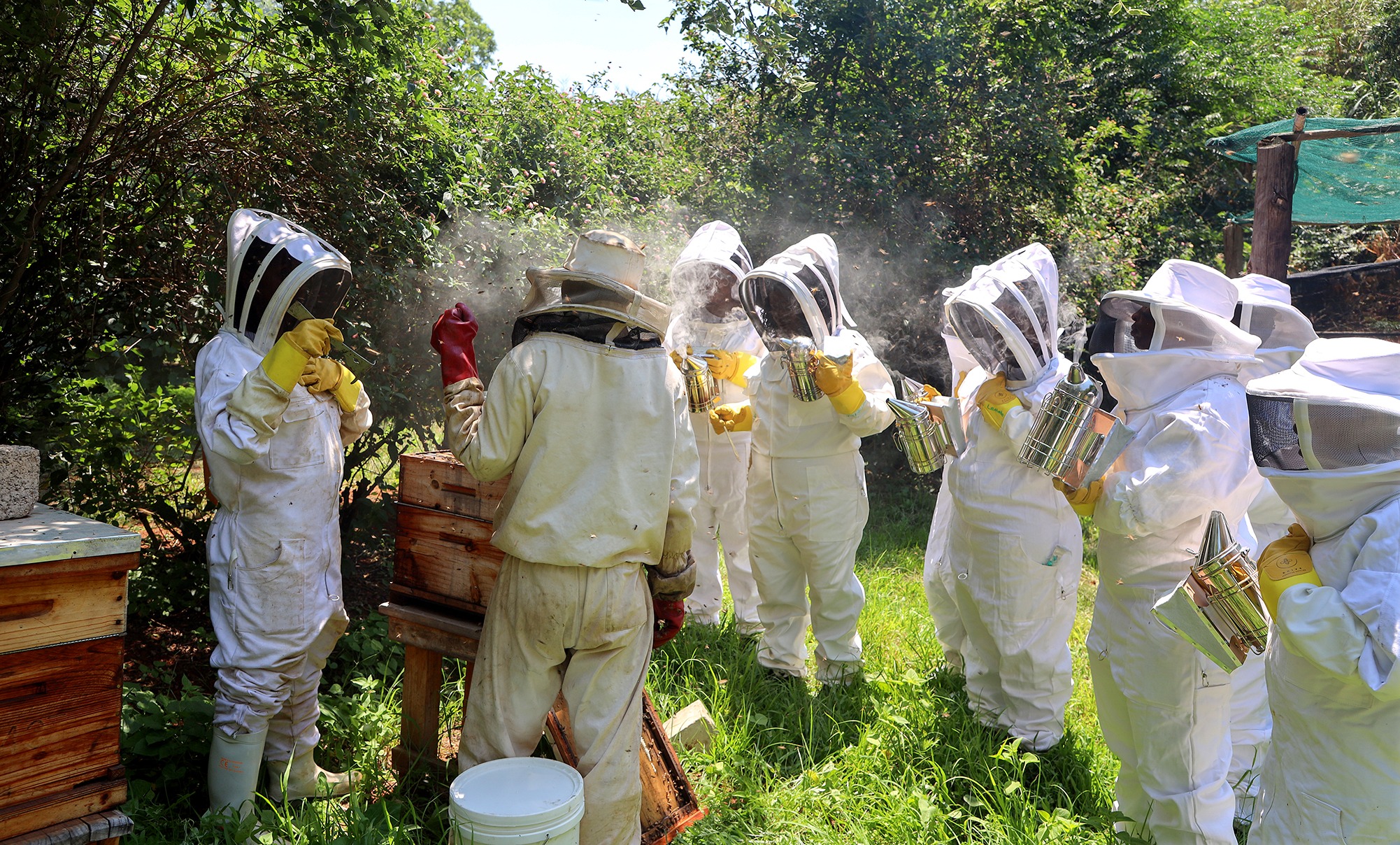
 Participants in one of Bongi Bees’ beekeeping training sessions harvesting honey from a hive. Education and skills transfer to other women are central to the vision for what Bongi Bees can be. (Photo: Supplied / Lulu Letlape)
On 20 May, SA joined the rest of the world in marking World Bee Day, an annual United Nations-recognised observance dedicated to raising awareness about the essential role bees and other pollinators play in food security, biodiversity and sustainable livelihoods.
This year’s global theme, “Bee Together for People and the Planet: A Partnership That Sustains Us All”, framed a day of reflection and conversation. At a webinar hosted by the Gauteng Department of Agriculture and Rural Development (GDARD), the Head of Department, Andiswa Jass, said: “Without bees, there is no agriculture.”
But beyond the pollination statistics and policy frameworks, two women are quietly building businesses that go well beyond honey.
Importance of the queen
Letlape’s path to beekeeping began not with ambition, but with survival. In 2016, a serious autoimmune diagnosis brought her corporate career to an abrupt halt. She left the city and moved to a farm in Pretoria.
A friend suggested she visit a beekeeping operation, as a chance to expand her mind and learn about new things. “It was really like [an] immediate connection,” she said.
/file/attachments/orphans/21_911473.jpg "Lulu Letlape, the founder of Bongi Bees. What started as a reinvention after a health crisis has grown into a thriving beekeeping business. (Photo: Supplied / Lulu Letlape)")
Letlape was inspired to start her own apiary. What started as a health-forward move quickly became something she shared with friends and family.
Bongi Bees has since grown from five hives to 100, with Letlape targeting 500 within three years, hoping to upgrade the operation to commercial.
She is also training the next wave of women beekeepers. Around 20 women in Gauteng and another 20 in the North West have come through her programme. For Letlape, the structure of the hive itself is part of the lesson. “The bee kingdom is led by women,” she said, and when trainees understand that the queen is the centre of everything, something shifts in how they see themselves.
Her training includes theoretical aspects such as the biology of a bee and of a hive, before moving to the more practical: what equipment you need, how to read bee behaviour, and what to look for in a site. Then the training moves on-site, where she has the chance to teach the women what she has learned, the tricks of her trade.
Teaching other women how to be beekeepers is almost as important as the bees themselves, said Letlape. Beekeeping, for women in rural and lower-income communities, is not just empowerment in the abstract; it is income.
After training, she buys honey from the women she mentors, absorbing the regulatory, bottling and packaging burden so they can focus on production and earning.
/file/attachments/orphans/11_650725.jpg "Bongi Bees’ 100% raw honey, harvested and bottled from Lulu Letlape’s apiaries in Pretoria, Gauteng. Letlape buys the honey from the women she trains, then handles bottling, labelling and selling on their behalf, letting them focus on what they do best. (Photo: Supplied / Lulu Letlape)")
Migrating to the hive
For Dawn Noemdoe, founder of HoneyatDawn, beekeeping was also a second chapter, one she arrived at through agricultural journalism and a growing passion for creating sustainable livelihoods for women in farming.
As a black woman of mixed descent, she was clear-eyed about the barriers to entering the sector.
“Access to the capital means of production, such as land, water and money for inputs, remains difficult,” she said. Apiculture, or beekeeping, felt like the most accessible entry point at the time. “To be clear, although it was easier, it was not a path of least resistance; it took me a year to secure my first apiary.”
Today, HoneyatDawn operates three apiaries in Paarl and Wellington. Noemdoe manages the hives herself, with support from her husband and a part-time employee, and provides seasonal hive maintenance, harvesting, bottling and wax processing to two fixed clients.
Through HoneyatDawn, Noemdoe also founded a training initiative, BeeGood Africa, with initial funding from WWF and the Nedbank GreenTrust. Fifteen beekeepers have come through the programme, some growing from one hive to 20.
/file/attachments/orphans/4_632376.jpeg "Dawn Noemdoe, founder of HoneyatDawn, with a freshly pulled honeycomb frame. Noemdoe manages her three apiaries herself, with support from her husband and a part-time employee. (Photo: Supplied / Dawn Noemdoe)")
According to Noemdoe, good apiary sites are hard to come by and fiercely protected. More established beekeepers can be guarded with knowledge accumulated over decades. But she believes collective growth is the only sustainable path.
“When knowledge is shared openly,” she said. “It creates a more informed community that is better equipped to handle challenges and adapt to change.”
Her most urgent concern is the rapid decline in bee forage, the availability of flowering plants to sustain healthy hives. This directly impacts “hive health, productivity, and the long-term sustainability of the industry”, she said.
It is a challenge she sees as inseparable from broader conversations about land use and biodiversity, ones she intends HoneyatDawn and BeeGood Africa to be part of actively.
“This journey has meant building a business that uplifts other women,” Noemdoe said. “Particularly in rural and urban and agricultural spaces, as well as within our townships, where stories like mine are often overlooked.”
At the GDARD webinar, the conversation extended well beyond the celebration of beekeepers. Jass said that SA is currently a net importer of honey, a gap she framed explicitly as a commercial opportunity for new entrants.
Research commissioned by the department is underway on two fronts: developing entrepreneurial black beekeepers as environmental protection agents in the province, and managing bee diseases, including American Foulbrood, a highly contagious and destructive bacterial disease affecting honeybee brood. DM
Comments
Scroll down to load comments...