



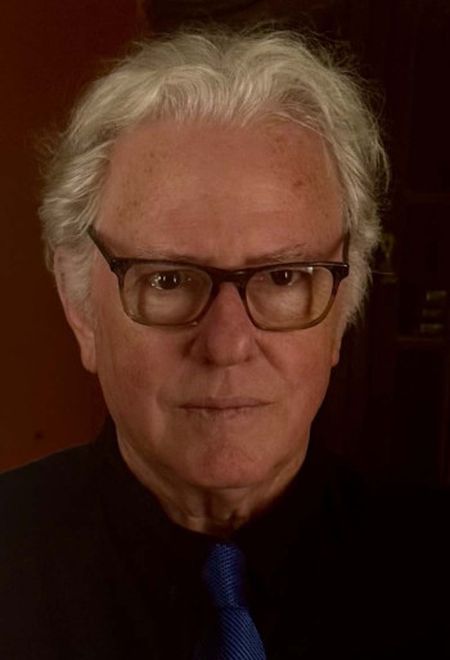
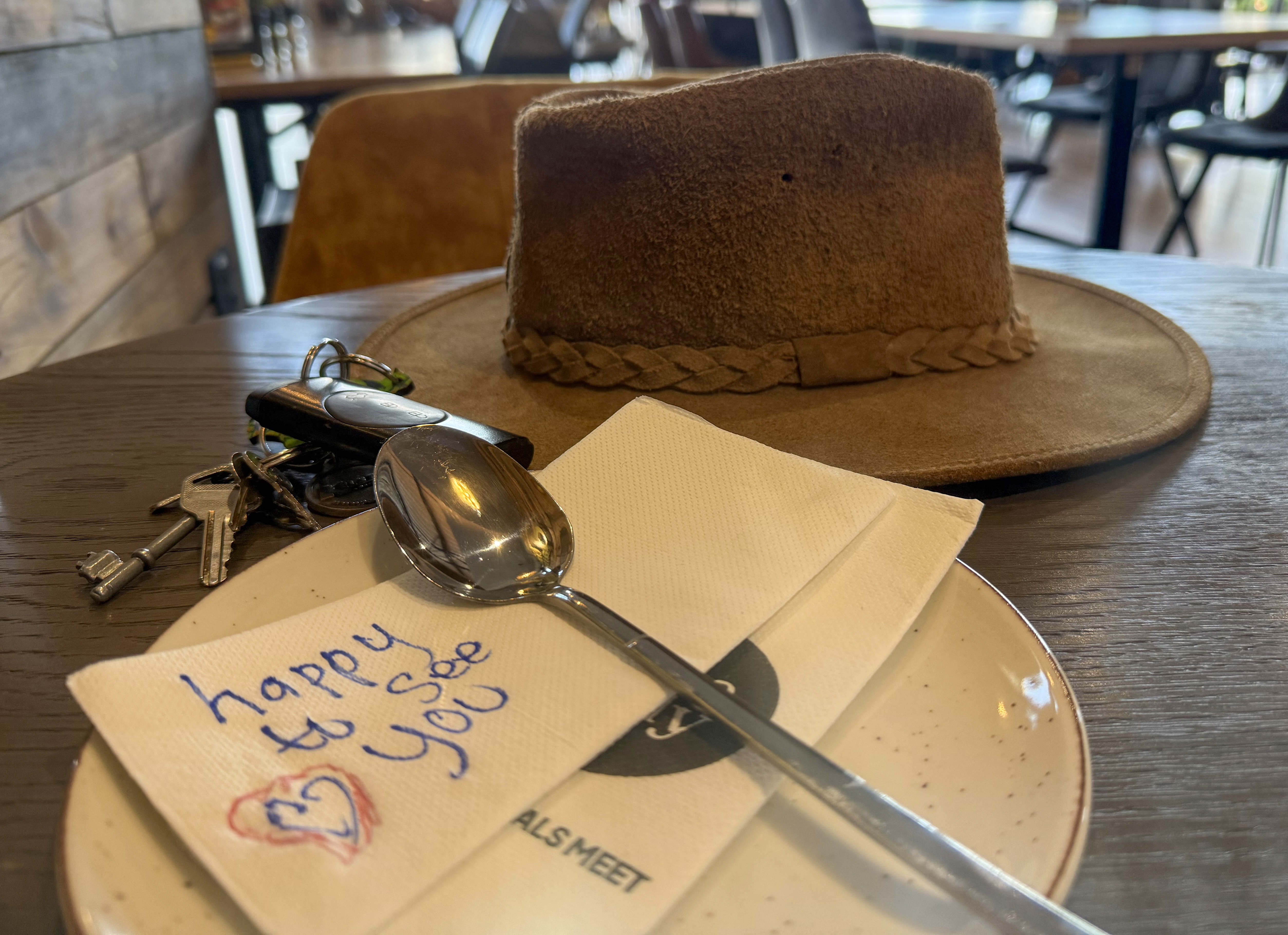
 The first time I went into my local coffee shop following my surgery and some recovery, I was welcomed back. (Photo: Tony Jackman)
What a difference a day makes. Twenty-four little hours in which a life that might soon have ended becomes a life with an infinite horizon. And people ask me: Have you changed?
Oh, I have. Perspectives shift. You stop and think more before blurting something you might regret having said. You look and listen more. Not that I was short on those things – they perpetuate a writer’s days. And nights. A sweet bonus: you’re not as scared of the things you were scared of.
But, for a while back there, everything was bleak. Everything was sorrow. There was no tomorrow. It was done, done, done.
Wednesday, 29 April 2026
I fell in love with the old Dinah Washington song What a Diff’rence a Day Makes when we lived in the UK two decades ago. It was revived there by cocky little jazz dynamo Jamie Cullum, what a crooner he is. His version changed the lyrics slightly, to What a Difference a Day Made. Past tense. Dinah celebrated the difference a day CAN make, Jamie celebrated the day that HAS BEEN made. (It was an English translation of a Spanish song, by the way: Cuando vuelva a tu lado, which means “When I return to your side”.)
Suddenly, the day before my open-heart surgery less than a month ago, the song surged back into my life. My anaesthetist came by for a chat, and before we were done he asked: “Tony, I want to play a song in the theatre while you’re going under. Give me a song.”
/file/attachments/2992/Screenshot2026-05-20at160219_319548.png)
It popped into my head immediately. I drew a shaky breath. “Jamie Cullum. What a Difference a Day Made.”
He was delighted. Turned out, he loved it. And Jamie. And as I was wheeled into the operating theatre the next morning, Wednesday, 29 April, there it was, as if I’d been wheeled into a bar or a jazz club.
What a difference a day made. Twenty-four little hours. Brought the sun and the flowers, where there used to be rain…
A nurse in starched whites lathered my chest with shaving cream and started shaving decades’ worth of chest hair. Then: blank. But with strange interruptions. When they say you’re “out”, how “out” are you? Instead of my waking reality, and also instead of what we might imagine to be our anaesthetised Other Self, lies a bizarre netherworld of bewildering and sometimes frightening things.
I’m looking up, and moving. Sliding into a tunnel, lights above, strange coloured lines and squiggles. Shift, stop. Voices. Shift again, stop again. A voice: “Okay.” I slide out. My memory seems to be of an MRI. I never got around to asking. Did it even happen or was it a dream? I don’t know. If it did happen, I wonder if they’d be surprised to know I was aware, in an addled sort of way? I don’t remembner hearing any music.
Where does the anaesthetised state end and the next phase begin, the period when (though you may not know it) you’re in a post-operative state, and recovering. Packed with meds the names of which you’re scared to ask. After the supposed MRI, there is nothingness, only confusion. All sense of time disappeared. Morning felt like late afternoon, afternoon like morning. They’d bring me food and I’d think it was breakfast but it was supper, the sun was bright and I’d look forward to sunset only to learn it was 9am.
I had vague memories of an ICU ward. A bearded man in a bed diagonally opposite me. His blonde wife patiently at his side. Adjacent to the bearded man, an Indian mama and her daughter and niece visiting her.
Instead of whatever reality was happening right in front of me – the normal shifts and pulses of an ICU ward – there were the scenes in my brain. The dank disreality of trauma mixed with heavy drugs. Somewhere in the cocktail was the little factor of my alcohol habit. I always deny being a heavy drinker, but I take more than a couple. It has never occurred to me that this was a problem, as I have always been able to stop or pause at will.
Paranoia is full of monsters
The little critters were few at first. Lying on my back, I’d spot them in the corner of a rectangular ceiling panel, crawling around the edges. Quickly, they multiplied, until there were thousands of them. They never stopped moving, and they wouldn’t go away. I wasn’t scared of them, only curious. They were all made of filigree legs and bodies, nothing bulky at all. Nothing you’d call a spider. Just little filigree insects chasing each other around the ceiling racecourse. They filled all four sides of every panel above me, never stopping. Sometimes they multiplied faster, and formed balloons of moving insects billowing this way and that. They were fascinating. My doctor told me later that there were signs of withdrawal from alcohol as a result of a sudden lack of it, mixed with the drugs.
I’d stare at my little ceiling friends and slide into a dreamscape. The chief protagonist was a lanky small-town Karoo-boy toting his shotgun like a rag doll, and his girlfriend photographing their little girl to get her into magazines while he kept inquisitive strangers at bay. Like me. They were right there in my ward, at night. His face was yellow, tiny and round. He wore dank black hair and a cowboy hat. He posed cockily, glaring at me, then at others supposedly in the room.
They were not alone. Random creatures appeared and then were gone. Some were real, I know now: the ward porter in his uniform, sundry nurses and visitors. Strangers sometimes peered down at me, mumbling questions and prodding.
Everyone is suspicious to my drugged mind. I trust no one. Even the specialists, the ones tasked with saving my life, and having the kindness to do that as well as the skill, have become my enemies.
I hear the voice of my wife, and of my daughter. As if they’re just up the passage at the ICU reception. I hear their concerned queries about me. I hear muffled responses. They react with distress, but we need to see him? He’s my dad! You can’t prevent me from seeing him! Instead of the solid wall that is behind me, in my mad dream there’s a door there, and my son-in-law is trying to prise it open, to get me out. He’s whispering to me. I whisper back: Get them out! Take them home! They can’t be here! These people want to kill us! Get them out!
I am one hundred percent doolally out-of-it paranoid, like Ozzy Osbourne and his Black Sabbath bandmates wrote that song for me. I now know what paranoia feels like, and it is dark and full of monsters.
I scream at them to go away
At one point in the darkest night of this drug-induced Hell, Karoo Gunslinger is leaning against a pole across the ward. Next to the bearded man are what seem to be his family, several little girls with ponytails playing with their dolls. To the right of my bed is a frosted window with a light on in the room beyond. In my madscape, Karoo Boy’s moll is leaning against the window from the other side with her blonde hair tumbling down. She’s pointing a camera towards the tableau across the ward, and it’s clear that one of the girls is her and Karoo Boy’s little darling. He’s pointing his shotgun at me so that I won’t prevent her from photographing the moment.
And still I hear the voices of my wife and daughter asking to see me, and still I scream at them to go away.
In the darkest phase of my confusion, I am inside myself, seeing my bloody insides from within. I can see a tiny red heartbeat lift and fall on a wall of my heart, like a bloodied little eye winking at me, and I am trying to shush it. I hear voices of what seem to be five or six different people. It becomes horrifically clear: these are the people! The people who want to kill my family! I have to stop them!
Whether in reality or not I can never know, but I hold my breath. If they don’t know I’m breathing, if they think I have died, they will let my family live. This is the core of my madness. I look at a blood-red spot at the bottom of my dream and slow my breath to a trickle. Voices mutter. It seems interminable. I hear my breath and it embarrasses me, because I need them not to hear. Rise, fall, rise, fall. Try not to breathe. I don’t want them to see any movement in me. I must be gone. A male voice says, “He’s still here.” Another says, “He can’t be? Five minutes ago, he was gone.”
Desperate (in my dream), I leap upright and yell to Rebs, Di and Neal to get out. Get out! (This, like so many other things that seemed so frighteningly real to me at the time, never happened.)
At a later point, the ward nurse enters my nightmare. She’s married to the night porter (not in real life, they’re only colleagues). In my dream, my family and I are at some weird, floaty indoor festival somewhere like Somerset West or Wellington, though it’s not clear. They are both out to get me, to take me back. I’ve escaped with my family. So it looks like they got me out.
Maybe my dream needed to “escape” me. Escape me from my mania created by drugs. From shape-shifting figures in my head to the very shifting of time itself.
Monday, 4 May
Suddenly, I’m on a bed looking up at ceiling lights. I’m staring at white panels above me. No insecets. The metal bed sides are up. Why – I ask myself – am I in Woolies? This is enough to have me tilting my head left and right. There is no food. No gift goodies. No shelves. Okay, this is not the best Woolies I’ve been in. Maybe it’s a new branch and the stock hasn’t arrived yet.
But why am I in a bed?
I look across to the far side and to my astonishment the bearded man is there. It’s the ward, the place of my torment. How did they get me back!? A dreadful clammy chill envelops me. How can I be here again?
Then the window comes into focus. The hospital is in the greater Blouberg area, and it is the classic view of Table Mountain. No, this isn’t reverie – that was my view. When I see this world-famous view, only one thing is clear to me: the terrible thing didn’t go away, there was only a strange interruption. And why have my family not been to see me?
As that glorious, sunny view registers, a terrible ache creeps through my being. I will never be close to that mountain again, never see my family again, never work again, never write again. I am here forever.
Everything I knew has gone.
That is the state that I was in following my surgery and anesthetisation. I have never felt bleaker.
What I didn’t know was that they had changed my meds. I was coming out of the fugue.
And suddenly, she is back. The nurse who spooked my dream with her porter husband. At the foot of my bed. “Mr Jackman! What is my name?”
Erm. A clue? Sorry.
“You said my name was Elizabeth.”
I did? … Is that your name?
“No, Mr Jackman, I told you. My name is Janette.”
Okay Janette. Sorry. This in a small voice. Is there anything else I need to apologise for?
She whoops with laughter. “Hoooo! And lots of people!”
Oh dear.
/file/attachments/2992/Screenshot2026-05-20at155945_543044.png)
As time creeps by, people are looking at me like I’m Jack Nicholson in One Flew Over the Cuckoo’s Nest. A buxom matron in whites with maroon trim glides in, greets Janette, then spots me. “Is this the gentleman?!”
Janette laughs. “That’s him.”
“Oh dear,” say I. “What did I do?
“What did you do? You tried to kill me!”
But this with a ribald, throw-your-head-back laugh.
As I start to get a little exercise, being held upright by nurses, everywhere we go I get stares from people who I seem to have, erm, entertained in some way over the past several days. Days that are a blank to me.
Slowly, my head is clearing. I am feeling less bleak. I apologise to Janette for my drug-addled behaviour and over the next days we become friends and allies.
I examine the reality of my surroundings, as compared with the dying unreality.
Across the ward is a little round yellow dial. It is a piece of hospital ward equipment, a meter of some kind. It is also Karoo Boy’s face, a rheumy fizzog created in my head and to which I added limbs, a hat and a shotgun. I look right, and there’s the window. His photographer moll’s tumbling blond hair is a white bag hanging on the other side of the window. Bearded man is still there, and his wife, but there are no little ponytailed girls playing with their dollies. In their stead, sundry other little dials that had become their faces, and random items of hanging medical paraphernalia that became their bodies and hair. Days later my ward mate tells me that at one point in my insanity his wife leapt up and called the nurses when I tried to climb out of bed and get to the window, screaming, “My grandchildren are over there! I have to get to them!”
Suddenly, I hear voices. Familiar voices. My voices. And light floods in. They haven’t forgotten me, I am not abandoned, and Di and Rebs hove into view at the end of my bed.
I tear up and say, “I’m so glad you’re here! I’ve been dying to see you! I’ve missed you so much!”
I wasn’t expecting their answers.
Rebecca speaks: “We’ve visited you every day, Dad.”
“What day is it?”
“It’s Monday.”
“Monday!”
“You’ve been here five days since your surgery, Dad. We saw you yesterday, and the day before, and…”
I am presuming it to be Thursday, because the operation was on Wednesday. They had sat with me and talked to me, and wondered when the glazed look would wane and I would be back. Thank goodness they couldn’t see inside my head.
And they have been there, at my side, every day, and I remember nothing of it. There were no monsters, no critters, no enemies, no threat, only love and compassion and the magnificent work of the medical geniuses who saved my life. And the remarkable women who populate that ICU all day, all night, never missing a beat as they ensure you get through your ordeal.
And I must say: whenever you visit somebody in ICU, and you spot another patient who is out-of-it and glazed over, be still around them. We cannot know what’s happening inside.
It was all recovery from there. Finding my mind again. Finding myself. Understanding that the blurred vision will settle in time. That I’ll be able to walk unaided to the bathroom again, but not yet. That I’ll be using my late mother-in-law’s walking stick for a few days after going home.
There was, of course, hospital food. And well-meaning friends urged me: “Tony, you must review the hospital food!”
Honestly, I couldn’t care less. I’m only happy to have been fed. In fact, the only part of those five days I remember is the meals, because they punctuated the time that made no sense.
I loved the moment when the dinner lady would bring tomorrow’s menu and take your choice of four breakfasts, lunches and suppers for the next day. In the end, one dish tasted much like another. There was lots of rice, nondescript minced meat, fish best avoided. I ate what I could at first, which wasn’t much. They seemed perturbed that I “wasn’t eating”. I tried harder, ordered more carefully. Tried to rearrange what was left on plates to look less than it was. Pushed food under other food. The food was okay, I just had no appetite.
The staff were having none of it.
“You must eat!”
“I am eating!”
For a second I almost added, “You’re not my mommy!”
/file/attachments/2992/charles-chen-9jI0GfzH9U4-unsplash_474855.jpg "Jelly all the way. With custard. All diabetic friendly and free of sugar of course. (Photo: Charles Chen on Unsplash)<br>")
But I took the jelly and custard every time, like a good boy. It was diabetic, sugar-free, including the custard, and nothing says “you’re getting better” more than jelly and custard. So, yes, that was my favourite hospital food. (I bought some sugar-free powdered jelly and made myself some at home.)
Oh and here’s an unexpected bonus: they sorted out my Type 2 diabetes while I was there. My sugar levels dipped to the normal range, and I’m keeping it up since going home.
I’ve cut back on alcohol. I might take a glass, maybe two at the weekend, but often I don’t touch anything. In fact, I haven’t had a drink in a week. In its place, masses of rooibos tea, hydrating and comforting. But I’ll be having a glass of wine tonight to celebrate saying good riddance to my pain.
In my last two days in ICU I charmed everyone from the bearded man to Sister Janette, Sister Unati and a horde of their ICU colleagues, then the crew in the general ward I was moved to for two nights. And 10 days after being admitted for minimally invasive mitral valve surgery, I was going home.
He vuelto al lado di mi familia. I have returned to my family’s side.
What a difference a day made.
Coda
/file/attachments/2992/flf-me-and-sally_115954.jpg "A triumphant return to life. The author was interviewed with fellow author Sally Andrew at the Franschhoek Literary Festival last Sunday, to a full house. (Photo: Rebecca Jackman-Derman)")
If you're going to undergo heart surgery, the Cape is the place to be. I have not named any of the medical professionals involved, as these things are generally kept private between them and their patients, and I respect that. But I grew to admire and love my extraordinary surgeon with his gentle ways, my watchful, inquisitive physiotherapist and my music-friendly anaesthetist, as well as my post-operative physician. If anyone needs a crack heart team, these soldiers who operate in the wake of what the Barnard brothers did for us all, and for cardiac surgery at the Cape, in December 1967, are as good as it gets.
You know who you are, gentlemen, and you will be in my heart forever. Right here. DM
Comments
Scroll down to load comments...