



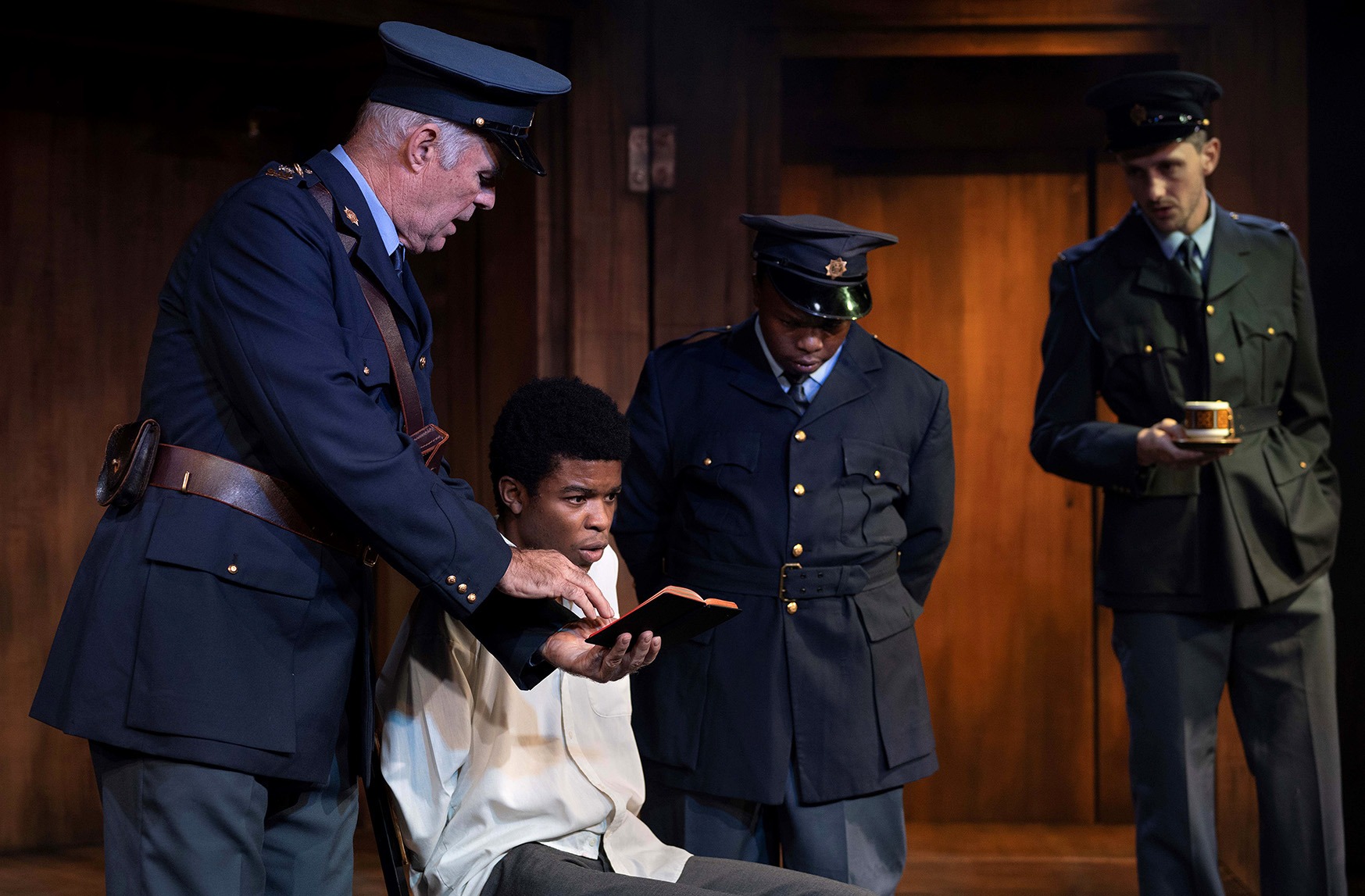
 Deon Lotz, Alex Sono, Sbuja Dywili and Ben Albertyn in Rise ’76: The Story of June 16th. (Photo: Fiona MacPherson)
 It’s quite a tricky business, crafting theatre out of historic events. The task can be especially daunting when the event sits so close to the heart of a nation, occupies such a significant part of our collective consciousness.
Despite the potential pitfalls, writer-director Tiisetso Mashifane wa Noni has risen admirably to the challenge of creating a play that illuminates the cascade of moments that led up to, and followed, the explosive event that permanently shifted South Africa off its axis on 16 June 1976.
On that day, police shot into crowds of children who had gathered in Soweto to march and protest against the apartheid regime’s implementation of Afrikaans as the medium of instruction at schools administered by the Department of Bantu Education.
As the play highlights, the policy was designed to further hamper the prospects of black pupils and make knowledge more difficult for them to access in an attempt to maintain a servile, subservient and impoverished underclass.
/file/attachments/orphans/ZilungileMbomboMfuneliNtumbukaandAlexSonoinRise76_FionaMacPherson_974502.jpg "Zilungile Mbombo, Mfuneli Ntumbuka and Alex Sono in Rise ’76. (Photo: Fiona MacPherson)")
/file/attachments/orphans/ZilungileMbomboBotlhaleMahlanguandAlexSonoinRise76TheStoryofJune16th_FionaMacPherson_888183.jpg "Zilungile Mbombo, Botlhale Mahlangu and Alex Sono in Rise ’76 The Story of June 16th. (Photo: Fiona MacPherson)")
In one poignant scene, a teacher, who is played by the luminous Mfuneli Ntumbuka, looks the audience squarely in the eyes and conveys the baffling lunacy of her predicament: how was she expected to teach a subject like maths in a language that, for her, was barely comprehensible?
While the play is rather straightforwardly titled Rise ’76: The Story of June 16th, and really does focus quite narrowly on this very specific event, its build-up and aftermath, it does so by way of an intimate story, gathering a diversity of characters around its core.
The effect is to make the grand narrative of history feel more personal, immediate and alive.
Much of this has to do with Mashifane wa Noni’s gift for dramatising details, for while there are facts and figures, specific dates and documented events, the material is packaged with imagination and theatrical flair.
Crafted from a diverse pool of resources (archival material, literature and inputs from more than 40 people), her docu-fictional account takes us on detailed side-excursions to witness the minutiae of the living, breathing world in which that terrible tragedy took place.
What we get is a story with heart and soul, and one that – apart from going quite hard on the emotions – is designed to make us engage contemplatively with the past rather than simply serving up history as a straightforward chronology.
Rather than zooming out to try to replicate the scale of the horror, it takes us in closer to give us the lived experience, feelings and sensations of the individuals affected.
Everywhere, there are acute details texturing the world of the play, amplifying the emotions that bubble up from below its surface. They’re in the secrets revealed by a bookshelf in the home of a teenaged boy who would rather write poetry and read banned books by Chinua Achebe than be taught maths in Afrikaans. And they’re in the heartbreakingly cold descriptions extracted from the autopsy of a tiny girl whose lifeless body is among those discovered in the wreckage of the Soweto Uprising around which the play is spun.
The other reason this play works so beautifully is the presence of its profoundly good ensemble – the actors are not only riveting to watch, but work incredibly hard to get under the skins of their various characters, ensuring that this awful tale is something you feel in the pit of your stomach.
At the heart of this particular story is a bright-eyed independent thinker named Bafana Buthelezi, the teenaged poet who is smart enough to have seen through apartheid’s evil system of social engineering, and brave enough to speak up about it.
/file/attachments/orphans/SbujaDywiliAlexSonoandBotlhaleMahlanguinRise76TheStoryofJune16th_FionaMacPherson_362777.jpg "Sbuja Dywili, Alex Sono and Botlhale Mahlangu in Rise ’76 The Story of June 16th. (Photo: Fiona MacPherson)")
Bafana is played by the wonderful Alex Sono who brings such quixotic energy, so much spirit and charm to the role – it is devastating to imagine that, when he tells the audience that “it began with a bullet”, he might be foreshadowing such personal tragedy.
Mfuneli Ntumbuka, who plays the aforementioned schoolteacher, also plays Bafana’s mother; in moments, she gives such an emotionally stirring performance that the entire theatre seems to shudder with the expansiveness of her character’s grief.
Another actor who quickly sweeps us off our feet is Zilungile Mbombo, who plays Kedibone, Bafana’s bright-eyed friend, who tells us early on that she is among the survivors of that fateful day. She introduces the idea of the play as a kind of palimpsest, that we are looking at past events and the people who existed back then through the long, often distorting lens of history – and through the vagaries of memory.
Also lovely to watch is Botlhale Mahlangu, who plays a sympathetic but browbeaten headmaster caught between his desire to educate and his duty to the dictatorial system in which he must operate. And there’s the marvellous Sbuja Dywili as a black policeman who is considered a malign betrayer to his own people and simultaneously forced to endure the indignity of being treated as “less than equal” by his white colleagues.
There are more dastardly characters, too.
Ben Albertyn channels considerable menace as a bookish-looking school inspector, who skulks predatorily across the stage like a wraith. That sustained low-key menace is transformed into bitter brutality when Albertyn later returns as a cop, full of simpering, self-righteous hatred – and when the opportunity for outright violence arises, he’s there front and centre.
/file/attachments/orphans/MfuneliNtumbukaBenAlbertynandAlexSonoinRise76TheStoryofJune16th_FionaMacPherson_814297.jpg "Mfuneli Ntumbuka, Ben Albertyn and Alex Sono in Rise ’76 The Story of June 16th. (Photo: Fiona MacPherson)")
/file/attachments/orphans/MfuneliNtumbukaSbujaDywiliandBenAlbertyninRise76TheStoryofJune16th_FionaMacPherson_969896.jpg "Mfuneli Ntumbuka, Sbuja Dywili and Ben Albertyn in Rise ’76 The Story of June 16th. (Photo: Fiona MacPherson)")
So, too, the underhanded police commander played by Deon Lotz, who, between giving the order to open fire on children and issuing death threats over the phone, invites his potential victims to join him at the station for a cup of coffee. Lotz coolly embodies a kind of terrifying presumption of superiority which comes packaged with his character’s white privilege and authoritarian power.
When Lotz shifts into the role of an apartheid government minister who declaims and deflects and points his finger during a press conference, the loathsomeness that oozes from every pore is – like so much in this play – something that you feel.
And that’s where this play beautifully succeeds: though it’s rooted in historical reality, its strength is the way it connects us emotionally with another time and with characters who have largely been relegated to history books – or condensed into a single image, such as the photograph of 12-year-old Hector Pieterson’s body being carried at the front of a largely anonymous crowd.
Rise ’76 compels us to consider June 16th as something more than a single snapshot frozen in time. Because, beyond the remembered facts and assumed historical truths, there are countless more untold stories, many forgotten heroes and an endless supply of grim ghosts. DM
Rise ’76: The Story of June 16th is playing in the Baxter Studio until 30 May and at The Market Theatre’s Mannie Manim from 5 to 28 June.