




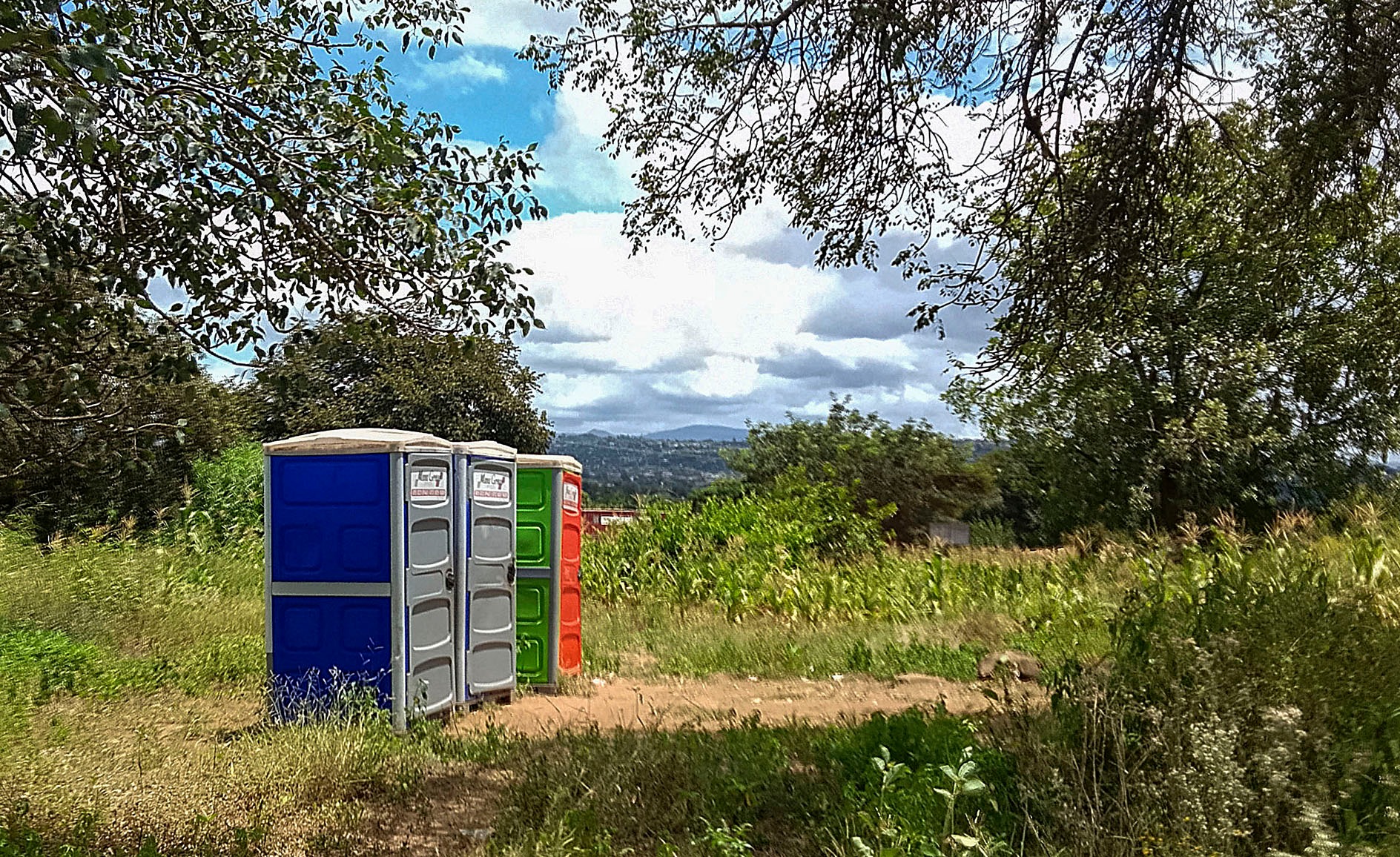
 The toilets that are used by the learners at Dzivhani Primary School near Thohoyandou, Limpopo, South Africa on 9 March 2026. For four years the school was promised new brick sanitation blocks after its pit toilets were demolished by the education department. (Photo: Chris Gilili)
Twelve years after the explosion of public outrage over pit latrines in schools, many Limpopo schools still have inadequate sanitation.
While most pit latrines have been demolished, hundreds of schools now depend on badly maintained, rented chemical toilets. Where toilet blocks have been constructed, these are often inadequate for the school’s needs.
Until fairly recently, many schools used pit latrines – unsafe, unhygienic and sometimes deadly. There was a nationwide outcry in 2014 after five-year-old Michael Komape drowned in a pit toilet at Mahlodumela Primary School in Chebeng village, Limpopo.
In 2018, following a legal battle led by NGO SECTION27, a high court landmark judgment declared that the failure to provide safe sanitation at schools violated learners’ constitutional rights to dignity, equality and basic education.
The court issued an order to compel the national and provincial basic education departments to urgently eradicate all pit toilets in Limpopo schools, and to provide proper sanitation facilities.
Eight years on, more than 800 of the 3,800 schools in Limpopo still do not have sanitation blocks, according to the Department of Basic Education. And among schools where toilets have been built there are many complaints of inadequate or unsafe facilities.
/file/attachments/orphans/IMG_20260316_114652copy_1_737084.jpg "A toilet in poor condition used by learners at Mbahela Primary School, Limpopo, on 16 March 2026. (Photo: Chris Gilili)<br>")
Pit latrines have largely been demolished – although there is evidence that they still exist in certain rural places, such as Ga-Mashashane. Lukhanyo Vangqa, spokesperson for the national Department of Basic Education, said that the eradication of pit latrines identified in the SAFE Initiative audit of 2018 was now 99% complete, although he said that some schools might have slipped through the net of the audit and might still be using pit toilets.
“Limpopo had one outstanding school on the SAFE Initiative List. This list is from the 2018 audit. It may not account for pit toilets that may have come up post the audit, or schools that may have got new toilets but decided not to break down the old pit toilets, or even schools that may have been missed by the audit,” said Vangqa.
Infrastructure condition assessments
He said the department had asked provinces to conduct their own infrastructure condition assessments, and that the funding for these assessments was “being released” to provincial authorities.
“Once that conditional assessment is done, it will indicate the extent to which pit toilets still exist.”
Where toilet blocks have been constructed, these are often inadequate for the school’s needs, and some schools have been renting mobile chemical toilets, also unsatisfactory, as an expensive stopgap for years.
Why the delays? Limpopo’s provincial education spokesperson Mike Maringa agreed that renting mobile chemical toilets was costly and should only be temporary, but said that the construction of proper toilets, although recommended, is “a process”.
Meanwhile, learners remain at risk. To take just one example, in the past year the department has spent R110,745 on the rental and maintenance of mobile toilets at Mabila Primary school, in a village 60km from Thohoyandou.
/file/attachments/orphans/IMG-20260319-WA0016copy_1_867192.jpg "A chemical toilet at Mabila Primary School on its side following heavy rains and flooding in Limpopo, on 16 March 2026. (Photo: Chris Gilili)<br>")
Mabila Primary has 130 learners who for years have had to share four chemical toilets, two for girls and two for boys. Such facilities are supposed to be serviced and cleaned every few days, but in March this year the Mabila toilets remained unemptied for more than three weeks when the service provider could not reach the school because heavy rains had made the road impassable.
Rotshidzwa Maluga, the chairperson of the school’s governing body, said it was a dire situation.
“The poor kids were suffering. They were sitting on top of faeces and urine for weeks.”
Things are about to get even worse. There are plans to merge Mabila Primary with nearby Ngalavhani Primary, which will result in more than 250 learners sharing four mobile toilets. The proposed merger perversely means that plans to build proper toilet blocks have been put on hold indefinitely
Maluga said he had been informed by Department of Basic Education officials that the decision whether and when to construct hygienic toilets would not be taken until after the two schools were combined.
/file/attachments/orphans/IMG_20260209_114018copy_1_570515.jpg "Three learners standing outside the chemical toilets at Dzivhani Primary School in Thohoyandou, Limpopo, on 9 March 2026. (Photo: Chris Gilili)")
“The matter is now with district education officials. All we can do is wait for instruction,” he said. “It is frustrating that there nothing we can do, while the kids suffer from the bad stench coming from these toilets. Also, the wind sometimes blows these toilets down and teachers have to try and lift them up again.”
The irony is that construction of toilet blocks at Mabila Primary was all set to commence. Tons of bricks were delivered to the school last year, with the promise that these were for the imminent building of new toilets. Nothing has happened since, and Maluga says the unused and unsecured piles of bricks now pose a safety threat to learners.
Mvula Trust
These bricks were allegedly donated by the Mvula Trust, a non-governmental organisation that aims to provide sustainable water solutions and dignified sanitation to rural and peri-urban communities. This organisation has been contracted by the department to run the Accelerated Schools Infrastructure Delivery Initiative, which aims to eliminate school infrastructure backlogs.
When Maluga contacted the Mvula Trust to ask why construction had not commenced at Mabila, he was told that the plan was on hold because “the person who authorised the building of our toilets passed away. We told them about the danger of all those bricks lying around and they said we can use them for anything.”
Dakalo Mudzielwana, chief financial officer for the Mvula Trust, said the planned construction of toilets at Mabila Primary had been abandoned because the department had cancelled the contract.
“Please ask the department why they cancelled,” he said.
Speaking for the department on this matter, Maringa said that the pit latrines at Mabila Primary school were demolished in 2024, and the provincial department was instructed to rent mobile chemical toilets while waiting for budget approval for the construction of proper sanitation blocks.
He did not comment on the bricks already supplied by the Mvula Trust, saying only that the plans to merge the two primary schools had caused the delay.
“The consultations are ongoing. So the department will not build new toilets for the school until this process has been finalised,” said Maringa.
/file/attachments/orphans/IMG_20260225_125245copy_1_762296.jpg "A young girl exits the toilets at Frank Mukhaswakule Primary School in Mashau, Limpopo, on 25 February 2026. Most of the toilets at the school are badly vandalised and don't have functioning taps. (Photo: Chris Gilili)<br>")
/file/attachments/orphans/IMG_20260225_125216copy_1_621200.jpg "Girls’ sanitation blocks at Frank Mukhaswakule Primary School on 25 February 2026. These blocks were constructed after pit toilets at the school<br>were burnt down by protesting parents. (Photo: Chris Gilili)<br>")
were burnt down by protesting parents. (Photo: Chris Gilili)
Mudzielwana said that the Mvula Trust had been “contracted by the department to construct a certain number of sanitation facilities per annum depending on budget availability. Since 2013, we have constructed toilets in more than 3,000 schools in Limpopo province. We plan to build sanitation facilities for 201 more schools during 2026/2027, and another 128 during 2027/2028.”
Another school still waiting for adequate sanitation is Dzivhani Primary, about 15 minutes outside Thohoyandou. In 2023, the Limpopo Department of Basic Education ordered the demolition of 10 dangerous and unhygienic pit latrines at the school. Since this was carried out, the school’s almost 300 learners have had to queue constantly to use six rented mobile chemical toilets: three for girls and three for boys.
Tondani Makhado, principal of Dzivhani Primary, said the Department of Basic Education promised him that building of new toilets would commence within a few months after the pit latrines were demolished.
“It has been three years and we are still waiting on that promise. Some schools have been told what their budget is and when they can expect construction to start. In my case, I remain in the dark while my learners are suffering every single day.”
Construction delays and insufficient temporary chemical toilets are not the only issues. In some cases, toilets built by the Mvula Trust – funded by the Department of Basic Education – are inadequate and/or not repaired or maintained.
Dangerous and derelict
Frank Mukhaswakule Primary School in Mashau is a case in point. The dangerous and derelict old pit latrines were broken down and burnt by protesting residents in 2018. In 2021, new toilets were finally built, but, said school principal Elizabeth Mashau, eight toilets were not nearly enough for a school that had more than 500 learners. Some of these toilets were now broken and there was also no running water for learners to wash their hands.
Mashau said that apart from needing more toilets and for taps to be provided, her school needed funds for the cleaning, repair and maintenance of sanitation facilities.
Although on paper Limpopo schools have improved their track record in the area of sanitation, these examples show that in practice a lot more attention needs to be paid to the allocation, disbursement and overseeing of funds for the construction of sufficient and properly equipped school toilets. Until then, learners will continue to suffer the indignities and health hazards of poor alternatives. DM
This report has been produced by the Southern Africa Accountability Journalism Project (SA | AJP), an initiative of the Henry Nxumalo Foundation with the financial assistance of the European Union. It can under no circumstances be regarded as reflecting the position of the EU.