



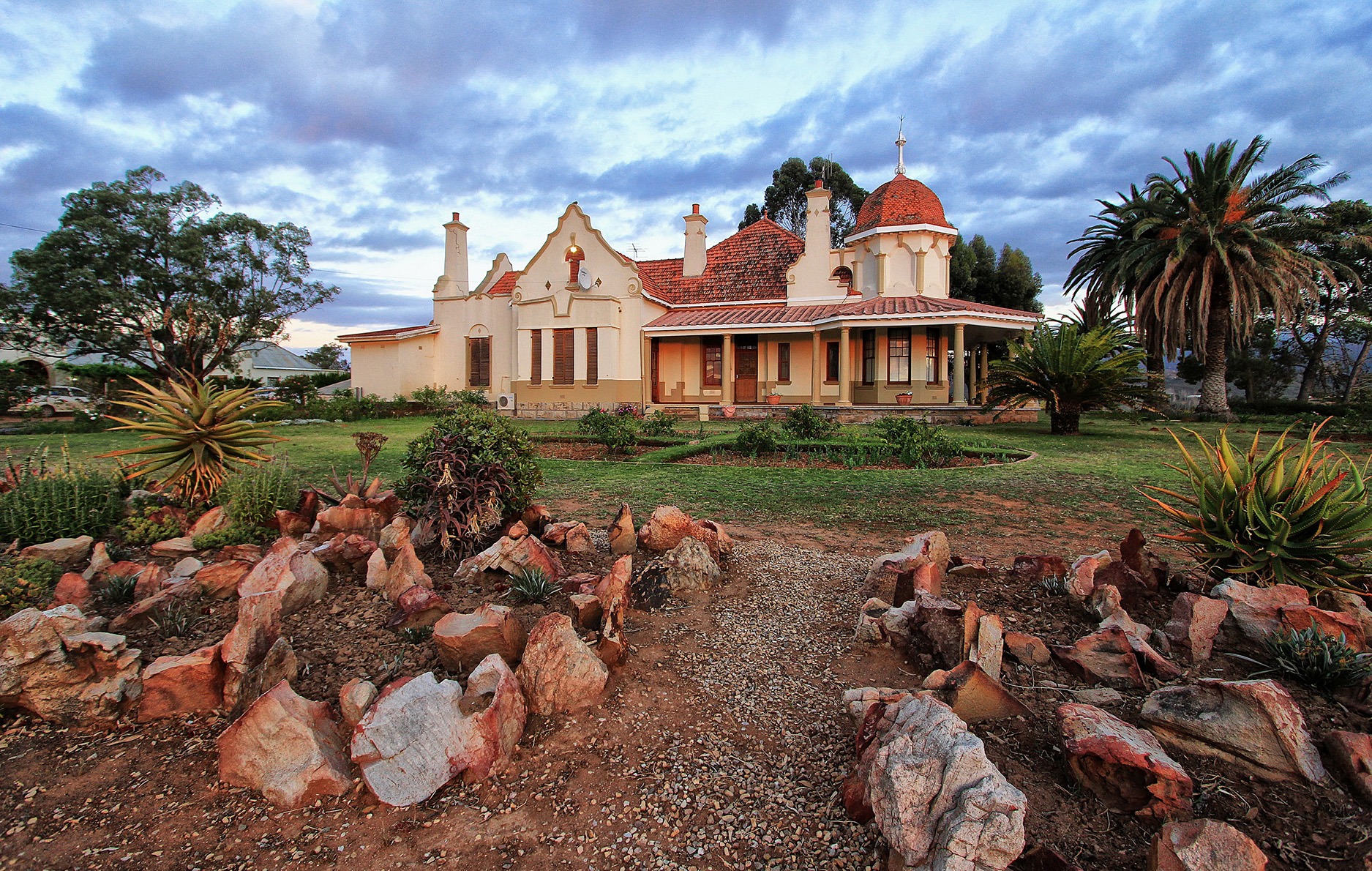
 Rietfontein Ostrich Palace – still in the Potgieter family. (Photo: Chris Marais)
 By the 1860s, Oudtshoorn had taken over from North Africa as the global hub of ostrich feathers, and the region grew out of poverty and into a period of unimaginable wealth. You see the gorgeous old “feather palaces” all around the Klein Karoo, but specifically concentrated in and about Oudtshoorn. All thanks to the domesticated (but still ornery) ostrich.
I love the stories of the Jewish traders who came out to South Africa with nothing, worked hard, hustled away and made something of themselves. In the process, they added magic to the dry spaces of this country, especially around Oudtshoorn.
Chances are that very same trader I spoke of, grubby though he might be from traipsing around the farms and buying plumes, was well connected to the global feather trade.
At first, the Sephardic Jews of North Africa ruled the roost when it came to good ostrich feathers. They exported plumes to London and skins to New York City, where the markets and workshops were owned by fellow Jews.
Oudtshoorn built its international reputation after the arrival of the Lithuanian Jewish feather men in the 1890s, and their dealings with the mainly Afrikaner farmers were amicable.
There was usually a special room on the farmstead for the wandering trader, who was regarded as a “human newspaper” by the isolated families.
“The smous visited all the homes of his clients, travelled far and wide, and could usually update his host on farming trends around the district,” says Antoinette le Roux in her 2013 Master’s thesis (Stellenbosch University) on the development of agriculture around Oudtshoorn.
As time went on, the trader settled and, like most feather moguls in the area, built himself a wondrous mansion filled with stained glass windows from Holland, woodwork from India, marbled floors from Italy, surrounded by a wrap-around porch, complete with cupolas and all manner of imported décor delights.
/file/attachments/orphans/TheexquisitefrontageofMimosaLodgeafeatherpalaceinOudtshoorn_ChrisMarais_115492.jpg "The exquisite frontage of Mimosa Lodge, a feather palace in Oudtshoorn. (Photo: Chris Marais)")
/file/attachments/orphans/GottliebHouseanin-townfeatherpalace_ChrisMarais_529816.jpg "Gottlieb House, an in-town feather palace. (Photo: Chris Marais)")
/file/attachments/orphans/SomeoftheOudtshoornfeatherpalacesnowservemodernbusinessneeds_ChrisMarais_382247.jpg "Some of the Oudtshoorn feather palaces now serve modern business needs. (Photo: Chris Marais)")
Folly and the fall
Architects like Charles Bullock and Johannes Vixseboxse made their names here. The Prince, Vintcent & Company shop in Oudtshoorn supplied guns, farming equipment, textiles, special imports on order and a lot of whisky to their increasingly wealthy clientele.
In the decade before World War 1, the Oudtshoorn feather market looked unstoppable. There were overseas trips, balls, indulgences and a general atmosphere of a party without end.
Then, of course, came the perfect storm of open-top Ford Model Ts (no feathered hats welcome), wartime austerity, and animal anti-cruelty campaigners who mistakenly thought ostriches were still being killed for feathers, like all the other exotic birds that were being slaughtered at the time, to adorn fancy hats.
By 1914, ostrich plumes were practically worthless. There were bankruptcies, suicides, and whole communities suddenly living in poverty.
Meet the Potgieters
However, not everybody went bust.
“My family were prudent farmers,” says Kobus Potgieter, one night over supper at Rietfontein, which sports a glorious feather palace you can admire from the distant Route 62 highway.
The Potgieters may have been prudent, but they were also lucky. Kobus (grandfather of our dinner host) was one of three brothers running the family farms at the turn of the 20th Century. He had long-standing health problems, so he travelled to Baden-Baden in Germany, to take in the healing waters. In the process, he met many influential European businessmen and learned a few hard facts about the coming war, the new motor cars, the dropping feather market and the sentiments of the animal lovers.
Kobus returned to Rietfontein and presented his brothers with a bleak vision of the future. Without much hesitation, they decided to diversify. By 1910 they had acquired more land, increased their fruit-farming operations, planted lucerne in quantities, and built up a large herd of cattle, flocks of sheep and goats.
They also bought a stallion in his prime and introduced him to their herd of 30 brood mares. Bear in mind that by 1910, the local feather industry was at the height of its glory, and those palaces were springing up everywhere. So when Kobus Potgieter tried to warn his neighbours about the coming catastrophe, most had a good laugh and continued to bet the bank on ostriches.
/file/attachments/orphans/PinehurstFeatherPalacenowaresidenceforteachersinOudtshoorn_ChrisMarais_940485.jpg "Pinehurst Feather Palace – now a residence for teachers in Oudtshoorn. (Photo: Chris Marais)")
/file/attachments/orphans/Thespruced-upWelgeluknowwelcomingguests_ChrisMarais_424927.jpg "The spruced-up Welgeluk, now welcoming guests. (Photo: Chris Marais)")
/file/attachments/orphans/Welgelukinitsmid-renovationdays_ChrisMarais_570057.jpg "Welgeluk in its mid-renovation days. (Photo: Chris Marais)")
A tourist farmer
Welgeluk Ostrich Palace is one of the most well-maintained feather mansions of the Klein Karoo. However, when we first met the owner, Stan Lipschitz, back in 2019, he was not an entirely happy chap.
The likeable Lipschitz, who grew up in this baronial pile, was in the throes of renovating the place – both the job and the costs involved were eye-watering.
We followed him around among the tarpaulins, ladders and paint tins where he swiftly showed us the many rooms, the rosewood Adams fireplace, the papier maché ceilings, the brass beds, the 1,500 litre bath, the nanny’s nook, the kitchens and the pantries. It was like being in a slightly dishevelled but very grand Victorian-era English mansion.
Built by the Olivier family in 1910, Welgeluk stood empty for years after the Feather Fall. The Lipschitz family bought Welgeluk in 1930, and Stan was about to turn it into an upmarket bed and breakfast establishment. Little did he know that, in addition to renovation costs, the bleak Covid-19 year of 2020 lay waiting.
When we stayed with Stan in October, 2024, it was a different story. Welgeluk was humming with bookings, the Safari Ostrich Show Farm next door was doing well, and Stan reckoned he had cooked more ostrich egg omelettes for his guests than any other human being on the planet.
Modern ostriches
These days, you can’t walk a block around Oudtshoorn without spotting something ostrich, be it a sign or an early 20th Century mansion that stands out among the modern buildings like a tuxedo at a midsummer Karoo braai. The ostrich will always be the icon of Oudtshoorn.
Lean meat, leather, eggs, pet by-products and tourism are all part of the modern ostrich value chain. And, oh yes, the demand for feathers is still strong.
But the world market is historically volatile, there is competition from other countries and the Klein Karoo can dry up in a couple of seasons, leaving the land parched and its people praying for winter rains. It’s never plain sailing when you bet the farm on your birds. DM
Klein Karoo Magic (390 pages, full colour) by Chris Marais and Julienne du Toit will be released in May, 2026. To order your author-signed copy (R400 including SA courier service), email Julie at julie@karoospace.co.za
/file/attachments/2988/HeaderKLEINKAROO_510874.jpg)